

Medically Reviewed by: Dr. Ipshita Johri
MBBS, DDV | Skinfinity Derma Clinic
Read Time: 8 Minutes
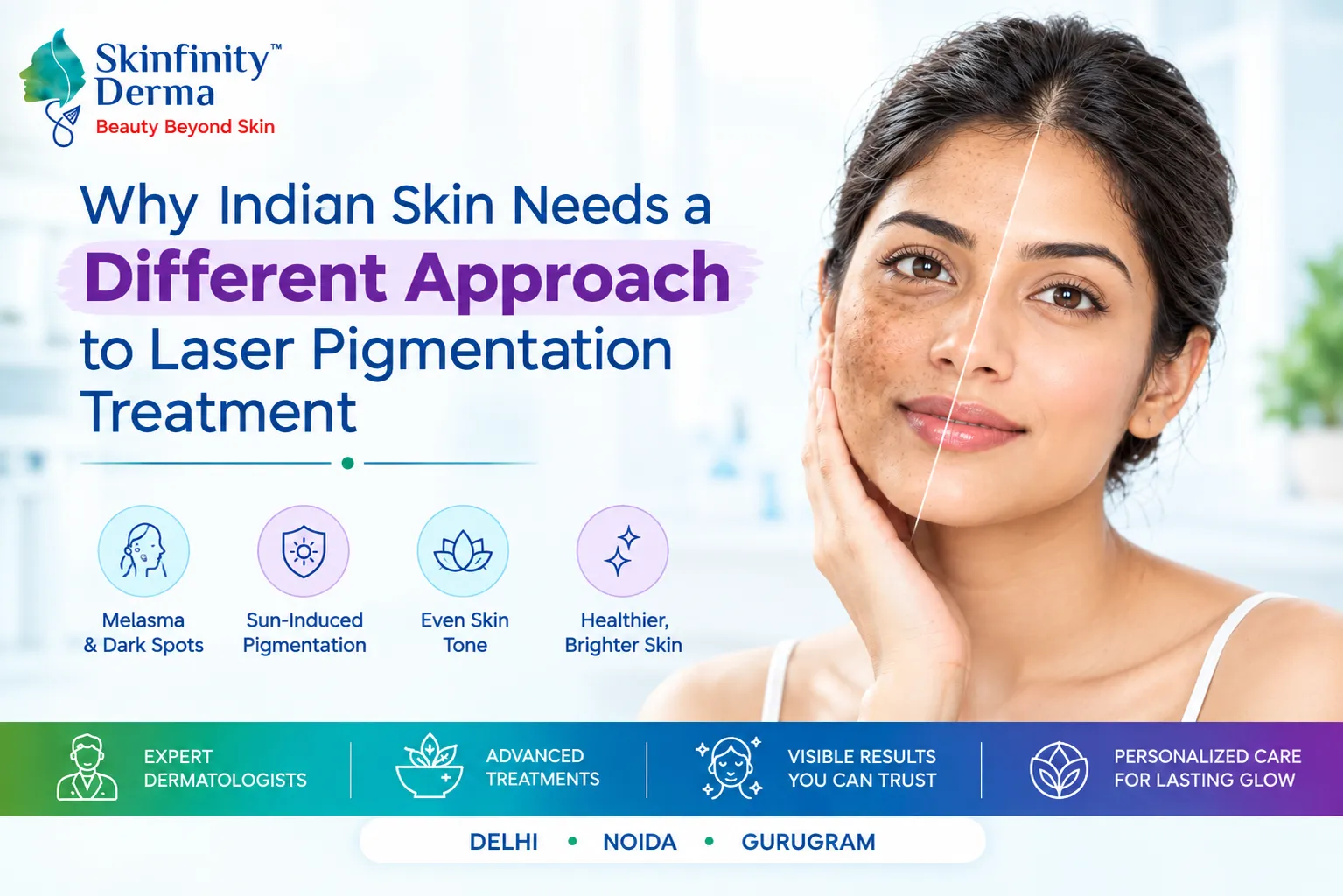
The same laser setting that reduces a dark spot on lighter skin can worsen pigmentation on Indian skin. This happens because laser energy targets melanin. Indian skin naturally contains more melanin and may respond strongly to heat or inflammation.
Laser treatment for pigmentation can improve selected dark spots, uneven tone and deeper pigment. However, the treatment must be customised for the patient’s skin tone and pigmentation type.
Aggressive settings can cause burns, prolonged redness or post-inflammatory hyperpigmentation. Melasma may also return after initially improving. Safe pigmentation laser treatment therefore begins with diagnosis rather than device selection.
Read on to understand why pigmentation treatment for Indian skin requires careful laser selection, conservative settings and strict aftercare.
Why Is Pigmentation More Common in Indian Skin?
Pigmentation develops when specialised cells called melanocytes produce additional melanin. Melanin gives the skin its natural colour and helps protect it from ultraviolet radiation.
Indian skin generally has more active melanin production than lighter skin. It may develop visible pigmentation after relatively mild inflammation or injury. Acne, eczema, waxing, burns and unsuitable skincare products can leave dark marks.
Post-inflammatory hyperpigmentation also tends to occur more frequently in darker skin tones. The marks may remain visible long after the original inflammation has settled.
Common triggers include:
-
Sun exposure
-
Acne and acne picking
-
Hormonal changes
-
Pregnancy
-
Skin inflammation
-
Friction
-
Harsh skincare products
-
Burns or injuries
-
Unsuitable cosmetic procedures
-
Certain medicines
Melasma is also common among Indian patients. It can be influenced by hormones, genetics, ultraviolet radiation and visible light. Sunlight stimulates pigment production and can deepen existing melasma patches.
This does not mean every Indian patient will develop pigmentation. Indian skin includes a wide range of tones and sensitivities. The risk depends on genetics, skin condition, treatment history and sun exposure.
What Makes Indian Skin Different During Laser Treatment?
Pigmentation lasers work by delivering energy that is absorbed by melanin. The energy heats or fragments unwanted pigment so the body can gradually clear it.
The challenge is that healthy surrounding skin also contains melanin. Darker skin may absorb more laser energy before it reaches the intended pigment. Excessive heat can then irritate or damage the surrounding tissue.
Dermatologists must balance two goals:
-
Deliver enough energy to target unwanted pigment.
-
Protect the natural melanin in the surrounding skin.
Several treatment factors become especially important:
-
Laser wavelength
-
Energy or fluence
-
Pulse duration
-
Spot size
-
Number of passes
-
Cooling method
-
Treatment interval
-
Pigment depth
-
Recent tanning
-
Previous treatment response
Longer wavelengths generally penetrate deeper and interact less strongly with surface melanin. This is one reason why a 1064 nm Nd:YAG laser may be considered for selected concerns in darker skin.
However, the wavelength alone does not determine safety. High energy, repeated passes or incorrect pulse settings can still cause complications.
Why Can Lasers Cause Post-Inflammatory Hyperpigmentation?
Post-inflammatory hyperpigmentation develops when inflammation stimulates melanocytes to produce additional pigment.
A laser intentionally delivers controlled energy into the skin. Appropriate treatment creates a predictable response. Excessive energy can produce unnecessary heat and inflammation.
The skin may respond by depositing more melanin in the treated area. A lighter patch can therefore become temporarily or persistently darker.
The risk may increase when:
-
The settings are too aggressive
-
The skin is recently tanned
-
Multiple passes are performed
-
Treatment sessions are scheduled too closely
-
The patient has active acne or dermatitis
-
The treated area is picked or scratched
-
Sunscreen is not used consistently
-
Strong skincare products are restarted too early
-
The pigmentation diagnosis is incorrect
Research reviews describe a greater risk of pigment changes and scarring when laser procedures are performed on skin of colour.
Post-inflammatory hyperpigmentation can still occur after careful treatment. Proper planning reduces risk but cannot remove it completely.
Can Laser Treatment Make Pigmentation Worse?
Yes. Laser pigmentation treatment can worsen pigmentation when the wrong condition, device or settings are selected.
Temporary darkening is expected after certain spot treatments. The treated pigment may initially look darker before it flakes or fades. This response is different from new pigmentation spreading beyond the treated area.
Possible complications include:
-
Post-inflammatory hyperpigmentation
-
Rebound melasma
-
Patchy hypopigmentation
-
Blistering
-
Burns
-
Prolonged redness
-
Uneven skin tone
-
Scarring
-
Increased sensitivity
Melasma can be especially unpredictable. Heat and inflammation may stimulate additional pigment production. Lasers are therefore not always the first treatment for melasma.
Repeated low-fluence laser toning can also create problems when used excessively. Some patients may develop mottled light patches or uneven pigmentation.
Patients should contact their dermatologist if they develop severe pain, blistering, spreading redness or unusual skin discolouration.
How Do Dermatologists Choose the Right Laser for Indian Skin?
The dermatologist first identifies the type and depth of pigmentation. A device should not be selected only because it is popular or marketed as advanced.
1. Confirming the Diagnosis
Melasma, freckles, post-acne marks and pigmented birthmarks behave differently. They cannot be treated through one standard laser protocol.
The dermatologist may examine the skin with specialised lighting or dermoscopy. Suspicious moles should not receive cosmetic laser treatment before proper evaluation.
2. Assessing Pigment Depth
Epidermal pigment lies closer to the surface. Dermal pigment sits deeper within the skin.
The depth influences wavelength selection and expected response. Deep pigmentation may require more sessions and may not clear completely.
3. Evaluating Skin Tone
The dermatologist considers the patient’s natural skin tone and recent tanning. A history of pigmentation after acne, peels or previous lasers is also important.
4. Selecting the Wavelength
The 532 nm wavelength may target selected superficial pigmentation. However, it interacts more strongly with epidermal melanin and requires additional caution in darker skin.
The 1064 nm Nd:YAG wavelength penetrates deeper and may be used for laser toning or selected dermal pigmentation. Q-switched 1064 nm Nd:YAG treatment has been studied for post-inflammatory hyperpigmentation in skin of colour.
Picosecond lasers may also be considered for selected pigment concerns. They use shorter pulses to fragment pigment. They are not automatically safer or better for every Indian patient.
5. Using Conservative Settings
Treatment may begin with lower energy and fewer passes. The dermatologist can increase treatment intensity only if the skin responds safely.
6. Performing a Test Spot
A test spot may be performed before treating a larger area. The response can help the dermatologist select safer settings.
Which Types of Pigmentation Can Be Treated With Lasers?
A laser for pigmentation may help selected concerns. Suitability depends on the pigment’s cause, colour and depth.
1. Freckles
Pigment-targeting lasers may work on freckles. If you continue to expose yourself to the sun, you can get more freckles. There may be several sessions required depending on the colour and depth. Daily sunscreen helps minimize additional darkening and recurrence.
2. Solar Lentigines
Sun spots are well-defined areas of hyperpigmentation, called solar lentigines. If the diagnosis is confirmed by a dermatologist, selected lesions may respond well to treatment. After laser treatment, there may be some darkening or crusting of the spots temporarily. New lesions may occur if continued exposure to the sun occurs.
3. Post-Inflammatory Hyperpigmentation
Lasers can be used to treat some remaining acne or post acne/post inflammatory marks. Sun protection and topical treatment are typically the initial treatments used.
Prior to aggressive treatment, the original acne or inflammation should be controlled. If these settings are not correct, it can cause further inflammation and pigmentation. It may be suggested to treat a larger area after a test spot has been treated.
4. Melasma
Resistant melasma can sometimes be helped by laser toning. But recurrence is common, as the underlying hormonal and environmental factors are still present.
Lasers should generally be a component of a comprehensive melasma treatment program, not a stand-alone treatment. Prescribed skin care and sunscreen should be used daily to help sustain the improvement. Melasma in pigmentation-prone skin may get worse if treated aggressively.
5. Nevus of Ota and Selected Birthmarks
Some darker birthmarks, such as those with a darker hue, can be treated with Q-switched lasers. Several sessions may be required. The answer to this question will depend on the nature, colour and intensity of the pigmentation. A diagnosis by a dermatologist is required prior to treatment.
6. Tattoo Pigment
Q-switched and picosecond lasers can break tattoo ink into smaller particles that the body gradually clears. Tattoo removal is different from treating natural skin pigmentation. Results depend on the ink’s colour, depth and density. Several sessions are usually required for visible fading, and complete removal cannot be guaranteed.
Not every dark patch should be treated with a laser. Pigmented moles, infections and unexplained skin changes require a proper diagnosis before treatment.
Laser Toning vs Other Pigmentation Treatments
Laser toning uses repeated low-fluence laser energy to treat broader pigmentation. Other treatments work through different mechanisms.
Book An Appointment
|
Treatment |
Main Purpose |
Commonly Considered For |
Important Limitation |
|
Laser toning |
Targets pigment with controlled laser energy |
Melasma and uneven tone in selected patients |
Pigmentation may recur |
|
Topical treatment |
Reduces pigment production or improves cell turnover |
Melasma and post-acne marks |
Results develop gradually |
|
Chemical peel |
Creates controlled surface exfoliation |
Superficial pigmentation and texture |
Strong peels may cause PIH |
|
Microneedling |
Creates controlled micro-injury |
Texture and selected pigmentation protocols |
Can worsen inflammation if unsuitable |
|
Intense pulsed light |
Uses broad-spectrum light |
Selected sun-related pigmentation |
Requires caution in darker skin |
|
Q-switched laser |
Delivers short pulses to fragment pigment |
Spots, birthmarks and tattoo pigment |
Incorrect settings may cause pigment changes |
|
Picosecond laser |
Uses extremely short pulses |
Selected pigmentation and tattoos |
Higher cost does not guarantee better results |
Laser toning is not universally better than creams or chemical peels. The best pigmentation removal treatment depends on the diagnosis and treatment history.
Why a Combination Approach May Work Better for Pigmentation
Pigmentation rarely develops from one cause. Sun exposure, inflammation and active pigment production may occur together.
Laser treatment may break down existing pigment. It cannot permanently stop melanocytes from producing new pigment.
A dermatologist may combine laser treatment with:
-
Broad-spectrum sunscreen
-
Tinted sunscreen containing iron oxide
-
Prescription pigment-control creams
-
Azelaic acid
-
Retinoids
-
Vitamin C
-
Barrier-supporting skincare
-
Maintenance sessions
Tinted sunscreens containing iron oxide can provide additional visible-light protection. This may be useful for people managing melasma or dark spots.
Combination treatment must still be planned carefully. Performing several irritating procedures too close together can increase inflammation and worsen pigmentation.
How to Prepare Your Skin Before Laser Pigmentation Treatment
Preparation can reduce avoidable irritation and support safer healing.
-
Avoid Tanning
Reduce direct sun exposure before treatment. A recent tan increases the amount of melanin near the skin’s surface and may increase the risk of burns.
-
Use Sunscreen Consistently
Apply broad-spectrum sunscreen every morning. The dermatologist may recommend a tinted formulation for melasma or pigmentation-prone skin.
-
Discuss Current Skincare
Inform the doctor about retinoids, exfoliating acids, benzoyl peroxide and prescription creams. Some products may need to be paused temporarily.
Patients should not stop prescribed medicines without medical advice.
-
Disclose Medical History
Tell the dermatologist about:
-
Previous laser reactions
-
Keloid or abnormal scarring
-
Herpes or cold sores
-
Active infections
-
Pregnancy or breastfeeding
-
Photosensitive conditions
-
Recent cosmetic procedures
-
Current medicines
-
Skin allergies
-
Control Active Inflammation
Active acne, eczema or dermatitis may need treatment before laser sessions. Applying laser energy to inflamed skin can increase pigmentation risk.
-
Avoid Waxing and Harsh Procedures
Waxing, scrubbing and chemical peels can irritate the treatment area. Follow the preparation interval recommended by the dermatologist.
Laser Pigmentation Treatment Aftercare for Indian Skin
Aftercare is especially important for pigmentation-prone skin. The treated area may be temporarily more sensitive to heat, sunlight and active skincare.
General aftercare may include:
-
Apply the prescribed soothing product
-
Use broad-spectrum sunscreen
-
Reduce direct sun exposure
-
Avoid intense exercise temporarily
-
Skip steam rooms and saunas
-
Avoid hot showers on the treated area
-
Pause retinoids when advised
-
Avoid exfoliating acids and scrubs
-
Do not pick flakes or crusts
-
Use a gentle cleanser
-
Apply a barrier-supporting moisturiser
-
Avoid makeup until permitted
-
Attend scheduled follow-up appointments
Some spots may darken before they fade. This can be expected after selected treatments. However, severe swelling, blisters or increasing pain require medical review.
Sunscreen should continue after the skin heals. Without ongoing photoprotection, new pigmentation can develop.
Is Laser Pigmentation Treatment Safe for Indian Skin?
Laser treatment can be performed safely on Indian skin when the patient and device are selected correctly.
Safety depends on:
-
Accurate diagnosis
-
Suitable laser technology
-
Conservative settings
-
Dermatologist supervision
-
Test spots when required
-
Proper cooling
-
Adequate intervals
-
Careful aftercare
-
Consistent sun protection
Research supports the use of selected Q-switched 1064 nm and 532 nm Nd:YAG protocols for benign pigmentation across different skin types. However, treatment parameters and patient selection remain essential.
No medical laser treatment is completely risk-free. Patients should receive a clear explanation of expected benefits, limitations and potential complications.
When Should You Avoid Laser Treatment for Pigmentation?
Laser treatment may need to be postponed or avoided when the skin is unstable.
Treatment may not be appropriate during:
-
Active skin infection
-
Inflamed acne
-
Active eczema or dermatitis
-
Recent tanning or sunburn
-
Open wounds
-
Active cold sores
-
Uncontrolled medical conditions
-
Use of photosensitising medication
-
Recent aggressive peel or resurfacing
-
Pregnancy for elective procedures
-
Unrealistic expectations
Suspicious or changing pigmented lesions should not be treated cosmetically. They require medical evaluation and may need a biopsy.
A patient with previous laser-induced pigmentation may still receive treatment in selected cases. The dermatologist should review the earlier reaction before making a decision.
Why Professional Diagnosis Matters Before Treating Pigmentation
Different pigmentation conditions can look similar without being the same.
A brown patch may represent:
-
Melasma
-
Post-acne pigmentation
-
Sun damage
-
Contact dermatitis
-
Frictional pigmentation
-
A pigmented birthmark
-
Medication-related pigmentation
-
A fungal condition
-
A mole or another lesion
Using the wrong laser can waste money and make the condition more difficult to treat.
Diagnosis also determines whether the pigment is epidermal, dermal or mixed. Surface creams may work better for some epidermal pigmentation. Deeper conditions may require a carefully planned procedure.
A dermatologist can also identify triggers that will continue after laser treatment. Treating active acne, irritation or sun exposure helps protect the final result.
Final Verdict: Is Laser Pigmentation Treatment Suitable for Indian Skin?
Yes, pigmentation laser treatment can be suitable for Indian skin. However, it should never follow a one-setting-fits-all approach.
The dermatologist must consider the pigmentation type, pigment depth and natural skin tone. Previous reactions and current inflammation also affect the decision.
Lasers can reduce selected freckles, sun spots, birthmarks and post-inflammatory marks. They may also support resistant melasma treatment. However, complete or permanent clearance cannot be guaranteed.
Conservative treatment may require more sessions. This is often safer than using aggressive settings to chase a quick result.
The best pigmentation treatment for Indian skin combines accurate diagnosis, suitable laser parameters and long-term pigment control.
Pigmentation Laser Treatment at SKINFINITY Derma
At SKINFINITY Derma, we begin with a dermatologist-led assessment of your pigmentation. We examine the type, depth, colour and likely trigger before recommending a procedure.
Our Fine Beam Q-Switched Nd:YAG laser platform uses selected wavelengths for different pigment concerns. We adjust the treatment settings according to your skin tone, sensitivity and previous treatment response.
We may combine laser pigmentation treatment with medical skincare, chemical peels or sun-protection guidance when appropriate. Our goal is to reduce visible pigmentation while controlling the factors that can cause it to return.
Patients can visit our clinics in Noida and Gurgaon for a personalised assessment. Book a consultation with SKINFINITY Derma? to learn whether laser treatment for pigmentation is suitable for your skin.
Conclusion
Indian skin can respond well to laser pigmentation treatment when the procedure is selected carefully. The safest approach begins with diagnosis and conservative settings. Sun protection, aftercare and maintenance remain equally important. Lasers can reduce visible pigment but cannot permanently stop melanin production. Dermatologist supervision helps balance meaningful improvement with the risk of post-inflammatory pigmentation.
Frequently Asked Questions
1. Why Is Pigmentation Treatment Different for Indian Skin?
Indian skin is unique in terms of pigmentation treatment.
The amount of active melanin present in Indian skin is more as compared to lighter skin. The laser energy can then be absorbed by unwanted pigment cells and by neighboring skin cells as well.
Treatment should be done with appropriate wavelengths, conservative settings and proper aftercare. This will help prevent burns and hyperpigmentation after the burn.
2. Can Laser Completely Remove Pigmentation?
Selected pigmentation can be significantly reduced with laser treatment. It is not possible to ensure complete clearance.
Melasma and post-inflammatory pigmentation may recur following sun exposure, hormonal fluctuations or re-flares. Thus, they require ongoing care and adequate maintenance.
3. How Can I Prevent Pigmentation After Laser Treatment?
Apply broad-spectrum sunscreen and avoid direct sunlight. Do not use heat, scrubs, retinoids or exfoliating acids until they are allowed by the dermatologist.
Avoid scratching off crusts or peeling skin. Follow the skin care regimen and follow-up appointments.
4. Is Laser Toning Good for Indian Skin?
Laser toning may improve selected cases of melasma and uneven pigmentation in Indian skin. However, it is not suitable for everyone.
A dermatologist should decide the treatment settings because repeated or aggressive sessions may cause uneven pigmentation.

 Call Now
 WhatsApp