
Medically Reviewed by: Dr. Neha Dhankar
MBBS, MD (Dermatology, Venereology & Leprosy) | Skinfinity Derma Clinic
Read Time: 8 Minutes
Uneven skin tone, dark patches, tanning, melasma, acne marks, and other forms of pigmentation are common skin concerns. Pigmentation can develop due to sun exposure, hormonal changes, acne, inflammation, certain medications, or other underlying factors.
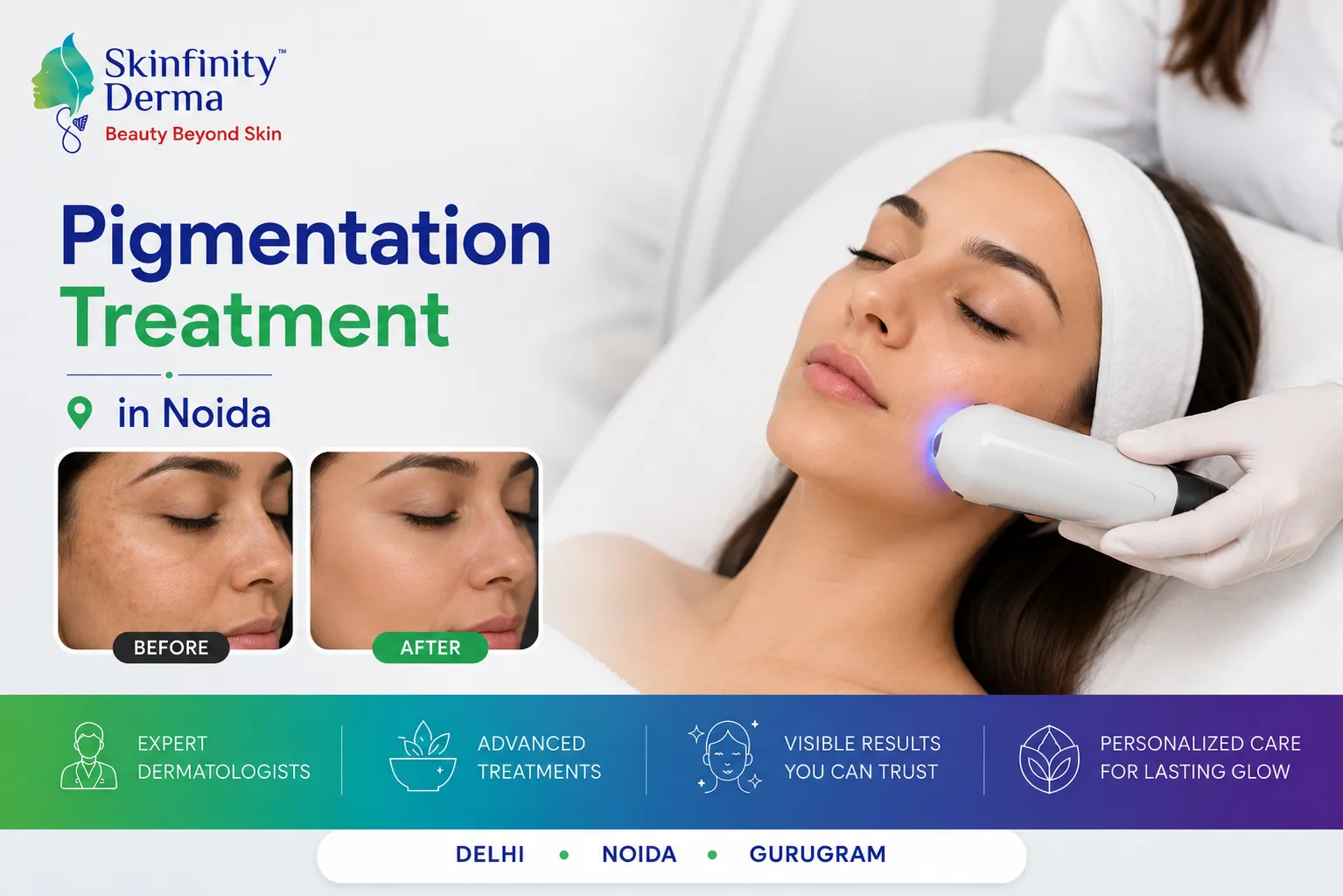
If you are looking for pigmentation treatment in Noida, the right treatment depends on the type, depth, cause, and severity of pigmentation. At Skinfinity Derma, treatment plans are customized after a dermatologist evaluates your skin and pigmentation pattern.
Quick Verdict
Book An Appointment
|
Skin Concern |
Chemical Peel |
Laser Treatment |
|
Post-acne dark marks |
Often a practical first procedure |
Considered for resistant marks |
|
Mild tanning |
Commonly suitable |
Usually not the first choice |
|
Epidermal melasma |
May support topical treatment |
Used selectively |
|
Freckles |
Gradual improvement |
More precise spot treatment |
|
Solar lentigines |
Useful for broader surface damage |
Often useful for defined lesions |
|
Dermal pigment |
Limited reach |
Selected lasers may reach deeper pigment |
|
Active acne with marks |
May address both concerns |
Usually delayed until inflammation is controlled |
|
Cost sensitivity |
Usually lower per session |
Usually higher per session |
|
Indian skin |
Safer with conservative superficial peels |
Requires careful device selection and settings |
Important Note: No procedure can promise permanent clearance.
What Is Skin Pigmentation?
Skin color comes largely from melanin and this compound is produced by melanocytes. Hyperpigmentation starts to develop when melanin production rises or the collection of pigments takes place in an uneven pattern.
The color alone does not reveal the cause. Brown patches may sit within the epidermis or the dermis. Some conditions affect both layers. Depth matters because superficial peels mainly affect the epidermis. Selected lasers can target pigment at different depths.
A dermatologist may assess the distribution and review previous triggers before recommending treatment. Dermoscopy or other clinical assessment methods may support the diagnosis in selected cases.
Common Types of Pigmentation
Here are some of the most common types of skin pigmentation.
-
Melasma
Melasma causes brown or grey-brown patches on the face and these patches are mostly symmetrical. It is often located on the cheeks and forehead. Patches can also form on the upper lip. Exposure to the sun and hormones can exacerbate the symptoms. Maintenance is required after improvement of melasma.
-
Post-Inflammatory Hyperpigmentation
Post-inflammatory hyperpigmentation or PIH, appears after inflammation or injury. Acne commonly causes PIH. Irritating skincare and poorly selected cosmetic procedures can also trigger it. The risk is greater in darker skin phototypes. Treatment-related inflammation can also make existing marks darker.
-
Freckles
Freckles are small pigmented spots that become darker with sun exposure. Their response to treatment depends on pigment depth and sun exposure. It also largely depends on the scale of genetic tendency.
-
Solar Lentigines
Solar lentigines are defined as brown spots linked with cumulative sun exposure. They often respond better to targeted treatment than diffuse melasma.
-
Tanning and Uneven Tone
Tanning is basically the mirror that reflects increased melanin production after ultraviolet exposure. A superficial peel may help when the pigment remains within upper skin layers.
-
Dermal Pigmentation
The deeper dermal pigment can be grey or blue-brown. Chemical peels are not very effective if pigment is predominantly located in the dermis as it is quite stubborn when present in this location.
What Causes Pigmentation?
Pigmentation often reflects more than one trigger.
Common causes include:
-
Ultraviolet exposure
-
Visible light exposure
-
Hormonal changes
-
Acne inflammation
-
Eczema or dermatitis
-
Skin injury
-
Friction
-
Irritating skincare
-
Certain medicines
-
Genetic susceptibility
The cause affects recurrence. A procedure may fade existing pigment but untreated acne can create new marks. Daily sunlight can also reactivate melanin production.
Responsible pigmentation treatment in Noida and other areas should therefore include trigger control. A procedure without daily photoprotection often produces short-lived improvement.
What Is a Chemical Peel?
A chemical peel is a controlled skin-resurfacing procedure.
The dermatologist applies a selected acid or chemical solution for a measured period. The solution loosens cells within specific skin layers and promotes controlled shedding.
Dermatologists use chemical peels for some forms of discoloration and acne. Treatment depth depends on the agent and its concentration. Skin preparation and contact time also affect penetration.
A professional Chemical peel in Noida should follow skin assessment rather than a fixed salon protocol.
How Chemical Peels Work on Pigmentation
Superficial peels remove pigment-containing cells from the epidermis. Repeated controlled exfoliation may gradually produce a more even tone. The peel must remain appropriate for the patient’s skin barrier and pigment depth.
Peels can also help when acne and PIH occur together. Salicylic acid may support acne control while glycolic acid may improve epidermal pigmentation.
Research involving dark-complexioned patients found that serial glycolic acid peels offered added benefit for PIH. Indian research also found that supervised glycolic acid peels improved melasma when combined with a topical regimen. These findings do not make peels a cure for every pigment disorder. Results depend on diagnosis and procedure strength.
Types of Chemical Peels
Here are the most prominent types of chemical peels used to address different skin concerns and pigmentation depths.
-
Superficial Peels
Superficial peels act mainly within the epidermis. They usually produce mild redness or light flaking.
Common agents include:
-
Glycolic acid
-
Lactic acid
-
Mandelic acid
-
Salicylic acid
These peels are often considered for mild PIH or tanning. They may also suit uneven surface tone.
-
Medium-Depth Peels
Medium peels reach deeper skin layers and create more visible peeling.
TCA may be used for selected concerns under medical supervision. Recovery takes longer than a superficial peel.
The risk of PIH also rises extensively when treatment is too aggressive or is performed with laxity.
-
Deep Peels
Deep peels produce extensive tissue injury and prolonged recovery.
A consensus review advises against deep peeling for dermal melasma in Fitzpatrick skin types IV to VI. Such treatment can cause scarring or severe pigment alteration.
Best Chemical Peels for Pigmentation
The best peel depends on the skin condition rather than a popular ingredient.
-
Glycolic Acid Peel
Glycolic acid is often used for epidermal melasma and post-acne marks. A review of glycolic acid peel therapy describes clinical use in Indian skin. The strength was gradually increased across supervised sessions.
-
Salicylic Acid Peel
Salicylic acid is oil-soluble and is a suitable peel for acne-prone skin. It can address clogged pores while helping superficial post-acne marks.
-
Mandelic Acid Peel
Mandelic acid penetrates more slowly than glycolic acid. Dermatologists may select it for sensitive or acne-prone skin.
-
Lactic Acid Peel
Lactic acid offers mild exfoliation and may suit dry skin. It is generally considered for surface-level discolouration rather than deep pigment.
-
TCA Peel
TCA creates deeper peeling at higher concentrations. It requires careful selection in Indian skin because inflammation can produce PIH. The appropriate chemical peel treatment cost depends partly on the chosen peel and planned session count.
What Is Laser Treatment for Pigmentation?
Laser treatment for pigmentation focuses a specific wavelength on a targeted area of the skin.
Lasers are directed at melanin in a lesion and are called pigment-specific lasers. The absorbed energy is broken down into smaller particles that are excreted by the body over time.
There are many devices that are called lasers. The characteristics of the Q-switched Nd: YAG systems are different from those of picosecond systems. Fractional resurfacing lasers operate differently.
The response of tissue is influenced by the wavelength and the duration of the pulse. The amount of energy absorbed by the surrounding epidermis is also influenced by skin color.
There are some laser systems that are US FDA cleared for the treatment of benign pigmented lesions. Clearance is applicable to certain devices and certain indications. Does not include all pigmentation disorders.
A qualified Dermatologist in Noida should identify the pigment disorder before selecting the device.
Chemical Peel vs Laser for Pigmentation: Key Differences
|
Decision Factor |
Chemical Peel |
Laser Treatment |
|
Main mechanism |
Controlled chemical exfoliation |
Selective light energy |
|
Typical depth |
Mainly epidermal |
Depends on device and wavelength |
|
Treatment area |
Useful across broader areas |
Useful for defined lesions |
|
Result pattern |
Usually gradual |
May be faster for selected spots |
|
Recovery |
Mild flaking to visible peeling |
Redness or temporary darkening may occur |
|
Main risk |
Irritation followed by PIH |
Burns or pigment alteration |
|
Melasma |
Usually an adjunct |
Reserved for selected cases |
|
Operator dependence |
High |
Very high |
|
Price |
Usually lower |
Usually higher |
Note: A laser is not automatically stronger or better. A chemical peel is not automatically safer. The ultimate procedure quality depends on the diagnosis and treatment parameters.
Which Treatment Is Better for Different Types of Pigmentation?
Let us now understand which treatment works better for different types of pigmentation.
-
Melasma
Melasma should usually begin with topical treatment and strict photoprotection.
A superficial peel may support treatment of the epidermal component. Laser treatment is generally reserved for carefully selected or resistant cases.
Heat and inflammation can cause rebound pigmentation. This makes aggressive laser treatment particularly risky for active melasma.
-
Post-Acne Pigmentation
A superficial peel is often a practical first procedural option.
Active acne should be controlled at the same time. Otherwise, new breakouts may continue creating fresh marks.
Laser treatment may be considered when pigmentation persists despite appropriate topical care.
-
Freckles
A pigment laser can target separate freckles with greater precision.
A chemical peel may gradually lighten widespread superficial freckling.
-
Solar Lentigines
Defined sunspots may respond well to a pigment-specific laser.
Chemical peeling may suit broader photodamage accompanied by rough texture.
-
Tanning
A superficial peel is usually more proportionate for mild tanning.
Ongoing sun exposure must be addressed before treatment.
-
Dermal Pigment
Laser treatment may be more suitable when pigment lies deeper.
However, not every dermal pigment responds well to lasers. The exact diagnosis remains essential.
Chemical Peel Benefits
Chemical peels may:
-
Improve superficial pigmentation
-
Reduce selected post-acne marks
-
Support acne treatment
-
Smooth rough surface texture
-
Treat a broader facial area
-
Require less expense per session
The benefit is strongest when the peel depth matches the condition.
Laser Treatment Benefits
Laser treatment may:
-
Target defined lesions precisely
-
Reach selected deeper pigment
-
Produce faster change in suitable sunspots
-
Treat areas that respond poorly to peels
-
Use settings matched to lesion depth
The result still depends on operator judgment and skin response.
Who Is an Ideal Candidate for a Chemical Peel?
A chemical peel may suit a patient with surface-level pigment and a stable skin barrier.
Suitable concerns may include mild tanning or post-acne marks. Some patients with epidermal melasma may also benefit as part of a wider plan.
Treatment may be postponed when the skin has an active infection. Uncontrolled dermatitis can also make treatment unsuitable.
Recent medicines and previous reactions should be discussed during consultation.
The American Academy of Dermatology advises patients with darker skin to consult a dermatologist before a peel or laser. Permanent dark marks or light patches can occur after unsuitable treatment.
Who Should Choose Laser Treatment?
Laser treatment may suit patients with defined freckles or solar lentigines.
It may also be considered for selected deeper pigment after clinical assessment. Patients should understand that multiple sessions may be required.
People with active melasma need a cautious plan. The lowest appropriate energy is usually preferred.
A test spot may also be useful before wider treatment.
Can Chemical Peels and Laser Treatments Be Combined?
Yes. But combination therapy should be staged.
A dermatologist may first control inflammation with topical treatment. A superficial peel may then address epidermal pigment.
Residual defined lesions may later receive laser treatment.
Combination treatment should not mean greater intensity. Each procedure should have a clear role.
A review of melasma and PIH treatment supports combining topical therapy with procedures in selected patients. The same review supports condition-specific management rather than one universal protocol.
Which Treatment Is Safer for Indian Skin?
Safety depends more on technique than treatment category.
Superficial peels can be used in darker skin when the agent remains conservative. Contact time must also reflect the patient’s response.
Deep peels carry greater pigment and scarring risks. Laser safety depends on two pivotal factors and they are: wavelength and energy settings. Cooling also matters. Pulse duration affects how the tissue responds.
The practical safety checklist is clear:
-
Confirm the diagnosis before treatment.
-
Ask who will perform the procedure.
-
Review the exact device or peeling agent.
-
Discuss prior PIH after acne or procedures.
-
Ask whether a test spot is appropriate.
-
Follow the prescribed aftercare.
-
Use daily broad-spectrum sunscreen.
Indian skin should not be treated with aggressive settings merely to shorten the treatment course.
Treatment Procedure: What to Expect
-
Chemical Peel Procedure
A peel appointment usually starts with cleansing. The dermatologist then applies the selected solution and observes the skin response. The peel is removed or neutralized when required.
Soothing skincare and sunscreen follow. A superficial peel may cause mild tingling. Light flaking can continue for several days.
Medium peels produce more visible recovery. A chemical peel session commonly takes 30 to 60 minutes at Skinfinity Derma.
-
Laser Procedure
The dermatologist first confirms the target lesion and reviews the patient’s skin type before starting the procedure.
Protective eyewear is used and a test spot may be performed before full treatment. Patients may feel heat or a snapping sensation. One more thing to note in this procedure is that temporary redness can follow.
Some pigmented lesions darken before they fade completely. The most important aspect of a laser process is aftercare and it usually focuses on gentle skincare and sun protection.
Cost of Chemical Peel vs Laser Treatment
Pigmentation Treatment Cost varies because pigmentation is not one condition.
The fee depends on:
-
Pigment type
-
Treatment area
-
Peel or laser technology
-
Session count
-
Dermatologist experience
-
Medicines used before or after treatment
Skinfinity’s published guide states that chemical peels across its Delhi NCR clinics start near ?2,000. The price may reach ?10,000 per session.
Its regional table places Noida superficial peels at ?2,500 to ?7,000 per session. Deeper peels cost more.
The clinic’s treatment page lists the following indicative Chemical peel Treatment Cost ranges:
|
Peel |
Estimated Price Range |
|
Glycolic peel |
rs3,500 to rs5,000 |
|
Cocktail peel |
rs3,500 to rs5,000 |
|
TCA peel |
rs3,500 to rs5,000 |
|
Salicylic peel |
rs3,500 to rs5,000 |
These are published estimates and may change after assessment.
Laser costs are usually higher because the fee reflects device use and operator expertise.
A patient should request a written estimate covering the full treatment course. Comparing one session alone can create a misleading cost picture.
How to Compare Treatment Plans
Price alone does not show value.
Ask these questions before starting:
-
What is the exact diagnosis?
-
What improvement is realistic?
-
Which procedure is being recommended?
-
Why is that option preferred?
-
How many sessions are expected?
-
What recovery is likely?
-
What can worsen the pigment?
-
What is the maintenance plan?
-
What is the total expected cost?
A clear answer should connect each procedure with a diagnosed concern.
Why Choose Skinfinity Derma for Pigmentation Treatment?
-
Advanced and Clinically Referenced Technologies
We use advanced technologies and formulations selected according to the patient’s skin concern and treatment goals. We work with US FDA-approved or FDA-cleared technologies.
Our dermatologists also explain the purpose of the recommended device and the possible risks before treatment begins.
-
More Than Nine Years of Clinical Experience
We bring more than nine years of clinical experience in treating pigmentation and other skin concerns. This experience is especially important for Indian skin. Why? Because Indian skin may respond differently to peels and other procedures.
Our approach is shaped by practical clinical knowledge rather than device popularity or one-size-fits-all packages.
-
Government-Registered Clinical Setting
Skinfinity Derma operates as a government-registered clinic. This allows us to follow documented protocols and provide treatment in a professionally managed medical environment.
-
Trusted by More Than 100,000 Patients
We have treated more than 100,000 patients across different skin and hair concerns. This broad clinical exposure helps our team understand varied skin responses and treatment expectations.
However, we never allow patient volume to replace individual attention. Every pigmentation treatment plan is created according to the patient’s specific skin condition.
-
Strong Patient Feedback
Our treatment pages currently report more than 3,200 verified reviews, with an average rating of 4.8. These experiences reflect the trust patients place in our dermatologists, treatment process, and continued support.
Review numbers may change over time, so patients can check our latest listings before booking.
-
Personalized Treatment Planning
We do not recommend pigmentation treatment based only on the most popular laser or peel. Our focus is on identifying the pigmentation correctly and selecting the safest suitable procedure. Our approach also stresses reducing the risk of recurrence.
We also help patients understand their condition and expected treatment timeline. We guide them through aftercare requirements and realistic results.
Do not choose a pigmentation procedure only because a device appears advanced. Book a consultation with our qualified Dermatologist in Noida and receive a treatment plan based on your skin and long-term needs. Consult the right experts for personalized Pigmentation Treatment in Noida and select an option designed for safer and more effective results. Book an appointment with us to know more.
Final Verdict: Which Works Better?
Chemical peels usually work better for broad surface-level pigment and post-acne marks. Laser treatment may work better for defined sunspots or selected deeper pigment. Melasma does not fit this simple comparison because it can worsen after either procedure.
The most reliable decision follows four questions:
-
What caused the pigmentation?
-
Where is the pigment located?
-
How reactive is the skin?
-
Which treatment carries the lowest reasonable risk?
A proper Pigmentation Treatment in Noida should answer these questions before discussing packages. Choosing the right pigmentation treatment requires more than comparing lasers and chemical peels.
FAQs
1. Which Is Better for Pigmentation: Chemical Peel or Laser?
Chemical peels are typically more effective for surface hyperpigmentation and post-acne marks. Laser treatment might be a preferable option for certain sun spots or darker pigments. The best one will vary according to the cause and depth of the pigment. Treatment should only follow a correct diagnosis.
2. Can a Chemical Peel Permanently Remove Pigmentation?
There is no existing treatment that will remove the pigmentation permanently and completely. A chemical peel can help lighten up any surface pigment and help to even out skin tone. But new pigmentation can occur later as a result of sun exposure or acne. The pigment can also be restored due to hormonal changes. Applying sunscreen and the proper skincare can help preserve the results.
3. Is Laser Treatment Safe for Indian Skin?
Indian skin can be safely treated with laser treatment by an experienced dermatologist. The dermatologist must choose the right device and use conservative settings. Skin with a high melanin level is more prone to burn or post-inflammatory hyperpigmentation from aggressive treatment. Appropriate post-treatment and a test spot can minimize these aggravating risks.
4. Which Treatment Gives Faster Results?
Laser treatment may provide faster improvement for selected freckles or sunspots. Chemical peels usually improve pigmentation gradually across several sessions. However, faster treatment is not always safer. Melasma and reactive skin often require a more cautious approach.
5. How Many Sessions Are Usually Required?
The number of sessions is not predetermined for each patient. The total may vary according to the type of pigmentation and the skin reaction. The depth of the pigment also affects the treatment time. Superfacial chemical peels may need to be a series of treatments. A few visits to the laser treatment may be necessary. With a dermatologist's examination of the skin, an estimate can be made.
6. Is Laser Treatment Painful?
Most patients describe laser treatment as warmth or a rubber-band snapping sensation. The discomfort level depends on the device and treatment area. Higher energy settings may feel more intense. Cooling or numbing cream may be used to improve comfort.
7. Are Chemical Peels Painful?
Facial chemical peels typically produce only slight tingling or a feeling of warmth. These feelings usually resolve after treatment. Higher peel grades could result in more pain and more recovery time. Peeling may be seen as well. The peel strength should be similar to the patient's skin type and concern.
8. Can Melasma Be Treated With Chemical Peels?
Yes, superficial chemical peels can help with the treatment of melasma. They are typically more effective if applied close to the skin surface. But peels should be used in addition to dermatologist-prescribed creams and proper sun protection. The management of triggers is still relevant. Excessive exfoliation may cause skin irritation and exacerbate melasma.
9. Which Treatment Is Better for Acne Pigmentation?
Superficial chemical peels are usually the first treatment tried for post-acne marks. They could be particularly beneficial if the skin is still oily or clogged. The laser treatment may be beneficial for certain persistent marks after active acne has subsided. Ongoing breakouts should be controlled first because each new pimple can leave another dark mark.
10. Can Pigmentation Return After Treatment?
Yes, pigmentation may come back following successful treatment. Melasma often relapses. Acne and irritation can also cause post-inflammatory pigmentation to return. Dark marks can also occur on the skin from injuries. The results can be maintained with daily use of sunscreen and a simple skin care regimen. There are other triggers that are known and can also be controlled to further minimize the risk of recurrence.

 Call Now
 WhatsApp