

Medically Reviewed by: Dr. Ipshita Johri
MBBS, DDV | Skinfinity Derma Clinic
Read Time: 8 Minutes
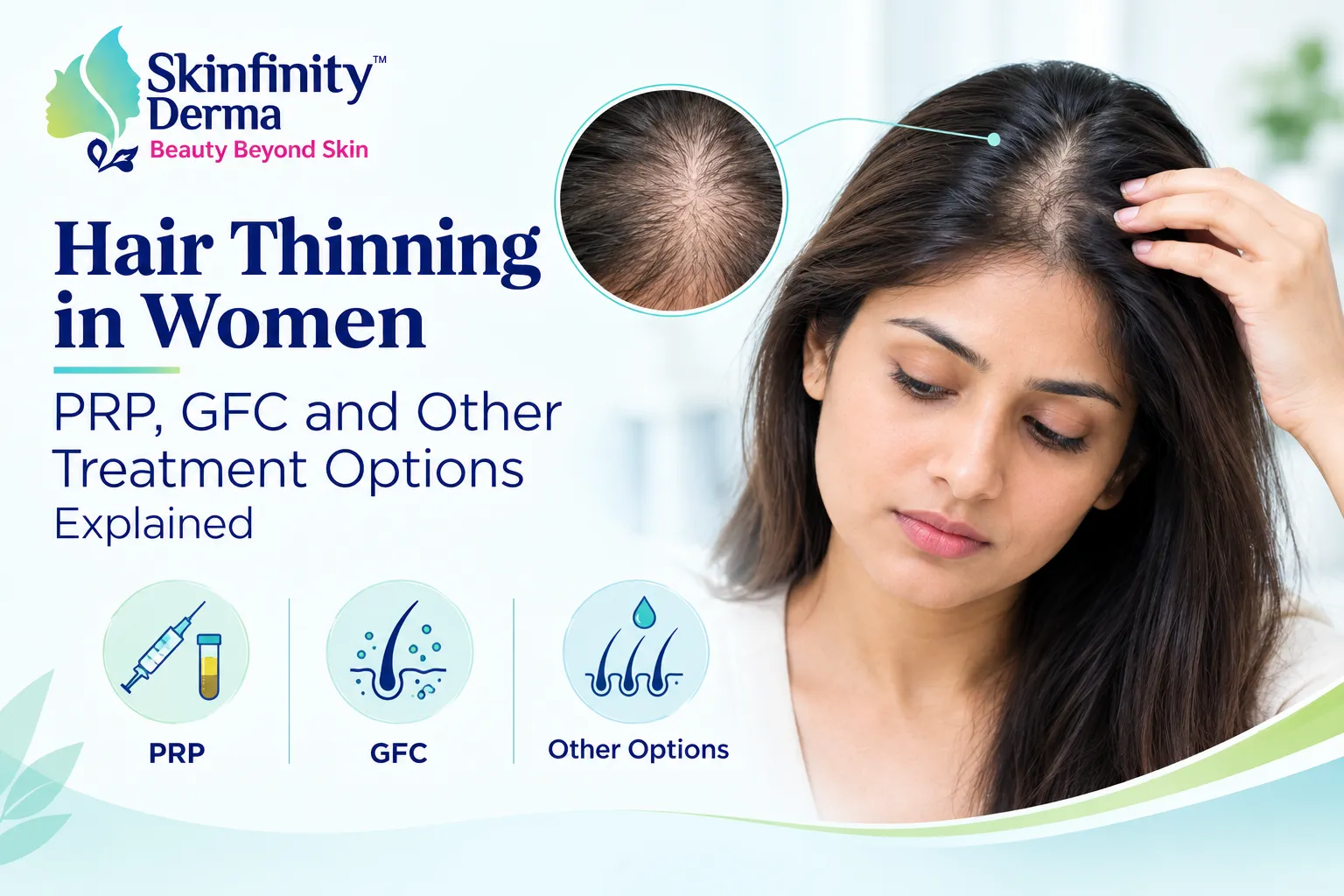
Is your ponytail feeling thinner, or does your parting appear wider than before? Hair thinning often develops gradually, making the early signs easy to overlook. Some women notice excessive shedding, while others see more visible scalp without losing large amounts of hair at once.
These changes can have different causes. Temporary shedding after illness requires a different approach from progressive female pattern hair loss. Scalp inflammation may also need treatment before any hair-growth procedure is considered.
PRP and GFC may support selected patients, but neither replaces an accurate diagnosis. Women exploring GFC treatment for hair in Gurgaon should first understand why their hair is thinning and what each treatment can realistically achieve.
Read our complete blog to explore the causes of female hair thinning and understand how PRP, GFC and other treatment options work.
Common Causes of Hair Thinning in Women
Hair thinning describes a reduction in visible density. It can result from excessive shedding or the gradual development of finer strands. Hair breakage may also make the hair appear less full.
1. Female Pattern Hair Loss
Female pattern hair loss usually develops gradually. The central part may widen as individual follicles produce increasingly fine hairs.
Family history can contribute, although relatives may show different patterns of thinning. This condition can occur even when hormone blood tests are normal.
2. Telogen Effluvium
Telogen effluvium causes increased shedding when more hairs enter the resting phase. It often follows a major physical or emotional trigger.
Shedding commonly becomes noticeable around two to three months after the trigger. Recovery usually begins after the underlying problem resolves, although visible fullness takes longer to return.
3. Nutritional Deficiencies
Iron deficiency can contribute to shedding, particularly in women with heavy menstrual bleeding. Inadequate protein intake or restrictive dieting may also affect hair growth.
Supplements should address an identified need. Taking several hair vitamins without assessment may provide little benefit and can occasionally cause harm.
4. Hormonal or Thyroid Conditions
PCOS can contribute to patterned thinning in some women. Thyroid disorders can also affect the hair-growth cycle.
Associated symptoms help guide investigation. Irregular periods or increased facial hair may suggest a need for hormonal assessment.
5. Traction and Repeated Damage
Tight hairstyles place prolonged tension on the follicles. Repeated traction can eventually cause permanent loss in affected areas.
Heat styling and chemical processing mainly damage the hair shaft. This creates breakage that can resemble shedding.
6. Inflammatory or Autoimmune Conditions
Alopecia areata can produce smooth patches of hair loss. Certain inflammatory scalp disorders can damage follicles and cause scarring.
Pain, persistent redness or shiny areas of scalp deserve prompt assessment.
How Stress, Nutrition and Hormones Affect Hair Growth
Hair follicles move through active growth and resting phases. Changes within the body can disturb this cycle.
-
Stress and Illness
Severe emotional stress or a significant illness may trigger delayed shedding. The hair loss can continue after the original event has passed, which makes the connection less obvious.
Stress management supports general well-being, but persistent thinning should not automatically be attributed to stress.
-
Nutrition and Restrictive Dieting
Rapid weight loss can place physical stress on the body. Diets that provide too little energy or protein may also disrupt normal growth.
A balanced diet supports recovery. Correcting a confirmed deficiency is more useful than adding supplements indiscriminately.
• Hormonal Changes
Some women experience temporary shedding after childbirth. Falling oestrogen levels allow more hairs to leave the growth phase.
Menopause may make underlying patterned thinning more noticeable. PCOS-related androgen activity can also contribute, although not every woman with PCOS develops hair loss.
The treatment depends on the diagnosis. A hormonal concern should not be managed solely through scalp injections.
When Hair Fall Requires Medical Investigation
Occasional shedding is normal, and the amount varies between individuals. A noticeable change from your usual pattern matters more than counting every strand.
Consult a dermatologist when you notice:
-
A progressively widening part
-
Sudden heavy shedding
-
Smooth patches of hair loss
-
Scalp pain or persistent itching
-
Redness with scaling
-
Loss of eyebrows or eyelashes
-
Hair loss with irregular periods
-
Thinning accompanied by unexplained fatigue
-
Continued loss despite an appropriate treatment plan
A consultation usually begins with your medical history and a scalp examination. Trichoscopy provides a magnified view of the follicles and hair shafts.
Selected blood tests may assess iron stores or thyroid function. Hormonal tests are considered when symptoms suggest a relevant disorder. A scalp biopsy is occasionally needed when the diagnosis remains uncertain.
Not every woman needs an extensive blood-test panel. Investigations should follow the examination findings.
PRP vs. GFC: Understanding the Differences
PRP and GFC both use material prepared from your own blood. Their processing methods differ, which affects the preparation injected into the scalp.
What Is PRP?
PRP stands for platelet-rich plasma. A blood sample is processed to obtain plasma containing an increased concentration of platelets.
Platelets release growth factors involved in tissue signalling. Scalp injections aim to support the activity of suitable existing follicles.
PRP preparation varies between systems. Platelet concentration and the presence of other blood cells can differ between protocols.
What Is GFC?
GFC stands for growth factor concentrate. Common protocols activate platelets during processing and collect a growth-factor-containing preparation for scalp injection.
The final composition depends on the preparation system. GFC should therefore not be treated as one identical product across every clinic.
It is not a stem-cell treatment and does not create new follicles.
A Practical Comparison
Book An Appointment
|
Factor |
PRP |
GFC |
|
Starting material |
Your own blood |
Your own blood |
|
Main preparation |
Platelet-enriched plasma |
Growth-factor-containing preparation after platelet activation |
|
Protocol consistency |
Varies between systems |
Also depends on the kit and processing method |
|
Treatment role |
Possible addition to medical care |
Possible addition to medical care |
|
Research base |
Larger body of published research |
Smaller and developing evidence base |
|
Guaranteed regrowth |
No |
No |
Is GFC Better Than PRP?
Current evidence does not establish one option as universally better for women.
A small retrospective comparison reported improvements with both treatments. The study involved only 42 patients, including men and women, which limits broad conclusions.
Treatment choice should consider the diagnosis and the preparation protocol. Claims that GFC always works faster or requires fewer sessions are too definite.
Possible Side Effects
Both procedures involve blood collection and scalp injections. Temporary tenderness or swelling may occur, and some patients develop bruising.
Infection is possible after an injection procedure. Using your own blood does not remove the need for sterile handling or medical screening.
Other Medical Treatments for Hair Loss
Procedures are only one part of hair-loss care. Some women benefit more from medication or correction of an underlying trigger.
1. Topical Minoxidil
Topical minoxidil is a commonly recommended treatment for female pattern hair loss. It can support growth and help maintain existing density.
Temporary increased shedding may occur early in treatment. Scalp irritation is another possible side effect.
Assessment takes several months, and continued use is generally needed to maintain benefits. Women who are pregnant or breastfeeding should avoid it. Pregnancy plans should also be discussed before treatment.
2. Low-Dose Oral Minoxidil
A dermatologist may consider oral minoxidil for selected patients. Its use for hair loss is off-label and requires medical assessment.
Possible effects include unwanted facial hair or fluid retention. Blood-pressure changes and cardiovascular history must also be considered.
3. Anti-Androgen Medicines
Spironolactone may be appropriate for some women with patterned thinning. It reduces androgen effects rather than treating every cause of shedding.
Kidney health and other medicines influence suitability. Pregnancy prevention and appropriate monitoring require discussion with the prescribing doctor.
4. Correction of Medical Triggers
Iron deficiency requires appropriate correction. Thyroid-related shedding needs treatment of the thyroid condition.
Acute telogen effluvium may improve after its trigger resolves. PRP or GFC is not automatically necessary during recovery.
5. Treatment for Scalp Disease
Inflammatory scalp disorders require diagnosis-specific care. Delaying treatment for a scarring condition can allow irreversible follicular damage.
6. Other Selected Options
Low-level light therapy may be considered for suitable patterned thinning. Hair transplantation is an option for carefully selected women with stable loss and sufficient donor hair.
Cosmetic fibres or hairpieces can also improve appearance during treatment.
Who May Benefit From PRP or GFC?
PRP or GFC may be considered for selected women with early or moderate patterned thinning. Existing follicles must remain capable of responding.
A dermatologist may discuss these procedures when:
-
Examination confirms a suitable non-scarring condition
-
Medical treatment alone has provided an incomplete response
-
The patient understands the evidence limitations
-
Regular follow-up is possible
Neither procedure reliably restores follicles destroyed by scarring. They also do not correct thyroid disease or nutritional deficiency.
Active scalp infection may require postponement. Platelet disorders or medicines affecting bleeding can influence suitability.
How Many Sessions May Be Needed?
An initial course may involve approximately three to four appointments spaced around a month apart. This is an example of a commonly used approach, not a universal schedule.
GFC protocols vary, and there is no single agreed session count for every patient. Maintenance should depend on documented response rather than an automatic package renewal.
Visible changes develop gradually over several months. Repeat photographs help distinguish genuine improvement from differences in lighting or styling.
How to Build a Personalised Hair Treatment Plan
An effective plan starts with identifying the condition rather than choosing a procedure.
1. Establish the Pattern
Your dermatologist examines whether loss is diffuse, patchy or concentrated around the central part. The scalp is also checked for inflammation.
2. Review Relevant History
The consultation should cover recent illness and major changes in diet. Menstrual history and current medicines may provide further clues.
3. Order Targeted Investigations
Tests are selected according to symptoms and examination findings. Routine testing for every possible deficiency is rarely useful.
4. Agree on Treatment Goals
Reducing shedding may be the first priority. Improving density usually requires a longer assessment period.
Preserving existing hair can also represent a meaningful treatment benefit.
5. Review Progress
Consistent photographs and trichoscopy can help assess response. Treatment should be reconsidered when the diagnosis changes or improvement remains inadequate.
Maintaining Hair Health After Treatment
Long-term care depends on the underlying condition. Patterned thinning may require ongoing medication even after a procedure course ends.
Helpful habits include:
-
Following prescribed treatment consistently
-
Eating enough protein and overall energy
-
Avoiding repeated crash diets
-
Keeping hairstyles loose
-
Limiting excessive heat styling
-
Treating persistent scalp irritation
-
Attending planned reviews
-
Discussing new medicines before changing treatment
Shampoo can cleanse the scalp and reduce breakage when appropriately selected. It cannot reverse progressive follicular miniaturisation by itself.
Hair Thinning Treatment at SKINFINITY Derma
Our approach at SKINFINITY Derma begins with understanding how your hair has changed. We assess the distribution of thinning and examine the scalp before discussing treatment.
-
Assessment Before Procedures
We review possible triggers and previous treatment responses. Symptoms suggesting hormonal involvement are considered before recommending investigations.
-
PRP or GFC Where Appropriate
Our team can discuss GFC treatment for hair in Gurgaon? when the diagnosis supports its use. We explain its possible role alongside medical care rather than presenting injections as a solution for every cause of thinning.
-
Ongoing Dermatologist Review
We review progress and adjust the plan according to your response. The aim may involve reducing shedding or preserving density, depending on your condition.
Women searching for a hair thinning specialist in Gurgaon can begin with a consultation to clarify the cause.
Conclusion
Hair thinning in women requires treatment matched to its cause. Temporary shedding may improve after a trigger resolves, while female pattern hair loss often needs continued care.
PRP and GFC may support selected patients, but results vary. Neither replaces medical investigation or guarantees regrowth. An early assessment with a dermatologist in Gurgaon can help identify suitable options and establish realistic expectations.
Book a Hair and Scalp Consultation
Connect with SKINFINITY Derma to discuss persistent shedding or visible thinning. Our dermatologists can assess your scalp and explain which treatments may suit your needs.
Frequently Asked Questions
1. What Causes Excessive Hair Fall in Women?
Common causes include telogen effluvium and female pattern hair loss. Iron deficiency or thyroid disease may also contribute.
Hair loss accompanied by irregular periods may require hormonal assessment. The pattern and timing help guide diagnosis.
2. What Is the Difference Between PRP and GFC for Hair?
PRP uses platelet-enriched plasma prepared from your blood. GFC uses a growth-factor-containing preparation collected after platelet activation.
Both protocols vary between systems. Neither has been proven universally superior for every woman.
3. How Many PRP or GFC Sessions May Be Needed?
Some initial courses involve three to four sessions around a month apart. The final schedule depends on the diagnosis and treatment protocol.
Further appointments should follow a progress review. More sessions do not automatically produce better results.
4. Can Hair Thinning Caused by Hormonal Changes Be Treated?
Yes, many hormone-related causes can be managed. Treatment may involve addressing PCOS or using medicines for patterned thinning.
Postpartum shedding often improves naturally. Pregnancy and breastfeeding affect which treatments are appropriate.
5. When Should I Consult a Hair Fall Specialist in Gurgaon?
Arrange an assessment for a widening part or persistent heavy shedding. Patchy loss and scalp pain need prompt review.
Early consultation is also useful when thinning occurs with menstrual changes or increased facial hair.

 Call Now
 WhatsApp