

Medically Reviewed by: Dr. Shradha Gumber
MBBS, MD - Dermatology , Venereology & Leprosy | Skinfinity Derma Clinic
Read Time: 8 Minutes
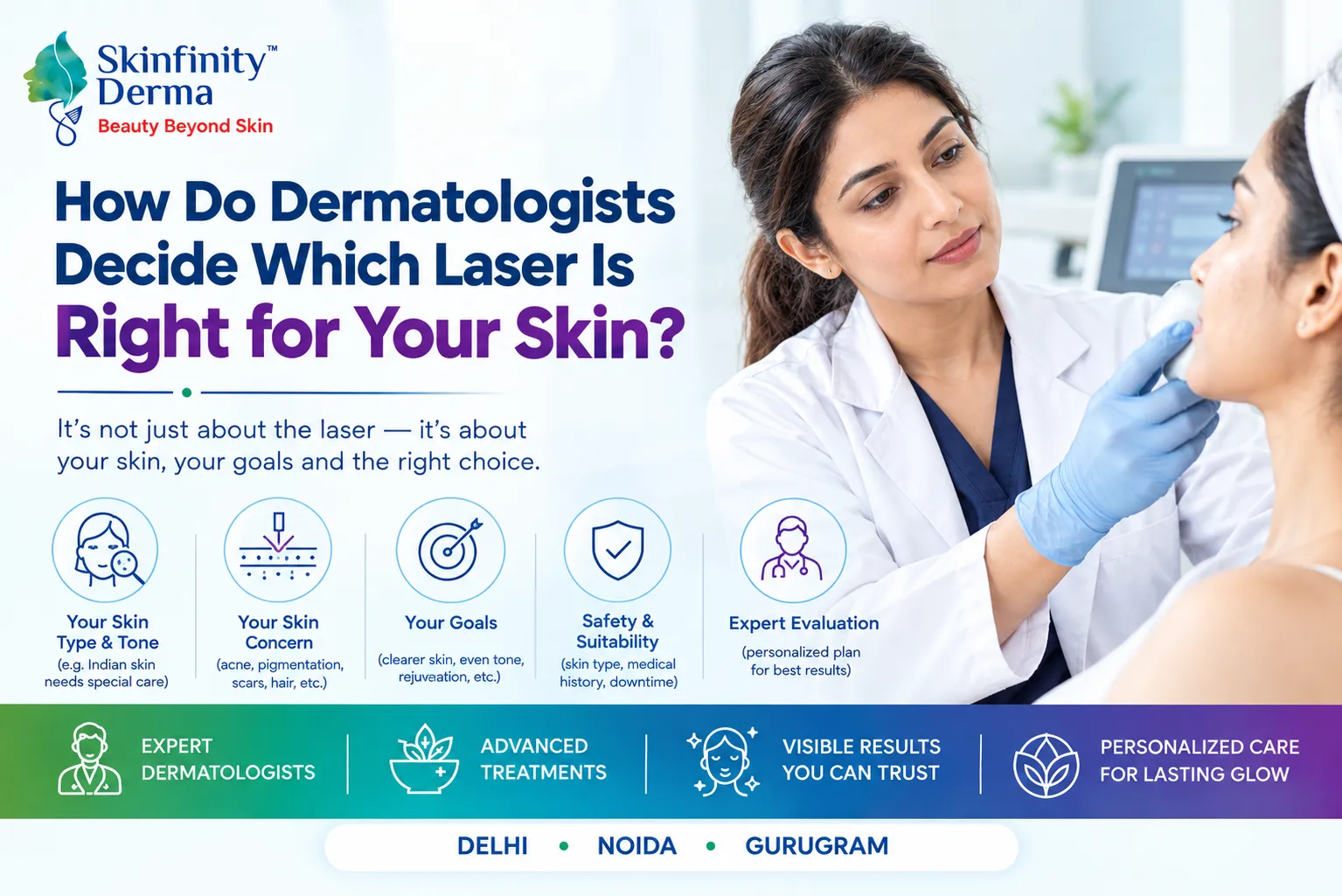
How Dermatologists Choose the Right Laser
Laser treatments can improve pigmentation, acne scars, unwanted hair and visible signs of ageing. However, the laser that works well for one concern may be completely unsuitable for another.
Every laser has a specific wavelength, pulse duration and treatment depth. These properties determine whether it targets melanin, haemoglobin, water or hair follicles. The dermatologist must also consider skin tone, sensitivity and healing response before selecting the technology.
This explains why an online list cannot identify the best laser treatment for skin. A successful treatment begins with the correct diagnosis. The device and treatment settings are then matched to the concern.
This guide explains how to choose the right laser for skin and why dermatologist supervision matters, particularly for Indian skin.
Why Is There No Single “Best” Laser for Everyone?
Lasers are designed to interact with specific targets inside the skin. These targets are called chromophores.
The three main chromophores are:
-
Melanin in pigmentation and hair
-
Haemoglobin inside blood vessels
-
Water within skin tissue
A pigment-targeting laser may improve freckles but cannot necessarily remodel deep acne scars. A fractional resurfacing laser may stimulate collagen but is not the standard choice for unwanted hair.
Even two patients with the same concern may need different treatment plans. One may have superficial pigmentation. Another may have deeper pigment or inflammation that makes laser treatment risky.
The best laser treatment for skin depends on:
-
The diagnosis
-
Treatment depth
-
Natural skin tone
-
Recent tanning
-
Skin sensitivity
-
Previous pigmentation
-
Scar type
-
Treatment area
-
Medical history
-
Expected downtime
-
Patient goals
The name of the laser alone does not determine safety or results. Patient selection and calibrated settings are equally important.
What Does a Dermatologist Check Before Choosing a Laser?
A dermatologist begins by identifying the condition rather than selecting a device immediately.
-
The Exact Diagnosis
Pigmentation can include freckles, solar lentigines, melasma, post-inflammatory hyperpigmentation or deeper birthmarks. These conditions behave differently and do not require the same treatment.
Similarly, acne scars may be rolling, boxcar, ice-pick or raised. A fractional laser may improve some scars while others need subcision or another procedure.
-
Skin Tone
The dermatologist may assess the skin using the Fitzpatrick classification. This system considers natural skin colour and the way skin responds to ultraviolet exposure.
Darker skin contains more epidermal melanin. This melanin may compete with the intended target for laser energy.
-
Pigment or Scar Depth
Brown pigmentation is often more superficial. Grey, blue or slate-coloured pigmentation may lie deeper within the skin.
Scar depth and attachment also affect treatment selection. Deep tethered scars may not respond adequately to laser treatment alone.
-
Previous Treatment Response
A history of burns, prolonged redness or pigmentation after procedures can influence the treatment plan.
The dermatologist should also ask whether the patient has previously received chemical peels, lasers, microneedling or prescription skincare.
-
Active Skin Conditions
Laser treatment may need to be delayed when the treatment area has:
-
Active acne inflammation
-
Bacterial or fungal infection
-
Cold sores
-
Eczema
-
Dermatitis
-
Open wounds
-
Recent sunburn
-
Unexplained skin lesions
-
Medical History
Medical history can affect whether laser treatment is suitable. The dermatologist should be informed about pregnancy, current medications, a tendency to develop keloids, and any conditions that may affect healing. Photosensitising medicines and recent isotretinoin use should also be discussed before treatment.
Does Skin Tone Affect Laser Selection?
Yes. Skin tone is one of the most important factors in laser selection.
Laser energy intended for pigmentation or hair can also be absorbed by natural epidermal melanin. This may create excessive heat when an unsuitable wavelength or aggressive setting is used.
Possible complications include:
-
Burns
-
Blistering
-
Prolonged redness
-
Post-inflammatory hyperpigmentation
-
Hypopigmentation
-
Uneven skin tone
-
Scarring
Darker skin is not automatically unsuitable for laser treatment. However, it may require a longer wavelength, conservative fluence, suitable pulse duration and efficient cooling.
Longer wavelengths such as 1064 nm generally penetrate more deeply and interact less with surface melanin than shorter wavelengths. This can make them useful for selected concerns in darker skin types. Research also supports careful use of low-energy fractional treatments for specific pigmentation concerns in skin of colour.
The dermatologist may perform a test spot when the treatment response is uncertain.
Which Laser Is Used for Pigmentation?
The best laser for pigmentation depends on the diagnosis and pigment depth.
1. Q-Switched Nd:YAG Laser
A Q-switched Nd:YAG laser releases energy in very short pulses. It may use 1064 nm or 532 nm wavelengths.
The 1064 nm wavelength penetrates more deeply and may be considered for deeper pigment, tattoo ink and selected darker skin types. The 532 nm wavelength acts more superficially and may be considered for selected epidermal spots.
Possible indications include:
-
Freckles
-
Solar lentigines
-
Selected birthmarks
-
Tattoo pigment
-
Uneven pigmentation
-
Certain resistant pigment concerns
2. Picosecond Laser
Picosecond lasers deliver energy in extremely short pulses. They are mainly used for selected pigmentation and tattoo concerns.
Treatment results depend on wavelength, spot size, fluence and pigment depth. The word “picosecond” does not automatically mean that a device is appropriate for every patient.
3. Laser Toning
Laser toning generally involves low-fluence Q-switched 1064 nm Nd:YAG treatment. It may be considered within a wider plan for selected melasma or uneven pigmentation.
Melasma is highly sensitive to heat and inflammation. Aggressive or repeated treatment can worsen pigmentation or cause irregular pigment loss. Laser toning should therefore not be treated as a routine brightening facial.
When a Laser May Not Be the First Choice
Post-inflammatory pigmentation may improve with sunscreen and medical skincare. Melasma usually requires trigger control and topical treatment before a laser is considered.
Pigmented moles and unexplained dark lesions must be diagnosed before cosmetic treatment.
Which Laser Is Used for Acne Scars?
The best laser for acne scars depends on scar shape, depth and skin tone.
-
Fractional CO2 Laser
A fractional CO2 laser is an ablative resurfacing treatment. It creates microscopic treatment columns while leaving surrounding tissue available for healing.
The controlled injury stimulates collagen remodelling. It may help improve:
-
Boxcar scars
-
Selected rolling scars
-
Uneven texture
-
Enlarged-looking pores
-
Certain surgical or traumatic scars
Fractional CO2 treatment can offer noticeable remodelling. However, it may involve redness, swelling, crusting and several days of downtime. Indian skin requires carefully selected density and energy because excessive inflammation can cause pigmentation.
Research supports fractional CO2 treatment for acne scars. However, treatment settings must be adjusted to balance improvement with side effects and recovery.
-
Non-Ablative Fractional Laser
A non-ablative fractional laser heats deeper tissue without removing the entire skin surface. It can stimulate collagen while generally causing less downtime than an ablative laser.
Several sessions may be required because each session tends to create a more controlled response.
-
Er:YAG Laser
Er:YAG is another resurfacing laser. Its energy is strongly absorbed by water and can remove controlled layers of the skin.
It may offer precise resurfacing with a different balance of downtime and thermal injury from CO2 treatment.
Why Laser Alone May Not Be Enough
Different scars require different procedures:
-
Tethered rolling scars may need subcision.
-
Ice-pick scars may need chemical reconstruction.
-
Deep boxcar scars may need resurfacing or surgical techniques.
-
Raised scars may require injections or silicone-based treatment.
-
Active acne must be controlled to prevent new scars.
Combination treatment often produces a more balanced improvement than repeatedly using one laser.
Which Laser Is Used for Skin Rejuvenation?
Skin rejuvenation can refer to several concerns. These include fine lines, rough texture, sun damage, enlarged-looking pores and mild loss of firmness.
1. Non-Ablative Fractional Lasers
These lasers generate a controlled thermal zone, which is below the surface of the skin. They promote collagen production, but cause relatively little surface injury.
May be recommended for early texture changes, fine lines and mild photodamage.
2. Fractional CO2 Laser
Fractional CO2 treatment offers more powerful resurfacing. May be appropriate for deeper texture issues and more apparent photoageing.
This is also because of the more robust treatment response which equates to more downtime and aftercare.
3. Er:YAG Laser
Er:YAG can be used to control resurfacing and skin renewal. Treatment depths can be modified based on the concern.
4. Q-Switched Nd:YAG Laser
For certain individuals, low-fluence Q-switched treatments can help achieve a more uniform skin tone. It is not as effective as a fractional CO2 laser when it comes to resurfacing.
The most effective rejuvenation depends on the primary issues: pigmentation, texture, or fine lines.
Which Laser Is Used for Unwanted Hair?
Laser hair reduction targets melanin within the hair follicle. The absorbed energy damages structures responsible for future growth.
Common technologies include:
1. Diode Laser
Diode systems are widely used for hair reduction. Their wavelength and pulse settings can be adjusted for several skin and hair types.
2. Long-Pulsed Nd:YAG Laser
The 1064 nm Nd:YAG wavelength penetrates deeply and has lower absorption by surface melanin. It may be selected for darker skin tones.
3. Alexandrite Laser
Alexandrite lasers can work effectively on lighter skin with dark hair. They require caution in deeper skin tones because surface melanin can absorb more energy.
4. Triple-Wavelength Platforms
Some platforms combine Alexandrite, diode and Nd:YAG wavelengths. They are designed to target hair at different depths.
Technology alone does not guarantee results. Hair colour, thickness, hormonal influence and treatment settings remain important.
White, grey and very light hair respond poorly because they contain insufficient melanin for effective targeting.
Q-Switched Nd:YAG vs Fractional Laser vs CO2 Laser: What’s the Difference?
Book An Appointment
|
Feature |
Q-Switched Nd:YAG |
Non-Ablative Fractional Laser |
Fractional CO2 Laser |
|
Main target |
Melanin or tattoo pigment |
Water and deeper tissue |
Water within skin tissue |
|
Primary goal |
Pigmentation reduction |
Collagen stimulation |
Stronger resurfacing |
|
Common concerns |
Freckles, sun spots and tattoos |
Mild scars, texture and fine lines |
Deeper scars and photoageing |
|
Surface removal |
No |
Usually minimal |
Yes, within microscopic columns |
|
Typical downtime |
Low to moderate |
Low to moderate |
Moderate to significant |
|
Pigmentation risk |
Depends on wavelength and settings |
Present if treatment is aggressive |
Higher in pigmentation-prone skin |
|
Sessions |
Often several |
Usually several |
Depends on scar severity |
|
Suitable for every skin tone |
No |
No |
No |
The term “fractional” describes the delivery pattern rather than one specific laser. A fractional device treats microscopic sections while leaving nearby skin untreated.
CO2 is an ablative laser that can also be delivered fractionally. Therefore, “fractional laser” and “CO2 laser” are not always opposing categories.
Why Laser Settings Matter as Much as the Laser Type
Two clinics can use the same laser platform and produce very different treatment responses.
A dermatologist adjusts several parameters:
-
Wavelength
-
Fluence or energy
-
Pulse duration
-
Spot size
-
Treatment density
-
Number of passes
-
Pulse frequency
-
Cooling
-
Treatment interval
Higher energy does not always mean better results. Excessive heat may damage surrounding tissue without improving the intended concern.
Pulse duration influences how long the target receives heat. Spot size affects treatment depth and energy distribution. Density determines how much tissue is treated during resurfacing.
Settings must be selected according to the patient rather than copied from a fixed machine protocol.
Can the Wrong Laser Cause Pigmentation or Burns?
Yes. The wrong device or unsuitable settings can cause thermal injury.
Burns may develop when natural melanin absorbs excessive energy. This risk can increase with:
-
Recent tanning
-
Aggressive settings
-
Insufficient cooling
-
Overlapping laser passes
-
Incorrect wavelength
-
Active skin inflammation
-
Inexperienced treatment
-
Poor aftercare
-
Unreported photosensitising medicines
Inflammation after a laser can stimulate additional melanin production. This leads to post-inflammatory hyperpigmentation.
Excessive damage to melanocytes may create lighter patches called hypopigmentation. Some pigment changes may take months to improve and can occasionally persist.
Contact the treating dermatologist if the skin develops severe pain, blistering, spreading redness, pus or unusual discolouration.
Why Indian Skin Needs Careful Laser Selection
Indian skin commonly falls within Fitzpatrick skin types III to V. However, skin tone and treatment response vary considerably between individuals.
Greater epidermal melanin creates more competition between the intended target and the surrounding skin. Indian skin may also respond to inflammation by producing persistent dark marks.
Post-inflammatory hyperpigmentation is generally more common and pronounced in darker skin types.
Careful treatment planning may include:
-
Confirming the diagnosis
-
Treating active inflammation first
-
Avoiding recent tanning
-
Choosing a suitable wavelength
-
Beginning with conservative settings
-
Using appropriate cooling
-
Performing a test spot
-
Allowing sufficient recovery
-
Prescribing pigment-control skincare when appropriate
-
Maintaining strict sun protection
The best laser for Indian skin is not one specific machine. It is the appropriate technology used with personalised settings by an experienced dermatologist.
Can Two Different Lasers Be Used for the Same Patient?
Yes. One patient may have several concerns at different depths.
A dermatologist may use one laser for pigmentation and another for acne scars. Treatments can also be combined with:
-
Subcision
-
Microneedling
-
MNRF
-
Medical skincare
-
Injectable scar treatment
-
Platelet-rich plasma therapy
The procedures may need to be performed on different dates. Treating the skin too frequently can increase inflammation and delay recovery.
Combination treatment should have a clear purpose. More procedures do not automatically produce better results.
What Happens During a Laser Consultation?
A laser consultation generally includes the following steps.
1. Skin Assessment
The dermatologist checks the area of concern, skin tone and treatment area. Active acne, infections and suspicious lesions are detected.
2. Medical History
Medicines, allergies and previous reactions should be revealed by the patient. Other issues such as pregnancy, cold sores, keloid tendency and healing issues should be discussed.
3. Diagnosis
The dermatologist will decide whether it is pigment, blood vessels, scarring, hair or another condition.
4. Treatment Selection
The doctor discusses the type of laser that might be appropriate and why. If laser treatment is not likely to yield the best results, alternatives should also be discussed.
5. Risk and Downtime Discussion
Patients are provided with information regarding discomfort, redness, peeling and expected recovery. Potential complications should be addressed prior to consent.
6. Treatment Planning
The consultation should cover the expected number of sessions, treatment intervals, preparation and aftercare. A test spot may be performed if necessary.
How Many Laser Sessions Will You Need?
The number of sessions depends on the condition and treatment response.
|
Concern |
General Treatment Pattern |
|
Superficial freckles or sun spots |
One to three sessions may be considered |
|
Melasma or uneven pigmentation |
Several carefully planned sessions may be required |
|
Acne scars |
Commonly three to six or more sessions |
|
Skin rejuvenation |
Often three to six sessions |
|
Laser hair reduction |
Commonly six to eight or more sessions |
|
Tattoo removal |
Several sessions depending on ink |
These figures are general estimates rather than guarantees. Deeper concerns usually need more treatment. Hormonal conditions and recurring pigmentation may also require maintenance.
How to Prepare for Laser Treatment
Preparation should follow the dermatologist’s instructions.
General guidance may include:
-
Avoid deliberate tanning.
-
Reduce direct sun exposure.
-
Apply broad-spectrum sunscreen.
-
Stop waxing before laser hair reduction.
-
Shave the area when advised.
-
Avoid strong exfoliating acids around treatment.
-
Pause retinoids when instructed.
-
Avoid home peels and physical scrubs.
-
Inform the doctor about medicines.
-
Report cold sores or active infections.
-
Arrive with clean skin.
-
Remove makeup from the treatment area.
Do not discontinue prescribed medicines without consulting the prescribing doctor.
How to Care for Your Skin After Laser Treatment
Aftercare depends on the laser type and treatment intensity.
General recommendations may include:
-
Cleanse the skin gently.
-
Apply prescribed soothing products.
-
Use broad-spectrum sunscreen.
-
Avoid direct sunlight.
-
Do not pick crusts or peeling skin.
-
Avoid scrubs and exfoliating acids.
-
Pause retinoids until approved.
-
Avoid intense exercise temporarily.
-
Skip saunas, steam rooms and hot showers.
-
Avoid makeup until permitted.
-
Contact the clinic if symptoms worsen.
Ablative resurfacing requires more detailed wound care than low-fluence pigment treatment. Follow the instructions provided for the specific procedure.
When Should You See a Dermatologist for Laser Treatment?
Consult a dermatologist when pigmentation, scars or unwanted hair do not improve with basic care. Medical assessment is also important before undergoing any laser procedure.
Seek professional evaluation for:
-
Persistent pigmentation
-
Changing dark spots
-
Deep acne scars
-
Frequent ingrown hair
-
Hormonal facial hair
-
Previous laser burns
-
Recurrent post-treatment pigmentation
-
Unexplained redness
-
Suspicious moles
-
Keloid-prone skin
-
Active skin conditions
A salon facial or generic laser package should not replace diagnosis.
How Does a Dermatologist Choose the Right Laser?
A dermatologist first identifies the condition and its depth. The doctor then considers skin tone, sensitivity, treatment area and previous reactions.
The wavelength is selected according to the intended target. Energy, pulse duration, spot size and cooling are then adjusted for the patient.
The right laser is therefore not simply a device name. It is a complete treatment plan based on clinical assessment.
Choosing Laser Treatment at SKINFINITY Derma
At SKINFINITY Derma, we begin with a dermatologist-led assessment of your concern. We determine whether the treatment should target pigment, texture, scars, hair follicles or another structure.
Our available treatment options include the Fine Beam Q-Switched Nd:YAG platform for selected pigmentation concerns. The system offers 1064 nm and 532 nm wavelengths that can target pigment at different depths.
For acne scars and deeper texture concerns, we may recommend fractional CO2 treatment or a combination plan. Laser treatment may be combined with subcision, microneedling or another procedure when one technology cannot address every scar type.
For unwanted hair, we use advanced laser machines. The treatment plan is adjusted according to your skin tone, hair thickness and treatment area.
We do not recommend a laser only because it is popular. Our dermatologists personalise the technology, settings and session plan after examining your skin.
Patients can visit our premium clinics in Sector 36, Noida or Sector 28 on Golf Course Road, Gurgaon. Book a consultation at our skin clinic in Noida? to understand which laser treatment is suitable for your skin.
Final Takeaway
There is no single best laser treatment for skin. Q-switched lasers commonly target pigment. Fractional lasers support collagen remodelling. CO2 lasers provide stronger resurfacing. Diode and Nd:YAG systems can target unwanted hair.
The correct choice depends on the diagnosis, skin tone and treatment depth. For Indian skin, conservative settings and careful aftercare are particularly important. A dermatologist-led consultation offers the safest way to select an appropriate treatment.
Frequently Asked Questions
1. Which Laser Is Best for Indian Skin?
There is no single best laser for Indian skin. The choice depends on whether the concern involves pigmentation, scars, rejuvenation or unwanted hair.
The 1064 nm Nd:YAG wavelength is often considered for selected concerns in darker skin. Fractional and CO2 lasers can also be used carefully when appropriate settings are selected.
2. Which Laser Is Best for Pigmentation?
Q-switched Nd:YAG and picosecond lasers may be considered for selected pigmentation concerns. The wavelength depends on pigment depth and natural skin tone.
Melasma and post-inflammatory pigmentation may require medical skincare before laser treatment. Not every dark spot should receive a laser.
3. Which Laser Is Best for Acne Scars?
Fractional CO2 and non-ablative fractional lasers may improve selected atrophic acne scars. The choice depends on scar depth, skin tone and acceptable downtime.
Tethered, ice-pick or raised scars may require additional procedures. Active acne should be controlled before scar treatment begins.
4. Is Laser Treatment Safe for Darker Indian Skin?
Laser treatment can be performed safely on darker Indian skin when the right device and conservative settings are used.
Incorrect settings can cause burns, darkening or lighter patches. Treatment should be planned by a dermatologist experienced with pigmentation-prone skin.
5. Can the Wrong Laser Damage the Skin?
Yes. An unsuitable laser or aggressive settings can cause burns, blistering, pigmentation changes and scarring.
Risk can also increase after tanning or when an active skin condition is present. Proper assessment and aftercare reduce avoidable complications.
6. Does Laser Treatment Permanently Remove Pigmentation?
Laser treatment may significantly reduce selected pigmentation. However, permanent clearance cannot be guaranteed.
Freckles, melasma and post-inflammatory pigmentation can return after sun exposure, hormonal changes or renewed inflammation. Daily sunscreen and maintenance treatment may be required.

 Call Now
 WhatsApp