

Medically Reviewed by: Dr. Neha Dhankar
MBBS, MD (Dermatology, Venereology & Leprosy) | Skinfinity Derma Clinic
Read Time: 8 Minutes
Shaving can leave stubble within days. Waxing can cause pain, irritation and ingrown hair. Laser hair reduction offers a longer-lasting alternative. However, one session cannot target every unwanted hair.
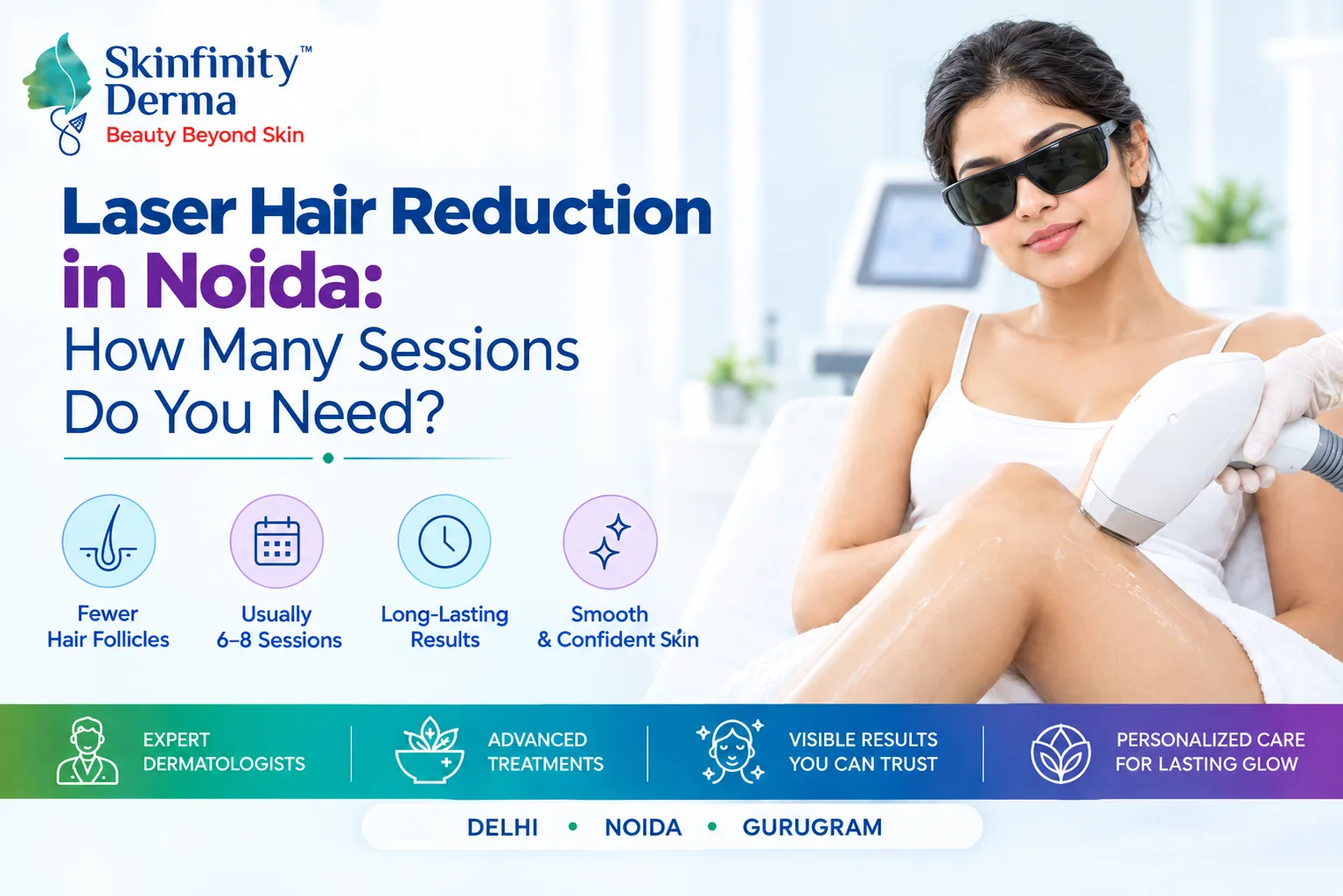
Most people need six to eight initial sessions. Facial hair may require eight to ten sessions or more. Hormonal conditions, hair thickness and treatment area can also affect the final number.
Anyone searching for the best laser hair reduction in Noida should look beyond low-priced packages. The laser technology, dermatologist’s experience and suitability for Indian skin directly influence safety and results.
Read on to understand how laser hair reduction works, why multiple sessions are needed and what to expect during treatment.
What Is Laser Hair Reduction?
Laser hair reduction is a medical procedure that uses concentrated light energy to target unwanted hair.
The pigment inside the hair absorbs the laser energy. This energy converts into heat and damages the hair follicle. The treated follicle then becomes less capable of producing thick hair.
Laser treatment works most effectively on dark and coarse hair. White, grey, blonde and very fine hair may respond poorly because they contain less target pigment.
Laser hair reduction should not be confused with electrolysis. Electrolysis treats individual follicles using an electrical current. Laser treatment can cover larger areas more quickly.
A laser hair reduction treatment in Noida may be performed on the face or body. The device and settings should be selected according to the patient’s skin tone, hair colour and treatment area.
How Many Laser Hair Reduction Sessions Do You Need?
Most patients need approximately six to eight initial sessions. Some may need fewer sessions, while others require ten or more. The expected number depends on the treatment area:
Book An Appointment
|
Treatment Area |
Common Initial Session Range |
|
Upper lip |
8–10 sessions |
|
Chin and jawline |
8–12 sessions |
|
Full face |
8–10 sessions |
|
Underarms |
6–8 sessions |
|
Arms |
6–8 sessions |
|
Legs |
6–8 sessions |
|
Bikini area |
6–8 sessions |
|
Back or chest |
6–10 sessions |
|
Full body |
6–8 sessions |
Why Does Laser Hair Reduction Require Multiple Sessions?
Hair does not grow continuously. Each follicle moves through a natural growth cycle.
The cycle includes:
-
Anagen: Active growth phase
-
Catagen: Transitional phase
-
Telogen: Resting and shedding phase
Laser treatment works most effectively during the anagen phase. Hair remains connected to the follicle during this stage. This allows heat to reach the growth structures more effectively.
Only a percentage of hair is actively growing during one session. Other follicles may be resting or transitioning. These follicles must be treated during later sessions when they enter active growth.
This explains why one session cannot provide complete reduction. Each session targets another group of growing hairs.
Sessions must also be separated by appropriate intervals. Treating the area too frequently does not force resting follicles to respond faster.
How Often Should You Have Laser Hair Reduction Sessions?
The interval depends on how quickly hair grows in the treatment area.
A general schedule may include:
-
Upper lip and face: Every four to six weeks
-
Underarms: Every four to six weeks
-
Bikini area: Every four to six weeks
-
Arms: Every six to eight weeks
-
Legs: Every six to eight weeks
-
Back and chest: Every six to eight weeks
Early sessions may be scheduled closer together. Later appointments may be spaced further apart because regrowth becomes slower.
Appointments should usually take place when new hair growth becomes visible. Treating completely hair-free skin too soon may provide little additional benefit.
Hormonal facial hair may continue developing even after a completed course. Maintenance sessions might be recommended every few months.
Which Areas Can Be Treated With Laser Hair Reduction?
Laser hair reduction can treat many facial and body areas.
Common treatment areas include:
-
Upper lip
-
Chin
-
Jawline
-
Sideburns
-
Full face
-
Neck
-
Underarms
-
Arms
-
Hands and fingers
-
Chest
-
Abdomen
-
Back
-
Bikini line
-
Brazilian area
-
Buttocks
-
Legs
-
Feet and toes
Laser energy should not be directed over the eyelids or extremely close to the eyes. Protective eyewear remains essential during facial treatment.
Tattoos should also be avoided during laser hair reduction. Hair-reduction lasers can react with tattoo pigment and cause burns or colour changes.
Suspicious moles or unusual skin lesions should be assessed before treatment. Lasers may alter the appearance of pigmented moles and make future monitoring more difficult.
Laser Hair Reduction for Indian Skin: Is It Safe?
Yes. Laser hair reduction can be performed safely on Indian skin when suitable technology and calibrated settings are used.
Indian skin contains more epidermal melanin than lighter skin. The surrounding skin may therefore absorb some laser energy intended for the hair. Excessive heat can cause burns or post-inflammatory pigmentation.
Long-pulsed Nd:YAG technology is commonly considered for darker skin tones. Its longer wavelength penetrates more deeply and interacts less with surface melanin. Diode lasers may also be used when settings and cooling are appropriate. Reviews identify long-pulsed diode and Nd:YAG systems as suitable options for darker skin.
Safety depends on:
-
Correct laser selection
-
Suitable energy settings
-
Adequate skin cooling
-
Hair and skin assessment
-
Avoiding recently tanned skin
-
Following preparation advice
-
Performing a test spot when required
-
Proper aftercare
-
Dermatologist supervision
Temporary redness and swelling around follicles can occur. Less common complications include burns, blistering and pigmentation changes.
Patients should avoid salons offering one standard setting for every skin tone.
What Results Can You Expect After Each Session?
Laser results develop gradually. Treated hair may remain visible immediately after the appointment. It usually begins shedding over the following days or weeks.
-
After the First Session
Some hair may shed and regrowth may feel slower. The area will not become completely hair-free.
-
After Two to Three Sessions
Hair may begin growing in uneven patches. Some strands can appear finer or lighter.
-
After Four to Six Sessions
The overall density may become noticeably lower. Shaving may be required less frequently.
-
After Six to Eight Sessions
Many patients experience a significant and long-lasting reduction. Remaining hair may be finer and less visible.
-
After the Initial Course
Maintenance may be needed if new hair develops. Facial and hormonal areas usually require more maintenance than the legs or underarms.
Individual results depend on the device, settings and biological response. Hair reduction should be assessed through consistent photographs and regrowth patterns.
Does Laser Hair reduction Permanently Remove Hair?
Laser treatment is more accurately described as permanent hair reduction rather than guaranteed permanent reduction.
Some treated follicles may stop producing hair for long periods. Other follicles may recover partially or begin producing finer strands.
New hair can also develop because of:
-
Hormonal changes
-
Pregnancy
-
Menopause
-
Polycystic ovary syndrome
-
Certain medicines
-
Age-related changes
-
Previously inactive follicles
The American Academy of Dermatology notes that laser results can be permanent on many body areas after an adequate treatment course. However, hormonal facial hair in women may regrow and require repeat treatment.
No ethical clinic should promise that every hair will disappear forever. The realistic goal is a substantial reduction in hair density, thickness and growth speed.
Factors That Affect the Number of Sessions You Need
Session requirements vary because every person’s hair-growth pattern is different.
-
Hair Colour
Dark hair absorbs laser energy more effectively. Grey, white and very light hair may show limited response.
-
Hair Thickness
Coarse hair usually responds better than very fine hair. Fine facial hair may require more sessions and careful settings.
-
Skin Tone
Darker skin requires suitable wavelengths and controlled energy. Conservative treatment may take more sessions but helps reduce avoidable complications.
-
Treatment Area
Underarm and bikini hair often responds well because it is coarse. Facial hair may be finer and more influenced by hormones.
-
Hormonal Conditions
Polycystic ovary syndrome and other hormonal conditions can stimulate facial hair growth. Laser can reduce existing hair but cannot correct the underlying hormonal trigger.
-
Treatment Consistency
Long gaps between appointments may delay progress. Sessions should follow the hair-growth cycle and dermatologist’s recommendation.
-
Previous Hair-reduction Methods
Waxing and plucking remove the hair from its follicle. The laser then has less pigment to target.
-
Laser Technology
A medical-grade laser differs from an intense pulsed light device. Results also depend on calibration, pulse duration and cooling.
-
Practitioner Experience
Correct settings require knowledge of skin tone, hair characteristics and laser-tissue interaction. Poor technique can reduce results or cause complications.
How to Prepare for Your Laser Hair Reduction Session
Correct preparation supports safer and more predictable treatment.
-
Avoid Waxing and Plucking
Avoid waxing, threading, tweezing or epilating the area prior to treatment. These techniques help eliminate the hair root that is required for laser targeting.
The clinic may recommend discontinuing these methods approximately four weeks before the appointment.
-
Shave When Advised
Shaving is a method that leaves the hair root within the follicle. Typically, the area to be treated is shaved prior to the treatment.
-
Avoid Tanning
Avoid deliberate tanning and excessive sun exposure. Recently tanned skin contains more active pigment and may be more susceptible to burns.
-
Use Sunscreen
Use a broad-spectrum sunscreen on treated areas that are exposed to the sun. This is especially true for the face, neck, arms and legs.
-
Review Skincare Products
Facial acids, retinoids and other irritating products may need to be avoided around the time of treatment. Do not discontinue prescribed medications without consulting your dermatologist.
-
Disclose Medicines and Medical Conditions
Inform the dermatologist about:
-
Hormonal treatment
-
Pregnancy
-
Previous laser reactions
-
Active infections
-
Cold sores
-
Keloid tendency
-
Recent procedures
-
Skin allergies
-
Polycystic ovary syndrome
-
Arrive With Clean Skin
Do not apply makeup, perfume, deodorant or body oils to the treatment area unless the clinic advises otherwise.
Who Is a Good Candidate for Laser Hair Reduction?
Laser hair reduction may suit adults who want a long-term reduction in unwanted facial or body hair.
Suitable candidates generally:
-
Have dark or coarse hair
-
Can attend multiple sessions
-
Have realistic expectations
-
Can avoid tanning
-
Can follow aftercare instructions
-
Do not have an active infection
-
Understand that maintenance may be required
Treatment may be less effective for people with white, grey or very blonde hair. Electrolysis may be discussed when laser treatment cannot target the hair effectively.
Laser treatment may need to be postponed during:
-
Pregnancy
-
Active skin infection
-
Open wounds
-
Sunburn
-
Recent tanning
-
Active herpes
-
Severe dermatitis
-
Use of certain photosensitising medicines
Laser hair reduction can reduce hair caused by hormonal conditions. However, medical treatment may also be needed to control continued growth.
Why Choose a Dermatologist for Laser Hair reduction in Noida?
Laser hair reduction is an energy-based medical procedure. The provider must understand both laser technology and the skin’s response to heat.
A dermatologist in Noida can assess:
-
Natural skin tone
-
Recent tanning
-
Hair colour
-
Hair thickness
-
Treatment area
-
Hormonal symptoms
-
Previous skin reactions
-
Active medical conditions
-
Pigmentation tendency
-
Current medicines
Dermatologist supervision becomes especially important for Indian skin. Incorrect settings can cause burns, post-inflammatory hyperpigmentation or lighter patches.
The best laser hair reduction in Noida should include:
-
Proper consultation
-
Medical history review
-
Suitable laser technology
-
Individualised settings
-
Protective eyewear
-
Skin cooling
-
Test spots when required
-
Clear aftercare
-
Progress assessment
-
Complication management
Choosing a clinic only because it advertises the lowest package price may compromise treatment quality. Patients should ask which device will be used and who will supervise the procedure.
How Many Sessions Are Needed for Facial Hair Reduction?
Facial hair reduction commonly requires eight to ten initial sessions. Chin and jawline hair may need ten to twelve sessions in some patients.
Facial hair can be more difficult to treat because it may be:
-
Fine
-
Closely spaced
-
Influenced by hormones
-
Affected by polycystic ovary syndrome
-
Stimulated by certain medicines
-
Frequently removed through threading or waxing
Upper-lip sessions are often scheduled every four to six weeks. The interval may increase as regrowth becomes slower.
Very fine facial hair requires careful assessment. Treating unsuitable fine hair with incorrect settings may occasionally stimulate thicker growth around the area. This is known as paradoxical hypertrichosis.
A dermatologist should assess the entire facial hair pattern before treatment. Hormonal evaluation may be recommended when facial hair increases suddenly or occurs with irregular periods, persistent acne or scalp thinning.
Why Choose SKINFINITY Derma for Laser Hair Reduction in Noida?
The best laser hair reduction in Noida should offer more than a standard package. Safe treatment requires the right technology, personalised settings and regular assessment throughout the treatment course.
At SKINFINITY Derma, we provide dermatologist-led laser hair reduction for different facial and body areas. We personalise each plan according to your skin tone, hair thickness, hair density and growth pattern.
-
Dermatologist-Led Assessment
We begin by examining your skin and hair before the first session. Our dermatologists review previous hair-reduction methods, pigmentation tendency and medical history.
We also ask about hormonal symptoms when facial hair appears unusually thick or grows rapidly. Conditions such as PCOS can affect the number of sessions and increase the need for maintenance.
-
Advanced Laser Technology
We use advanced laser technology such as Soprano Titanium for laser hair reduction. Its controlled energy delivery and cooling support a more comfortable treatment experience across different skin tones.
Our dermatologists adjust the settings according to your skin and hair characteristics. We do not use one standard setting for every patient.
-
Personalised Session Planning
Most patients require approximately six to eight sessions. These sessions are commonly spaced four to eight weeks apart. The exact schedule depends on the area and hair-growth cycle.
Facial or hormonally influenced hair may need additional sessions. We monitor your response after every appointment and modify the treatment plan when required.
-
Facial, Body and Full-Body Treatment Options
Our laser hair reduction treatment in Noida? is available for:
-
Upper lip
-
Chin and jawline
-
Full face
-
Underarms
-
Arms and legs
-
Chest and back
-
Bikini area
-
Full body
The duration of each appointment depends on the size of the treatment area. Small facial areas require less time than the legs, back or full body.
-
Clear Pre-Treatment and Aftercare Guidance
We explain how to prepare before every session. Patients are generally advised to avoid waxing, tweezing and epilating because these methods remove the hair root required for laser targeting.
Our team also provides aftercare guidance based on the treated area. This may include avoiding direct sunlight, intense workouts, hot showers and saunas temporarily.
-
Convenient Noida Location
Our Noida clinic is located in Sector 36 near Logix Mall. This location makes follow-up sessions easier for patients seeking dermatologist-supervised laser hair reduction in Noida and nearby areas.
SKINFINITY Derma states that it uses Soprano Titanium technology, offers facial and body treatments and typically plans six to eight sessions at four-to-eight-week intervals.
Explore our laser hair reduction services? or schedule a consultation to receive a personalised treatment plan.
Conclusion
Most patients need six to eight laser hair reduction sessions initially. Facial or hormonally influenced hair may require eight to twelve sessions and occasional maintenance.
The number alone does not determine success. Suitable laser technology, correct intervals and personalised settings remain equally important. Patients seeking the best laser hair reduction in Noida should choose dermatologist-led treatment designed for their skin tone, hair type and long-term goals.
FAQs
1. How Many Sessions Are Needed for Underarm Laser Hair Reduction?
Underarm laser hair reduction typically requires six to eight sessions. Coarse, dark underarm hair may respond well to treatment.
Some patients may require additional sessions depending on hair density, hormonal influences and treatment response.
2. How Often Should Laser Hair Reduction Sessions Be Done?
Facial and underarm treatments are typically performed every four to six weeks. Arms, legs, back and chest may be treated every six to eight weeks.
The dermatologist may increase the interval between sessions as hair regrowth slows.
3. Can I Wax Between Laser Hair Reduction Sessions?
No. Waxing, threading, plucking and epilating pull hair from the follicle. This leaves less pigment for the laser to target.
Shaving is usually allowed between sessions because it does not remove the hair root.
4. How Long Does It Take to See Results From Laser Hair Reduction?
Some people may notice hair shedding within a few weeks after their first treatment. Visible improvement usually appears after three to four sessions.
More significant improvement typically develops after completing the recommended course. Results vary according to the hair type, treatment area, hormonal factors and laser settings.

 Call Now
 WhatsApp