

Medically Reviewed by: Dr. Neha Dhankar
MBBS, MD (Dermatology, Venereology & Leprosy) | Skinfinity Derma Clinic
Read Time: 8 Minutes
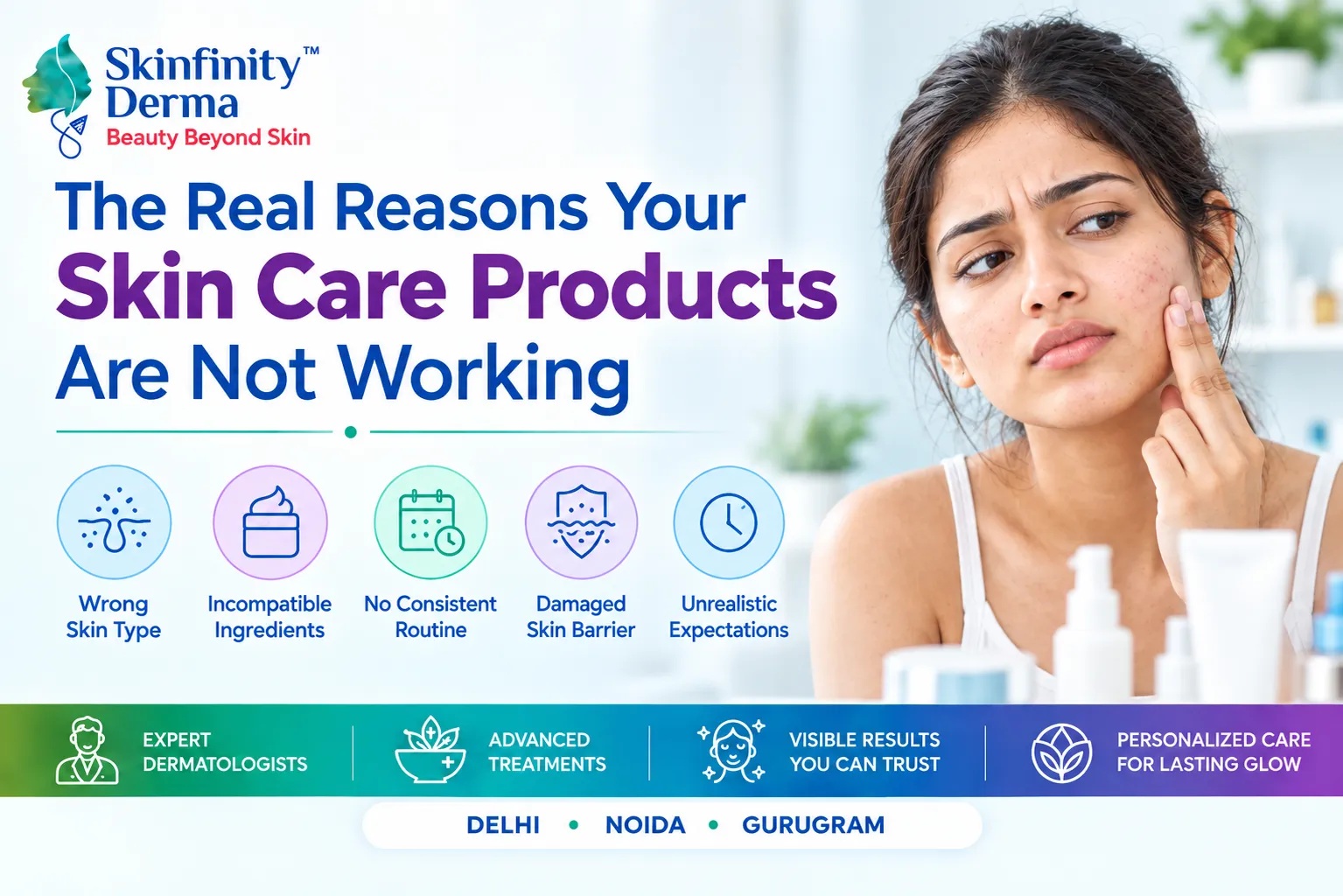
You have spent a small fortune on serums, moisturizers, and treatments that promised to give you glowing, blemish-free skin. Yet, weeks pass and your mirror tells a different story. If your skincare routine is not delivering results, you are not alone — and you are probably not using the wrong products. The truth is far more nuanced.
At Skinfinity Derma, we see patients every day who are frustrated, confused, and sometimes even harmed by well-intentioned skincare choices. In this comprehensive guide, our dermatology experts break down the real, evidence-backed reasons why your skin care products are not working — and what to do about it.
Book An Appointment
|
Important Fact: According to dermatology research, up to 60% of people use skincare products incorrectly — either in the wrong order, in wrong combinations, or without giving them adequate time to work. |
1. You Have Not Identified Your Actual Skin Type
Most of them choose their image type depending on a short internet-based quiz or advice from a friend — and they're often wrong. Your skin type is not only oily, dry or combination. It may be dry, irritated, pimpled or suffer from an undiagnosed condition such as rosacea, eczema or seborrheic dermatitis.
For oily skin, products are frequently made with alcohol-based toners and light gels which can dry out dry skin or skin that is sensitive. On the other hand, oily or acne-prone skin types should avoid using rich, occlusive moisturizers as they can clog pores and worsen acne outbreaks.
Active ingredients are the key to any good skincare regimen, as they are tailored to fit your skin type. It doesn't matter if the most expensive and well formulated products are used, unless it is available, it can cause more problems.
What to do:
Book a professional skin consultation at Skinfinity Derma. Our dermatologists perform clinical skin analysis to identify your precise skin type, underlying conditions, and sensitivities before recommending a customized skincare protocol.
2. You Are Not Layering Products in the Correct Order
Beauty blogger rumours beget skin science! Ingredients need to penetrate the surface of your skin in order for your skin to absorb them. When you apply a thick cream first, and then a light serum, the serum won't actually reach the deeper layers of your skin where it should be working.
The cardinal rule of layering is to start with the lightest consistency first and work up to the thickest consistency last. This helps to ensure that the product will be able to penetrate without being blocked by a thicker product applied in prior steps.
The correct morning skincare routine order:
• Cleanser (creates a clean base for absorption)
• Toner or essence (balances pH and preps skin)
• Serums — Vitamin C, niacinamide, hyaluronic acid (active ingredients in lightweight formulas)
• Eye cream (targeted treatment)
• Moisturizer (seals in moisture and actives)
• Sunscreen SPF 30+ (always last in the morning)
At night, after cleansing, apply treatments like retinol or prescription actives, then follow with a moisturizer. Applying heavier products too early in the sequence is one of the biggest — and most overlooked — reasons for skincare failure.
3. You Are Using Incompatible Ingredient Combinations
The skincare world has exploded with powerful active ingredients — retinoids, AHAs, BHAs, vitamin C, niacinamide, benzoyl peroxide. Used correctly, these ingredients are transformative. Used together incorrectly, they can neutralize each other or cause significant skin damage.
Common incompatible combinations to avoid:
• Retinoids + Benzoyl Peroxide: Benzoyl peroxide oxidizes and deactivates retinol molecules, rendering them ineffective. Use benzoyl peroxide in the morning and retinoids at night.
• Retinoids + AHAs/BHAs (Glycolic Acid, Salicylic Acid): Both exfoliate aggressively. Combining them can cause extreme dryness, peeling, redness, and a compromised skin barrier.
• Vitamin C + Niacinamide: Some research suggests they can counteract each other's brightening benefits. Use vitamin C in the morning and niacinamide in the evening for best results.
• Multiple exfoliants together: Over-exfoliation destroys the skin barrier, leads to chronic irritation, and paradoxically makes skin more prone to breakouts and sensitivity.
|
Expert Tip from Skinfinity Derma: Always introduce new active ingredients one at a time, spaced at least two weeks apart. This allows you to identify reactions and ensures your skin barrier remains intact. |
4. You Are Not Being Patient Enough
Today we live in a world for instant gratification and the beauty industry has jumped on this bandwagon with some claims of results that happen “overnight” and “visible changes in 7 days.” The reality? But, biology doesn't work like that in the skin.
It takes about 28 days for skin cells to turn over in young adults and 45-90 days as we get older. That means you will have to wait at least 4 to 12 weeks to know if a skin care product works or not. Products used for anti-ageing may not be effective until the person has been using them for 3 to 6 months.
One of the worst skin care habits you can have is changing products every 2-3 weeks. Not only does it inhibit a product from performing its function, it can also be an overload on the skin and cause irritation, acne and sensitivity.
5. Incorrect Product Storage Is Degrading Your Formulas
If you've ever had to replace skincare products you were using because they had expired, you've probably found they've been stored in the bathroom.Most people keep their skin care in the bathroom (which is the least stable place to store products). Steam, changing temperatures and humidity from hot water showers can actually degrade active ingredients in your products.
Vitamin C serums become orange-brown and oxidized when exposed to heat and light, which is an important indicator that they are no longer effective. Retinoids are heat- and UV-sensitive too. Sunscreens kept in hot vehicles or left at the windows may be ineffective in blocking the sun's UV rays and can irritate skin if used.
Best storage practices:
• Store vitamin C, retinoids, and peptides away from sunlight and heat
• Keep products in a cool, dry place — ideally in a dedicated skincare fridge
• Always check the Period After Opening (PAO) symbol on packaging
• Never use expired products — they can cause infections and skin reactions
6. You Are Using Over-the-Counter Products for a Medical Skin Condition
This may be the least talked about reason why skin care products don't work — and dermatologists are increasingly encountering it. Acne, hormonal acne, rosacea, perioral dermatitis, melasma and seborrheic dermatitis, are conditions that need medical grade treatment and not a topical over the counter serum.
For instance, salicylic acid is helpful for mild comedonal acne, but it is completely ineffective for cystic or hormone acne, which may require prescription treatment like oral antibiotics, spironolactone, tretinoin or isotretinoin. A skin care brightening serum from the store will not cure melasma at the source level, by eliminating the hormonal and/or UV sensitivity that causes it, and may actually make it worse if it contains the wrong ingredients.
Other conditions such as rosacea can also be confused with sensitive skin or oily skin. Any over-the-counter exfoliants or astringents sold to remove oils from skin can greatly aggravate rosacea, resulting in persistent redness, visible veins and inflammation.
If you haven't found any relief from the skin after using OTC products for several months, one of the best indicators is that it's time to go to a dermatologist. Skinfinity Derma is able to diagnose with accuracy chronic and complex skin conditions, and provide prescription strength treatments that are not available on a pharmacy counter.
7. You Are Skipping Sunscreen — And It Is Undoing Everything
Even the best skin care regimen can be undermined if you don't incorporate a good broad-spectrum sunscreen on a daily basis. UV is the #1 cause of premature skin ageing, hyperpigmentation, skin colour unevenness and collagen loss. It actively reverses the effects of anti-aging serums, brightening treatments and recovery post-procedure.
No matter what the season or weather, or what skin tone, broad-spectrum SPF 30+ sunscreen is the final ingredient in every morning skin care routine. The ultraviolet exposure can happen indoors, as UV rays can penetrate cloud cover and glass windows.
For anyone practicing vitamin C for brightening, anti-aging with retinoids and those who are adding any kind of AHA/BHA to exfoliate — sunscreen is a must. These treatments can make skin more sensitive to the sun's rays without it, and make them more likely to cause damage.
8. Lifestyle Factors Are Working Against Your Skin
Your skin care products are working with your body — not against it. Even the best topical products can be undermined by chronic sleep deprivation, a high-sugar diet, dehydration, smoking, unmanaged stress and hormonal imbalances.
The stress hormone (cortisol) directly stimulates sebaceous gland hyperactivity and inflammatory response, increasing acne and redness. Clinically, excess intake of processed food and dairy products has been associated with a worsening of acne. The skin's repair process, which happens mostly during the night, is interrupted. When skin doesn't seem to be getting better after following a regular skin care regimen, it might be time to look at lifestyle issues in addition to the product regimen.
Why Choose Skinfinity Derma? |
At Skinfinity Derma, we go beyond generic skincare advice. Every patient is unique, and we treat them that way. Here is what sets us apart:
Expert Dermatology Team: Our board-certified dermatologists and trained skin care specialists bring years of clinical experience and ongoing training in the latest dermatological advances.
Accurate Skin Diagnosis: We use advanced clinical assessments — not guesswork — to diagnose your precise skin type, condition, and underlying triggers before recommending any treatment.
Customized Treatment Plans: No two treatment plans at Skinfinity Derma are identical. We design a protocol built specifically around your skin's needs, lifestyle, and goals.
Medical-Grade Treatments: We offer prescription-strength solutions and advanced clinical treatments that are simply not available in a pharmacy or beauty store.
Holistic Approach: We treat the root cause, not just the symptom — addressing hormonal imbalances, nutritional factors, and lifestyle contributors alongside topical treatments.
Safe & Proven Technology: Every treatment we offer is evidence-based, clinically validated, and performed under strict safety protocols.
Treatments We Provide at Skinfinity Derma
We offer a comprehensive range of medical and aesthetic dermatology treatments to address every skin concern:
Medical Dermatology
• Acne Treatment & Management (including hormonal acne, cystic acne, and acne scarring)
• Rosacea Diagnosis & Treatment
• Eczema (Atopic Dermatitis) & Psoriasis Management
• Melasma & Hyperpigmentation Treatment
• Seborrheic Dermatitis & Fungal Skin Conditions
• Allergy Patch Testing & Sensitive Skin Evaluation
• Skin Tag, Mole & Lesion Removal
Advanced Aesthetic Treatments
• Medical-Grade Chemical Peels (AHA, BHA, TCA) for skin renewal and brightening
• Laser Skin Resurfacing for pigmentation, texture, and anti-aging
• Microneedling with Collagen Induction Therapy
• HydraFacial & Medical Facials
• Botox & Dermal Fillers for anti-aging and facial contouring
• PRP (Platelet-Rich Plasma) Therapy for hair loss and skin rejuvenation
• Carbon Laser Facial for deep cleansing and pore refinement
Prescription Skincare & Customized Protocols
• Tretinoin & Retinoid Therapy
• Prescription Brightening Protocols (for melasma and post-inflammatory hyperpigmentation)
• Custom-compounded topical formulations
• Dermatologist-curated homecare regimens with medical-grade products
|
Every treatment at Skinfinity Derma begins with a thorough consultation — because the right diagnosis is the foundation of the right treatment. We do not offer one-size-fits-all solutions. We offer yours. |
Frequently Asked Questions (FAQs)
Q: How long should I give a new skincare product before deciding it is not working?
Most dermatologists recommend using skincare products consistently for at least 4–8 weeks before expecting visible results. For concerns like acne, pigmentation, or anti-aging, treatments such as retinoids and brightening serums may take 8–12 weeks to show noticeable improvement, as the skin renewal cycle takes around 28 days. However, if you experience irritation, burning, or worsening within the first 2 weeks, stop using the product and consult the dermatologists at Skinfinity Derma.
Q: Can I use multiple active ingredients like retinol, vitamin C, and AHAs in the same routine?
Yes, but not all at once. Powerful actives like retinoids, vitamin C, and AHAs should be used strategically to avoid irritation or over-exfoliation. A simple rule: use vitamin C in the morning with SPF, and retinol at night. Introduce one active at a time, ideally two weeks apart. For a safe, personalized routine, consult the dermatologists at Skinfinity Derma.
Q: When should I see a dermatologist instead of continuing with over-the-counter products?
You should see a dermatologist if your skin concern hasn’t improved after 3 months of consistent OTC treatment, if products are causing persistent irritation, or if you suspect conditions like rosacea, eczema, psoriasis, melasma, or scar-forming acne. Sudden changes in pigmentation, texture, or new moles should also be evaluated professionally. The dermatologists at Skinfinity Derma can create a personalized treatment plan tailored to your skin concerns.

 Call Now
 WhatsApp