

Medically Reviewed by: Dr. Shradha Gumber
MBBS, MD - Dermatology , Venereology & Leprosy | Skinfinity Derma Clinic
Read Time: 8 Minutes
One of the most prevalent skin issues faced in India is pigmentation disorders. These can range from the effects of post-acne hyperpigmentation to tanning caused by the sun, persistent melasma, and congenital birthmarks, all of which can impact self-confidence and quality of life. So picking the right clinic with the right technology and qualified dermatologists isn't only a cosmetic choice; it's a health choice!
We know at Skinfinity Derma that everyone's skin tone and concern is different. This is why we provide the most sophisticated Q Switch laser treatments in Gurgaon to be customized to your unique pigmentation issues to give you a visible, precise, safe and effective treatment.
What Is Q Switch Laser Treatment?
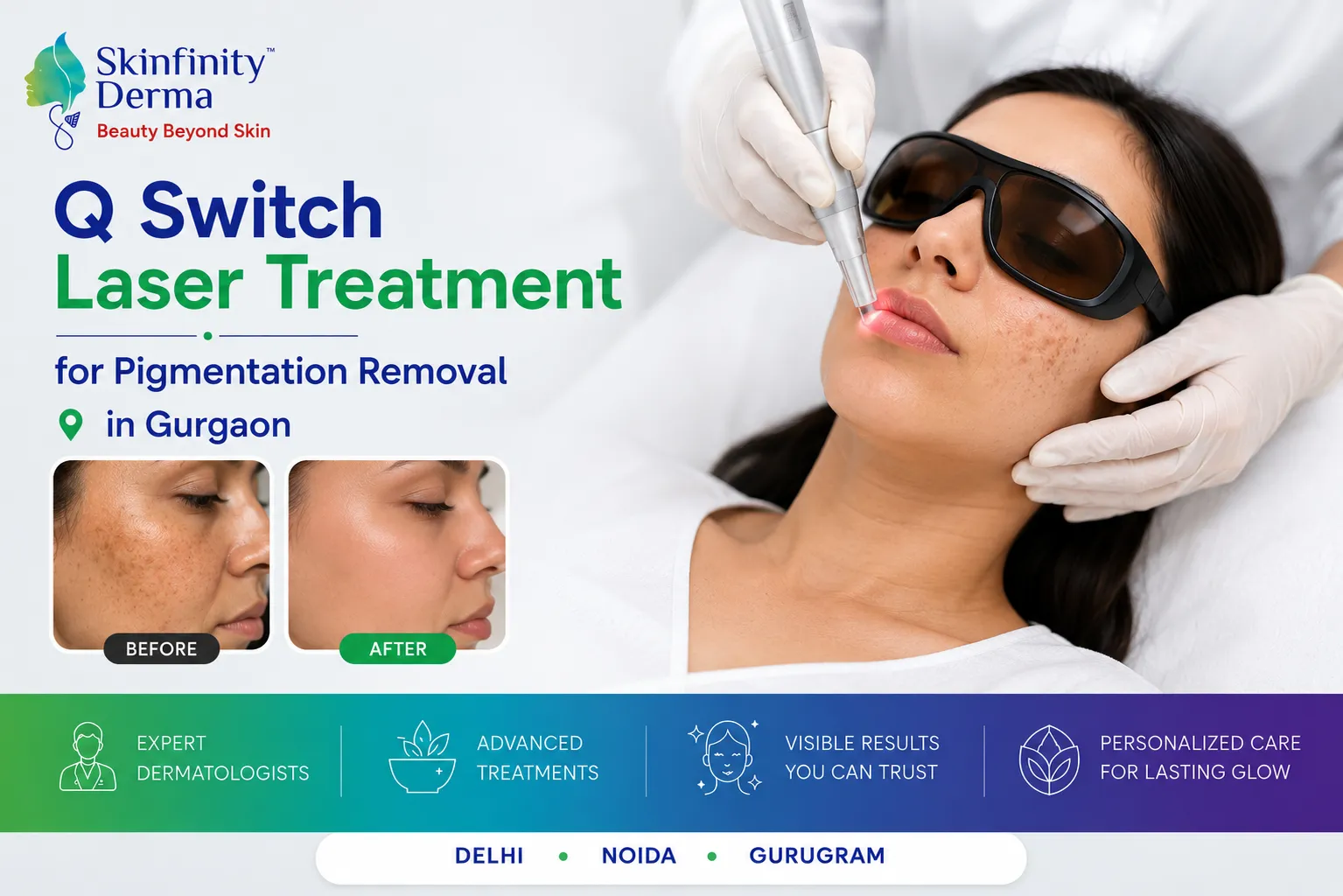
Q Switch laser - short for Quality-Switched laser - is a state-of-the-art, non-invasive technology that emits ultra-short bursts of high-intensity light energy in nanoseconds. These rapid pulses are selectively absorbed by melanin (the pigment responsible for dark spots) and ink particles, shattering them into microscopic fragments without causing harm to the surrounding skin tissue.
The body's immune system then naturally clears these fragments over the following days and weeks, resulting in progressively lighter, more even-toned skin. The treatment is non-ablative, meaning it does not remove the outer skin layer, which makes recovery faster and discomfort minimal.
How the Technology Works
• The laser emits energy at two key wavelengths: 1064 nm (targets deeper, darker pigmentation) and 532 nm (targets superficial, reddish-brown spots).
• The Q-switching mechanism stores energy and releases it in extremely brief pulses, achieving high peak power without excessive heat build-up.
• Selective photothermolysis ensures only the pigmented target cells are affected.
• The surrounding collagen network is stimulated, leading to improved skin texture and a subtle skin-tightening effect as a bonus.
Skin Conditions Treated with Q Switch Laser in Gurgaon
Our dermatologists use Q Switch laser to address a wide spectrum of pigmentation-related conditions. The table below summarises each condition along with the mechanism of action and typical session requirements:
Book An Appointment
|
Condition |
How Q Switch Helps |
Expected Sessions |
|
Melasma |
Breaks down deep melanin clusters without damaging skin barrier |
6-10 sessions |
|
Sun Tan & Tanning |
Shatters surface melanin deposits caused by UV exposure |
3-6 sessions |
|
Post-Acne Marks |
Reduces red and brown PIH marks left after acne heals |
4-8 sessions |
|
Freckles |
Selectively destroys clustered melanin in freckle spots |
3-5 sessions |
|
Birthmarks / Nevus |
Gradually lightens congenital pigmented lesions safely |
8-15 sessions |
|
Tattoo Removal |
Fragments ink particles for lymphatic clearance |
6-12 sessions |
It is important to note that individual results vary based on depth of pigmentation, skin type, lifestyle, and sun exposure habits. Our dermatologists will give you a realistic, personalised timeline during your initial consultation.
Q Switch Laser vs Other Pigmentation Treatments
With so many pigmentation removal options available today, it can be difficult to know which treatment is right for you. Here is a clear comparison of Q Switch laser against other commonly used treatments:
|
Feature |
Q Switch Laser |
Chemical Peel |
IPL / Broadband |
|
Precision |
Very High |
Moderate |
Moderate |
|
Downtime |
Minimal (1-3 days) |
3-7 days |
2-5 days |
|
Skin Types Suitable |
All (I-VI) |
I-IV only |
I-IV only |
|
Sessions Required |
4-8 sessions |
3-6 sessions |
5-10 sessions |
|
Treats Tattoo Ink |
Yes |
No |
Partially |
|
Melasma Treatment |
Yes (specialised) |
Limited |
Limited |
|
Safety for Indian Skin |
Excellent |
Moderate |
Lower |
As this comparison highlights, Q Switch laser stands out for its ability to treat all skin types safely - a critical advantage for patients with darker Indian skin tones, who face a higher risk of post-inflammatory hyperpigmentation (PIH) with other procedures when not performed carefully.
What to Expect During Your Q Switch Laser Session at Skinfinity Derma
Step 1: Consultation and Skin Assessment
Your journey begins with a comprehensive consultation with one of our board-certified dermatologists. We use dermatoscopy and detailed skin mapping to assess the nature, depth, and distribution of your pigmentation. A customised treatment plan is then created — including wavelength selection, energy settings, and session intervals.
Step 2: Pre-Treatment Preparation
Prior to the session, the target area is thoroughly cleansed. A topical numbing cream may be applied for sensitive areas or patients with a lower pain threshold. Protective eyewear is placed over the eyes as a standard safety protocol.
Step 3: The Laser Session
The handpiece is glided over the treatment area, delivering controlled laser pulses. Most patients describe the sensation as a mild snapping or warm tingling feeling. A typical session for the face lasts between 20 to 40 minutes. There is no need for anaesthesia in most cases.
Step 4: Immediate Post-Treatment Care
• A soothing gel or cool compress is applied to calm the skin.
• Mild redness and warmth are normal and typically subside within a few hours.
• SPF 50+ sunscreen must be applied immediately after treatment and continued rigorously.
• Avoid sun exposure, steam, and swimming pools for at least 48-72 hours.
Step 5: Follow-Up and Maintenance
Sessions are usually spaced 3 to 4 weeks apart to allow the skin to complete its natural regeneration cycle. Most patients begin noticing visible improvement after the second or third session. Our team provides personalised post-care instructions and a medical-grade skincare regimen to maintain and enhance your results.
Why Skinfinity Derma Is the Best Q Switch Laser Clinic in Gurgaon
Choosing a clinic for laser treatment is not a decision to take lightly. At Skinfinity Derma, we have built our reputation on clinical excellence, patient safety, and measurable outcomes. Here is what makes us different:
|
Our Advantage |
Details |
|
Board-Certified Dermatologists |
Every treatment plan is designed and supervised by qualified skin specialists with years of laser expertise. |
|
Advanced Q Switch Technology |
We use US-FDA approved Q Switch Nd:YAG lasers with dual wavelengths (532 nm & 1064 nm) for precise targeting. |
|
Customised Protocols |
No two skin concerns are alike. We tailor energy levels, intervals, and number of sessions to your unique skin profile. |
|
Safe for Indian Skin Tones |
Our team has extensive experience with Fitzpatrick Type IV-VI skin, reducing hyperpigmentation risk post-treatment. |
|
Transparent Pricing |
No hidden charges. Full cost breakdown provided during consultation so you can plan with clarity. |
|
Post-Treatment Support |
Dedicated follow-up care and personalised skincare routines to protect your results long-term. |
Is Q Switch Laser Safe for Indian Skin?
This is one of the most important questions we receive from patients. The short answer is: yes, absolutely — when performed by trained professionals using the correct parameters.
Indian skin tends to fall in the Fitzpatrick Type III-V range, which means it produces more melanin and is more prone to post-inflammatory hyperpigmentation if treated aggressively. Our dermatologists at Skinfinity Derma are highly experienced in designing protocols specifically for Indian skin tones, using conservative energy settings and appropriate cooling techniques to minimise any risk.
Unlike at-home devices or unregulated aesthetic parlours, laser treatments at Skinfinity Derma are always performed or directly supervised by qualified dermatologists — ensuring your safety at every step.
Pre and Post-Treatment Care Tips
Before Your Session
• Avoid direct sun exposure and use SPF 30 or higher for at least two weeks prior to treatment.
• Discontinue use of retinoids, AHAs, BHAs, and bleaching agents 5-7 days before the session.
• Stay well hydrated and inform your doctor of any ongoing medications or recent skin treatments.
• Do not undergo waxing or threading on the treatment area within one week of the session.
After Your Session
• Apply the prescribed soothing moisturiser and SPF 50 sunscreen diligently every morning.
• Avoid picking at any darkening or crusting of treated spots — this is a natural part of the healing process.
• Stay away from hot showers, saunas, and vigorous exercise for 24-48 hours post-treatment.
• Wear a broad-brimmed hat or use an umbrella when stepping outdoors during the treatment course.
Typical Result Timeline
Patient outcomes at Skinfinity Derma speak for themselves. While individual responses vary, the following represents a typical progression observed across our patient base:
• After Session 1: Treated spots may temporarily appear darker before lightening — a process known as 'darkening before clearing.' Skin begins natural shedding.
• After Session 2-3: Noticeable lightening of superficial pigmentation. Skin texture begins to improve and pores appear refined.
• After Session 4-6: Significant reduction in darker patches, freckles, and post-acne marks. Complexion looks more even and radiant.
• After Session 6-10: Near-complete clearance for most pigmentation types. Collagen remodelling contributes to firmer, healthier-looking skin.
Results are maintained with proper sun protection and a prescribed skincare routine. Annual maintenance sessions may be recommended depending on your skin condition and lifestyle.
Book Your Consultation at Skinfinity Derma Today
If you have been searching for the best Q Switch laser treatment clinic near you for pigmentation removal, your search ends here. At Skinfinity Derma, we combine medical expertise with cutting-edge laser technology to deliver results you can see and feel — safely and sustainably.
Our team of board-certified dermatologists in Gurgaon is ready to evaluate your skin, answer your questions, and create a treatment plan that works for your unique concerns and lifestyle.
Visit us at www.skinfinityderma.com to book your consultation, or walk into our clinic to speak with a skin specialist. Clearer, brighter, more confident skin is closer than you think.
Frequently Asked Questions (FAQs)
Q1. How many Q Switch laser sessions will I need for complete pigmentation removal?
The number of sessions required depends on the type, depth, and extent of your pigmentation, as well as your skin type and lifestyle. Most patients with common concerns like sun tanning or post-acne marks see significant improvement within 4 to 8 sessions, while deeper conditions such as melasma or birthmarks may require 8 to 15 sessions. During your initial consultation at Skinfinity Derma, our dermatologist will provide a personalised estimate based on a thorough assessment of your skin.
Q2. Is the Q Switch laser treatment painful, and is there any downtime?
The procedure is generally well-tolerated. Most patients describe the sensation as a mild snapping or warm tingling, similar to the flick of a rubber band. A topical numbing cream can be applied beforehand for those with greater sensitivity. Downtime is minimal — you may experience redness and mild warmth for a few hours, and treated spots may temporarily darken before flaking off naturally over 5 to 7 days. You can typically resume daily activities immediately after the session, making it a convenient treatment for working professionals.
Q3. Will the pigmentation come back after Q Switch laser treatment?
Q Switch laser permanently destroys the targeted melanin clusters at the time of treatment. However, pigmentation can recur if the underlying triggers — such as unprotected sun exposure, hormonal fluctuations, or ongoing use of pigmentation-causing medications — are not addressed. At Skinfinity Derma, we design a comprehensive aftercare programme that includes medical-grade sun protection, prescription skincare, and dietary guidance to significantly reduce the chances of recurrence. Maintenance sessions may be recommended once or twice a year as a preventive measure, especially for conditions like melasma.

 Call Now
 WhatsApp