

Medically Reviewed by: Dr. Dharmesh Kumar
MBBS, MD (Dermatology, Venereology, and Leprosy) | Skinfinity Derma Clinic
Read Time: 8 Minutes
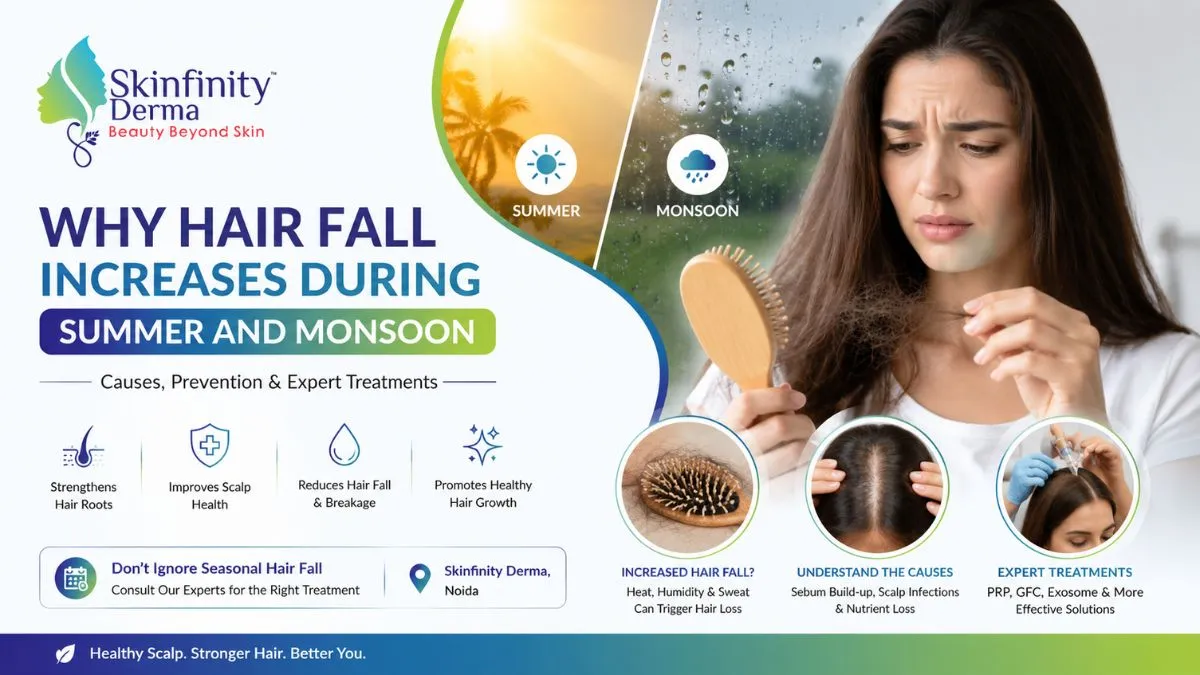
Why Hair Fall Increases During Summer and Monsoon
The Science, the Seasons, and the Solutions — A Dermatologist's Complete Guide
Each year, in May and July, millions of people in India open up their shower drains to discover a horrifying quantity of hair staring back at them. Hairbrushes fill up quicker. A pillowcase holds more strands than a 2-pocket bag. Ponytails feel thinner. The whole flow of patients comes to dermatology clinics with the same urgent question; "Is my hair falling out forever?"
The simple answer: no. The longer and more important answer is, however, that seasonal loss of hair is a phenomenon that is actually documented and scientifically proven to happen, and needs to be understood not ignored, especially during the harsh Indian summer and the rainy season during the monsoons. While most shedding problems go away in time, if left untreated they can escalate into a serious problem.
Every summer and monsoon season, hundreds of patients come to Skinfinity Derma for hair fall treatment in Noida. Our dermatologists explain why these are the two seasons when you are more likely to experience increased hair loss, what's going on inside your scalp, and — most importantly — what you can do to fix it.
Did You Know? Dermatological research has found a consistent seasonal increase in hair shedding between July and October — a period that directly overlaps with India's monsoon season. Some patients lose up to 250 strands per day during peak shedding, compared to the normal 50–100 strands daily.
Summer Hair Fall — The Hidden Damage of Heat and UV
1. UV Radiation Weakens the Hair Shaft
The Indian summer is associated with a regular occurrence of levels of UV Index up to 8 to 11+ in most parts of the country, which is considered as 'Very High' to 'Extreme' by WHO. Most people believe that the only thing UV protection is for is skin. The truth is that UV exposure over time will break down the protein structure of your hair shaft, which will tear apart the bonds of keratin and will decrease the protective layer of the cuticle of each strand.
Damaged hair is brittle, porous and prone to breakage, especially at the mid-shaft and hair ends. This type of hair loss would not have a cause of follicle damage, it would be structural breakage. However, the difference is in how the hair looks after you are done, with the hair being thinner and weaker, and more falling out when you wash and comb your hair.
2. Heat Stress and Telogen Effluvium — Summer's Silent Trigger
This is where the science really gets interesting. High ambient temperatures, during summer, are known to be a physiological stressor. Under severe stress (thermal or nonthermal) the body can experience a condition known as Telogen Effluvium (TE).
Normally, about 85% to 90% of scalp's hair follicles are in the anagen (growth) phase at any one time, while 10% to 15% of the follicles are in the resting/telogen phase (shedding phase). If a stressor such as severe heat is applied to the body, more follicles enter the telogen phase at once. After 3-4 months, those follicles resting on the scalp all shed their hair simultaneously resulting in sudden and dramatic hair loss.
Important: If you notice heavy hair fall in June or July, your trigger likely occurred back in March or April — during the peak of pre-monsoon heat. This delayed onset is one of the most misunderstood aspects of seasonal hair loss, and it is why patients often panic, believing something has suddenly gone very wrong.
3. Scalp Sweat, Product Buildup, and Follicle Clogging
India's summer months mean a constantly sweating scalp. Over production of sweat combined with the natural oils of the scalp (sebum), forms a barrier that blocks the hair follicles, increases the pH of the scalp (should be between 4.5 and 5.5), and provides an ideal environment for the ability of bacteria to over grow and cause inflammation.
When the scalp is chronically stressed, it is unable to maintain healthy hair growth. If left untreated, follicles begin to weaken at the base over time, and the hair becomes thinner, shorter and weaker with each subsequent cycle. Proper and frequent hair washing is therefore not only a hygienic hair care measure during the summer season, but also a medically important hair maintenance measure.
4. Dehydration and Nutritional Depletion
During the summer months, it's easy to lose a lot of fluid through sweating, and many people are under-hydrated all summer. Blood flow is essential for nourishing hair follicles with micronutrients, protein and oxygen for their healthy growth. Dryness of the blood decreases blood volume and hinders the delivery system.
Moreover, dietary patterns in summer in India may also change towards lighter and less protein rich foods. All the essential minerals for the growth of the hair cycle, such as Iron, Zinc, Biotin and Vitamin D, are depleted, especially in women. There are clinical studies that confirm that iron deficiency is one of the most common causes of telogen effluvium in the Indian women as the diet changes during summer, it can adversely affect the existing nutritional deficiencies.
Monsoon Hair Fall — When Humidity Becomes the Enemy
5. High Humidity Weakens Hair Roots
So when the monsoon comes it's like a breath of fresh air: cooler weather, a drenching of rain, and a reprieve from all that heat. However, with high humidity for your scalp and hair, all of these issues are different. When too much water evaporates into the air, each hair shaft takes up water, expands, and weakens. Failing shafts are easily brittle and are very prone to breaking at the root even from normal combing and styling.
At the same time, the hair follicles weaken in a constantly wet environment. Many patients will experience an increased rate of hair loss during the monsoon, as the humidity impacts on both the hair shaft and the root of the hair. Dermatologists say that typically, people lose between 50 and 100 strands a day, but this can be doubled during the monsoon season.
6. Fungal Infections and Seborrheic Dermatitis
Scalp fungi thrive when the skin is warm and moist, especially Malassezia furfur, which is the cause of dandruff and seborrheic dermatitis. In the monsoon season, Malassezia grows rapidly on the naturally oily scalp, causing inflammation, excessive itching, peeling and imbalance of the scalp's microbes.
Emotional stress may cause a patient to scratch an itchy, inflamed scalp repeatedly, which may worsen the damage to the sensitive hair follicles and promote hair loss. If left untreated, these fungal infections can lead to folliculitis (follicle infection), which can result in permanent damage to the follicles if not controlled.
7. Rainwater Contamination and Chemical Damage
Rainwater in an urban Indian is not as pure as our grandparents would imagine. It transports atmospheric dissolved air pollutants, particulates, sulphur dioxide, nitrogen oxides and other industrial pollutants which have been deposited into the atmosphere. This polluted water is slightly acidic and in prolonged contact with the skin and hair removes the acid mantle which protects the skin.
Polluted rainfall will do damage to the scalp's pH, remove natural oils, induce cuticle damage and micro-inflammation at the scalp level, all of which play a significant role in hair fall during the monsoons.
8. Post-Summer Telogen Effluvium: The Double Hit
This is something patients often don't anticipate: The heat stress-induced hair loss doesn't always occur in the summer months. The mass shedding from the body's heat-stress response is usually strongest in April and May, which is the onset of the monsoon (typically July and August). This makes for a double whammy of monsoon specific factors that cause hair fall (humidity, fungal growth, rainwater damage) along with delayed TE due to summer heat.
This is why monsoon hair fall might appear so acutely troublesome when contrasted to either of the seasons - because for a lot of people it is.
Clinical Insight: A study published in the Indian Journal of Dermatology, Venereology and Leprology noted that researchers found an increased frequency of telogen effluvium between July and October, proposing a possible 'actinic effluvium' — a summer UV effect that manifests as shedding in the monsoon months. This directly mirrors what our dermatologists observe at Skinfinity Derma every year.
What You Can Actually Do About It
Understanding why your hair falls is the first step. Acting on that understanding is the second. Here are dermatologist-approved strategies for managing seasonal hair fall:
For Summer:
- Cover your hair with a scarf, hat, or UV-protective serum when stepping outdoors to shield against UV radiation.
- Wash your scalp 2–3 times per week with a mild, sulphate-free shampoo to prevent sweat and sebum buildup.
- Stay well-hydrated — at least 2.5–3 litres of water daily — to support scalp blood circulation.
- Increase dietary intake of protein (eggs, lentils, fish), iron (spinach, dates, rajma), and zinc (pumpkin seeds, nuts) or discuss supplementation with your dermatologist.
- Avoid heat styling tools during the summer months; let hair air-dry whenever possible.
For Monsoon:
- Dry your hair thoroughly after exposure to rain — never tie wet hair, as this creates a warm, moist environment for fungal growth at the scalp.
- Use an antifungal or medicated shampoo (ketoconazole or zinc pyrithione-based) twice weekly if you are prone to dandruff.
- Cover your hair when going out in rain to minimize contact with contaminated rainwater.
- Rinse hair with clean water immediately after getting wet in the rain.
- Avoid leaving hair products on overnight during humid months — residue buildup is significantly worse in high humidity.
Year-Round:
- Scalp massage with dermatologist-approved oils (like diluted castor or Bhringraj oil) improves blood circulation and strengthens roots.
- Manage stress actively — cortisol is one of the most potent disruptors of the hair growth cycle.
- Get annual blood work done for haemoglobin, ferritin, thyroid function, and Vitamin D levels — these are the most common correctable causes of chronic hair fall in India.
Why Choose Skinfinity Derma for Seasonal Hair Fall?
There are many places to seek help for hair fall. Here is why patients across the region consistently trust Skinfinity Derma with their scalp health:
Board-Certified Dermatologists — Not Generalists
Seasonal hair fall sounds simple, but diagnosing its precise cause — and ruling out androgenetic alopecia, thyroid disorders, or autoimmune conditions — requires specialized expertise. At Skinfinity Derma, every hair fall consultation is conducted by a board-certified dermatologist trained in trichology. We do not guess. We diagnose.
Advanced Trichoscopy & Diagnostic Testing
We use trichoscopy — a non-invasive dermoscopic examination of the scalp and hair follicles — to assess follicle health, miniaturization patterns, and scalp inflammation at the microscopic level. Combined with targeted blood panels (ferritin, thyroid profile, hormonal workup), this gives us the complete clinical picture needed to design an effective treatment plan.
Clinically Proven Treatments Under One Roof
From medicated scalp treatments and PRP (Platelet-Rich Plasma) hair therapy — which stimulates dormant follicles using your body's own growth factors — to low-level laser therapy (LLLT), GFC (Growth Factor Concentrate) treatments, and prescription-grade topicals, Skinfinity Derma offers the full spectrum of evidence-based hair restoration solutions.
Customized for Indian Scalp Types & Climates
We understand that a treatment protocol designed for European skin in a temperate climate needs significant modification for the Indian scalp in a tropical one. Our seasonal hair care protocols are specifically calibrated for Indian scalp physiology, humidity levels, and the unique stressors of our environment.
Transparent, Honest Consultations
We will always tell you the truth — including when hair fall does not require treatment beyond lifestyle modification. Our goal is your hair health, not repeat visits. If a problem can be solved with dietary correction and a good shampoo, we will say so. If it requires medical intervention, we will explain exactly why, what to expect, and what the results will realistically look like.
Post-Treatment Monitoring & Follow-Up
Hair restoration is a process, not an event. Skinfinity Derma provides scheduled follow-up consultations, trichoscopic progress assessments, and ongoing nutritional and lifestyle guidance to ensure your results are sustained beyond the treatment phase.
The Final Word: Don't Wait Until It's Chronic
Seasonal hair fall is common, but common does not mean it should be ignored. For many patients, the summer-to-monsoon cycle represents a perfect storm of UV damage, heat stress, humidity, fungal growth, and nutritional depletion — all converging on vulnerable scalp follicles over a three-to-five-month window.
The good news: when caught and addressed early, seasonal hair fall is almost always fully reversible. The risk lies in normalizing it until underlying issues like androgenetic alopecia, chronic telogen effluvium, or scalp infections have progressed beyond the point of easy recovery.
If you are finding more hair in your brush, your shower drain, or your pillow than usual — and it has been going on for more than four weeks — that is your signal to book a consultation. Don't wait for thinning to become visible. Your scalp will thank you.
Book your hair fall consultation at Skinfinity Derma today.
Frequently Asked Questions (FAQs)
FAQ 1: Is it normal to lose more hair during summer and monsoon? When should I be worried?
Yes, seasonal hair shedding is very common, especially during certain times of the year. Losing slightly more hair than usual for a few weeks is generally normal and temporary. However, if hair fall continues beyond 8–10 weeks, you notice visible thinning, patchy hair loss, scalp irritation, or symptoms like fatigue and hormonal changes, it’s best to consult a dermatologist. At Skinfinity Derma, we use advanced scalp analysis and diagnostic tests to identify the exact cause and recommend the right treatment.
FAQ 2: What professional treatments does Skinfinity Derma offer for seasonal hair fall?
At Skinfinity Derma, hair fall treatments are customized based on the root cause and severity of your condition. Depending on your diagnosis, dermatologists may recommend PRP or GFC therapy to stimulate hair growth, scalp mesotherapy to nourish follicles, Low-Level Laser Therapy (LLLT) to improve scalp circulation, or prescription-based scalp treatments for concerns like dandruff, inflammation, or thinning. Every treatment plan is personalized to deliver safe, effective, and long-term results.
FAQ 3: Can seasonal hair fall lead to permanent baldness if not treated?
In most cases, seasonal hair fall is temporary and fully reversible, with regrowth usually starting within a few months. However, persistent shedding can sometimes hide underlying conditions like pattern hair loss, scalp infections, or nutritional deficiencies that may lead to long-term thinning if left untreated. That’s why an early dermatologist evaluation is important. At Skinfinity Derma, we identify the exact cause of hair fall and create a personalized treatment plan to protect and restore your hair health.

 Call Now
 WhatsApp