

Medically Reviewed by: Dr. Ipshita Johri
MBBS, DDV | Skinfinity Derma Clinic
Read Time: 8 Minutes
The Skincare Conversation Has Officially Shifted
If you look through your social media timeline for five minutes, you'll see the words, skin barrier repair everywhere. Dermatologists are talking about it. Content being created around it by beauty influencers. Beauty companies are re-inventing themselves around it. Thanks to it, and it helped millions of people with red, reactive, and always dry skin get answers.
This isn't simply the latest fashion craze in skin care. Skin barrier repair has become the number one shift in thinking about skin health — and the numbers support this. So far, the #skinbarrier hashtag has garnered more than 302 million views on TikTok alone, and Google searches of “barrier repair skincare” and similar phrases are at an all-time high. This discussion is overdue and at Skinfinity Derma, we feel the need to initiate it. Let's take a look at all the elements you need to know.
What Exactly Is the Skin Barrier?
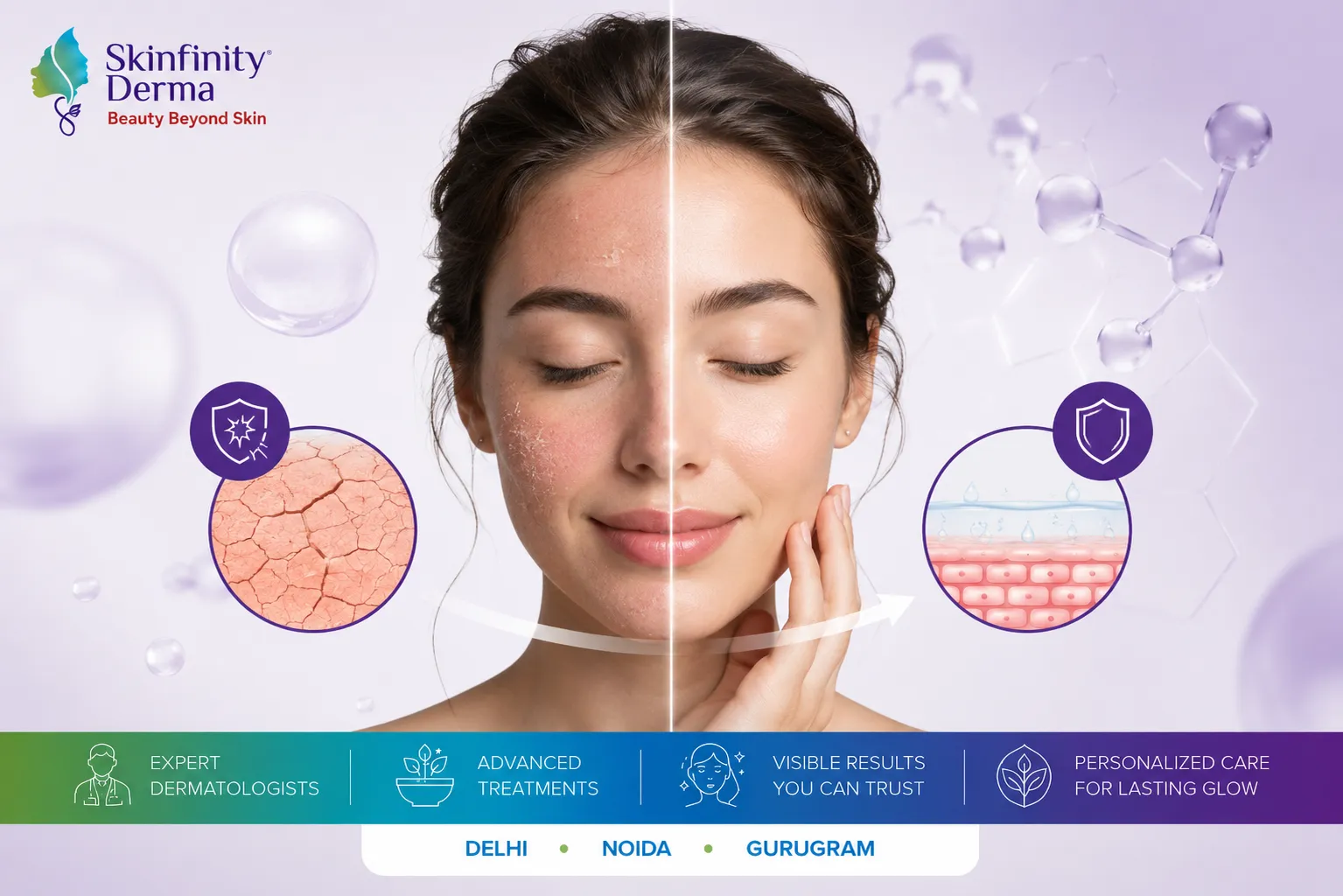
Let's first understand the basics before going into why it's damaged, and how to fix it. The stratum corneum (or outer layer) is the surface layer of skin. Just like a brick wall, your skin cells are the brick, a combination of natural fats (lipids), ceramides and cholesterol is the mortar that binds them together.
This amazing structure has 3 important functions: It keeps moisture in your skin to keep it hydrated, it prevents environmental aggressions such as pollution, UV rays, and bacteria from entering the skin, and it blocks irritants and allergens from reaching deeper layers of skin. If you have a barrier that's working properly, you'll have a smooth, full, radiant complexion. When it is compromised, the results are anything but.
“A damaged skin barrier is like a crumbling wall — moisture escapes freely, irritants walk right in, and no amount of expensive serums can fix what is structurally broken underneath.”
Is Your Skin Barrier Damaged? Watch for These Signs
Millions of people are living with a compromised skin barrier without knowing it. They blame their products, their climate, their genetics — when the real culprit is often the state of their outermost protective layer. Here are the tell-tale warning signs:
? Persistent redness or flushing that worsens with skincare products
? Skin that feels tight or dry despite moisturising daily
? Stinging or burning sensation from previously well-tolerated products
? Unexplained increase in breakouts and pore congestion
? Flaking, peeling, or rough texture patches on the skin
? Shiny or “waxy” skin appearance without any glow
? Extreme sensitivity to sunlight, wind, or temperature changes
? Overproduction of oil as skin tries to compensate for dryness
If you recognise three or more of these symptoms, there is a strong chance your moisture barrier has been compromised — and your existing skincare routine may be making it worse, not better.
Why the Skin Barrier Gets Damaged: The Modern Skincare Paradox
The bad news is that a lot of people have really harmed their skin barriers in the pursuit of better skin. Many of the things we do to achieve that coveted glass skin also contribute to barrier disruption, like the double cleansing, acids, retinols, exfoliating brushes, etc.
One of the top reasons is over-exfoliation. Exfoliating too often or with products that are too harsh on your skin can remove lipids, disturb the skin's microbiome, and create a problem for your skin. This causes inflammation, trans epidermal water loss (TEWL) and hindered healing. A shocking 68% of patients dermatologists have seen are harming their skin barrier with wrong techniques for exfoliation, according to dermatology specialists.
Other culprits of the modern day include: harsh sulphate-based cleansers that deplete natural oils, adding too many active ingredients at once (such as retinol, AHA, vitamin C is a common mistake!), not using an SPF, environmental factors such as pollution and extreme weather and fragrance in any skincare product which causes chronic inflammation.
“Many people mistake barrier damage for skin “purging” and respond by exfoliating even more aggressively — worsening the cycle dramatically. This is one of the most misunderstood patterns in skincare today.”
The rise of 10-step skincare routines, while well-intentioned, created a generation of over-treated skin. Consumers are now experiencing the consequences — and they are demanding smarter, gentler solutions.
Why This Trend Is Different — and Here to Stay
Products, diets, and beauty routines pass in and out: snail mucin, jade rollers, 12-step routines. But the skin barrier repair trend is so different, as it's not a trend in the first place, it's just a return to the basics of dermatology.
It has been a decades-long campaign by the industry to promote the notion of more equal to more – more acids, more actives, more steps, more products. The result? A worldwide condition where skin is sensitised, reactive and inflamed. The shift to barrier repair is a collective realization that healthy skin isn't something that can be forced, it's something that can be cared for.
This is a lasting trend, as confirmed by market data. Ingredients innovation, AI personalised skin care, and the increasing demand for evidence-based formulations will be responsible for the expected growth of barrier-focused skin care products, which are expected to grow at 5–7?GR. This is also being driven by the growing preference for fewer steps, with 63% saying they prefer products that do more with less — a preference for multi-functional products that are doing more with fewer steps.
The Power Ingredients Behind Skin Barrier Repair
When it comes to the best ingredients for skin barrier repair, dermatologists consistently point to a core group of actives that work in harmony with your skin rather than against it:
Book An Appointment
|
Ceramides Lipid molecules that replenish the skin’s natural mortar, restoring structural integrity and reducing transepidermal moisture loss. |
Hyaluronic Acid A powerful humectant that draws moisture into the skin, improving elasticity and maintaining optimal hydration levels. |
Niacinamide Reduces inflammation, visibly improves moisture retention, and strengthens the barrier over time — suitable for all skin types. |
|
Centella Asiatica A botanical powerhouse that calms redness, accelerates skin healing, and supports long-term barrier resilience. |
Peptides Signal proteins that instruct the skin to repair damage, increase structural resilience, and rebuild collagen — ideal for mature skin. |
Squalane A lightweight emollient that closely mimics skin’s own natural oils, providing deep non-greasy hydration without clogging pores. |
At Skinfinity Derma, we always recommend patch testing new actives and introducing barrier-repairing ingredients gradually — especially if your skin is currently reactive or compromised.
A Dermatologist-Approved Barrier Repair Routine
Repairing your skin barrier is less about buying new products and more about simplifying and restructuring what you already do. Here is a science-backed, dermatologist-approved barrier repair routine to follow:
|
1 |
Gentle, Sulphate-Free Cleanser (AM + PM) Switch immediately to a pH-balanced, sulphate-free cleanser. Avoid anything that leaves your skin feeling “squeaky clean” — that sensation means your protective oils have been stripped. |
|
2 |
Hydrating Toner or Essence Apply a fragrance-free, alcohol-free toner containing hyaluronic acid or panthenol on damp skin. This primes the barrier for the next steps and boosts moisture absorption. |
|
3 |
Barrier Repair Serum (Ceramides + Niacinamide) A targeted barrier serum is the cornerstone of your repair routine. Look for formulations that combine ceramides with niacinamide and centella asiatica for maximum restoration. |
|
4 |
Rich, Occlusive Moisturiser Seal everything in with a ceramide-rich moisturiser. Choose lightweight gel for oily skin, or a rich cream for dry or mature skin. This locks hydration and prevents transepidermal water loss. |
|
5 |
Broad-Spectrum SPF 50+ (AM only) UV radiation directly degrades ceramide levels and accelerates barrier deterioration. Daily sunscreen is non-negotiable — choose a mineral or hybrid formula for sensitive skin. |
Important: During the repair phase, pause all exfoliants, retinoids, and strong vitamin C formulations for at least 2–4 weeks. Resist the urge to “speed up” results with actives — your skin needs calm, not stimulation, to heal.
How Long Does It Take to Repair Your Skin Barrier?
Most people start to see the results in 2-4 weeks with regular use of the correct products and a streamlined routine. The duration of the treatment, however, is dependent on the extent of damage and each person's skin biology. The mild barrier compromise should clear up in 10-14 days; if the barrier is severely damaged — like over-exfoliation or overusing chemical peels — it will take 6-8 weeks of disciplined gentle care to heal.
Patience is the least of all skin care ingredients. The key factor is to do less. Trust the process, limit actives, stay hydrated and do not neglect the skin from UV and environmental stressors daily.
“True skin transformation in 2025 does not come from doing more to your skin. It comes from understanding what your skin actually needs — and giving it exactly that, with consistency and care.”
The Future of Skincare Is Barrier-First
Skin barrier repair is transforming the beauty industry as a whole. Cleansers are getting milder, toners more hydrating, serums more supportive and moisturisers more multi-functional. Formulations designed to minimize skin sensitivity, being free from fragrance and respecting the skin microbiome are becoming mainstream.
This transition is particularly important for individuals who suffer from diseases such as eczema, rosacea or perioral dermatitis. These conditions are all primarily linked to a failure of the barrier, and the industry is increasingly moving towards repairing rather than correcting these issues, providing real, lasting relief for millions of people for years that they have been unable to achieve.
We are proud to be a part of this evidence-based journey at Skinfinity Derma. We always believe that the most important thing is to maintain skin health rather than achieving quick results, which is now catching on in the world. From starting your skin barrier repair journey to fine-tuning your current regimen, we're here to support you all the way.
Frequently Asked Questions
Q1. What is the fastest way to repair a damaged skin barrier?
The simplest way to fix damaged skin barrier is to immediately reduce the complexity of your skin care routine. Temporarily discontinue any exfoliants, retinoids and strong active ingredients. Wash with a mild, sulphite-free face wash, apply a ceramide-enriched serum and finish with a non-scented moisturiser. Use a broad spectrum SPF every day. Redness and sensitivity are generally reduced within 7-14 days if followed in a simplified manner. Remember, it's consistency that counts, not complexity — don't add actives too quickly.
Q2. Can a damaged skin barrier cause acne and breakouts?
Yes — this is one of the most confusing pairing in skincare. When the skin barrier is damaged, acne-causing bacteria are able to work their way deeper into the skin and cause inflammation and acne. Excessive exfoliation can also trigger the skin to produce more oil to make up for loss to the skin, exacerbating congestion. People often over-exfoliate in response to these acne breakouts, exacerbating the problem greatly. If your skin is breaking out alongside symptoms like redness, stinging, or unusual dryness, barrier damage may be the root cause — not a standalone acne issue.
Q3. Which ingredients should I avoid with a damaged skin barrier?
When your skin barrier is compromised, avoid the following until healing is complete: physical and chemical exfoliants (AHAs, BHAs, scrubs), retinol and retinoids, high-concentration vitamin C, alcohol-based toners, fragranced products, essential oils, and harsh sulphate cleansers like sodium lauryl sulphate (SLS). Also avoid very hot water when cleansing. Once your barrier has healed — typically after 4–6 weeks — you can gradually reintroduce actives at lower concentrations under dermatologist guidance.
Q4. Is skin barrier damage permanent, or can it fully heal?
In the vast majority of cases, skin barrier damage is not permanent and can fully heal with the right approach. The skin renews itself approximately every 2–4 weeks through cellular turnover. With consistent use of barrier-supportive ingredients like ceramides, hyaluronic acid, and niacinamide, combined with a simplified and gentle routine, most people experience significant improvement within 4–8 weeks. Severe or chronic barrier dysfunction linked to underlying conditions like eczema or psoriasis may require dermatologist-prescribed treatment, but even in those cases, meaningful healing and management is absolutely achievable.

 Call Now
 WhatsApp