
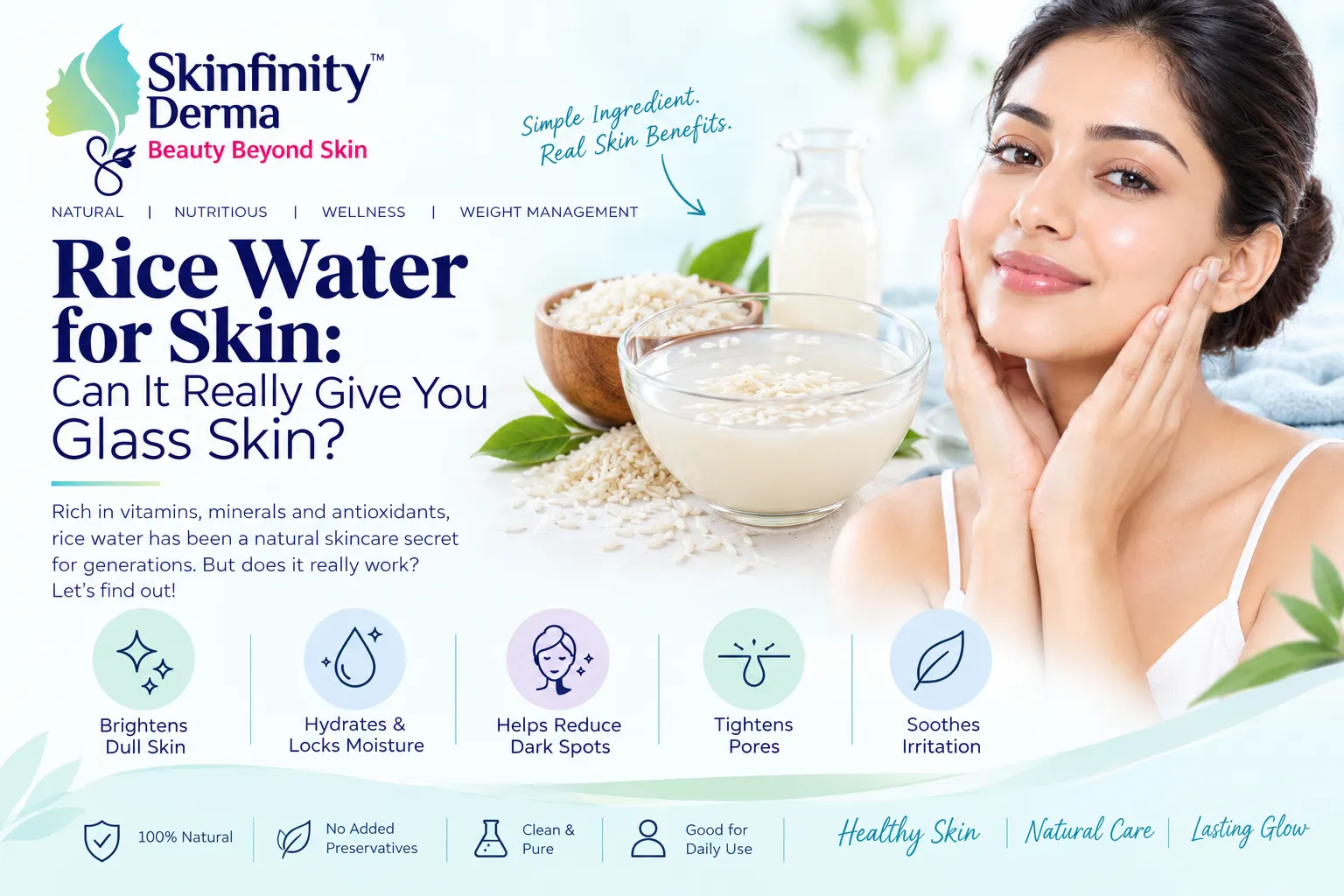
Rice water has become one of the most popular home remedies for glowing skin. Videos often show people applying the cloudy liquid as a toner and claiming that it creates smooth, reflective skin within days.
The idea sounds convincing because rice-derived ingredients are already present in several cosmetic products. However, homemade rice water and a professionally formulated rice extract are not the same.
Rice water may temporarily make the skin feel soft. Its starch content can also leave a smooth layer across the surface. However, there is limited clinical evidence that homemade rice water can treat acne or remove pigmentation.
Glass skin also requires more than one ingredient. Hydration and an even-looking tone contribute to its appearance. Skin texture and light reflection also influence the result.
This guide explains what rice water for skin can realistically achieve. It also covers safer alternatives for anyone seeking glowing or glass-like skin.
What Is Rice Water and Why Is It Trending for Skin?
Rice water is the cloudy liquid produced when rice is rinsed, soaked or cooked. Small amounts of starch and water-soluble compounds move from the rice into the surrounding water.
Its composition depends on:
-
The type of rice
-
The quality of water
-
The preparation method
-
The soaking duration
-
Whether the rice is cooked
-
Whether fermentation occurs
-
The amount of rice used
Rice has a long history of cosmetic use across several Asian cultures. This traditional association has contributed to the renewed interest in rice water for face care.
Modern skincare brands also use ingredients derived from rice. These may include rice bran extract or rice ferment filtrate. Hydrolysed rice protein and rice starch may also appear in product formulas.
Social media often treats these ingredients as proof that homemade rice water provides the same benefits. However, cosmetic extracts are manufactured under controlled conditions. Their concentration and stability can be tested before they reach the skin.
Homemade rice water has no standard formula. One batch may contain a different amount of starch from another. Storage conditions can also change the liquid quickly.
Can Rice Water Really Give You Glass Skin?
Rice water cannot guarantee glass skin.
“Glass skin” is not a medical condition. It describes skin that appears smooth and evenly hydrated. Light reflects more uniformly when the surface has minimal dryness and roughness.
Rice water may produce a temporary smoothing effect. Starch can leave a fine layer across the skin and reduce the appearance of dryness for a short period. This may create the impression of brighter skin.
The effect does not mean that pigmentation has cleared. It also does not mean that pores have permanently become smaller.
The appearance of glass skin depends on several factors:
-
Skin hydration
-
Surface texture
-
Active acne
-
Pigmentation
-
Sun damage
-
The health of the skin barrier
-
Natural pore visibility
Some people naturally have more visible pores or uneven texture. A healthy skincare routine can improve skin quality, but it cannot make normal skin look completely poreless.
For someone with acne or melasma, the first goal should be controlling the underlying concern. Applying layers of homemade remedies can worsen irritation and delay appropriate treatment.
Rice water for glass skin may therefore serve as an optional cosmetic step. It should not become the foundation of the routine.
What Does Rice Water Do to Your Skin?
The effect of rice water varies according to its preparation. Individual skin tolerance also influences the response.
1. It May Temporarily Soften the Skin
Rice water contains starch that can settle on the skin’s surface. This may make the face feel smoother after application.
The effect is temporary and does not confirm structural skin repair. Washing the face may remove much of the residue.
2. Rice Starch May Support Barrier Comfort
Research involving measured rice starch has suggested possible benefits for damaged skin barriers. However, these studies have not used ordinary homemade rice water as a facial toner.
A formulated rice-starch product may provide more predictable results. It also allows the concentration to be controlled.
3. It May Improve the Appearance of Dryness
Dry skin often looks dull because its surface reflects light unevenly. A hydrating rice-based formulation may make the skin appear fresher.
Homemade rice water does not replace a moisturiser. It may evaporate without providing enough support to reduce water loss.
4. Rice-Derived Ingredients May Offer Antioxidant Support
Rice bran contains naturally occurring compounds with antioxidant properties. Ferulic acid and gamma-oryzanol are among the compounds studied in rice-derived materials.
Their presence in rice does not guarantee an effective concentration in homemade rice water. A standardised extract can be formulated more precisely.
5. It May Leave a Temporary Brightening Effect
When skin becomes more hydrated, its surface can appear brighter. A starchy film may also create a smoother finish.
This visual change should not be confused with skin lightening. Rice water does not change the natural colour of healthy skin.
Does Rice Water Help With Pigmentation and Dark Spots?
There is not enough evidence to confirm that homemade rice water can remove pigmentation or dark spots.
Some rice-derived compounds have shown an effect on processes involved in melanin production during laboratory research. However, laboratory findings do not prove that applying soaked rice water will fade facial pigmentation.
Dark spots can develop after inflammation. Acne and eczema may leave post-inflammatory hyperpigmentation after the active condition improves. Picking the skin increases the likelihood of a persistent mark.
Sun exposure can make these marks darker. Visible light may also worsen some pigmentation concerns, particularly melasma.
Rice water is unlikely to treat:
-
Established melasma
-
Deep post-inflammatory pigmentation
-
Sunspots
-
Freckles
-
Pigmentation caused by medication
-
Dark patches linked to hormonal changes
-
Acanthosis nigricans
Pigmentation treatment should begin with sunscreen. A broad-spectrum sunscreen with an SPF of at least 30 can help prevent marks from becoming darker.
A tinted sunscreen containing iron oxides may provide additional protection from visible light. This can be helpful for people with Indian skin who are prone to melasma or post-inflammatory pigmentation.
Persistent dark spots may require azelaic acid or a retinoid. Vitamin C and niacinamide may also support an even-looking tone. The right ingredient depends on the diagnosis and skin sensitivity.
Rice Water for Acne: Does It Actually Help?
Rice water is not an established treatment for acne.
Acne develops when dead skin cells and sebum block hair follicles. Inflammation can then produce red pimples or deeper painful lesions.
Homemade rice water has not been shown to consistently unclog pores. It also cannot replace evidence-based acne ingredients.
Some rice-derived formulations may feel soothing. However, a homemade liquid can leave starch across the skin. People with oily or acne-prone skin may find this residue uncomfortable.
Improper storage can also allow unwanted microorganisms to grow. Applying contaminated rice water to inflamed skin may cause further irritation.
Mild acne may respond to ingredients such as:
-
Salicylic acid for clogged pores
-
Benzoyl peroxide for selected inflammatory breakouts
-
Azelaic acid for acne and post-acne marks
-
Adapalene when medically appropriate
-
Niacinamide as supportive skincare
The choice should depend on the type of acne. Using several active ingredients together may cause dryness and make pigmentation worse.
Deep or painful acne requires dermatologist care. Early treatment can reduce the risk of scars.
How to Use Rice Water on Your Face
A professionally formulated rice product is more predictable than homemade rice water. It includes a preservation system and clearer application instructions.
Anyone still choosing to use homemade rice water should proceed cautiously.
Step 1: Select Clean Rice
Use plain rice without added flavouring or seasoning. Wash the rice and discard the first rinse.
This step does not sterilise the rice. It only removes some surface dust and residue.
Step 2: Prepare a Small Amount
Soak the washed rice in clean water. Avoid preparing a large batch for repeated use.
Homemade rice water does not contain preservatives. Its safety cannot be judged only by appearance or smell.
Step 3: Patch-Test Before Facial Use
Apply a small amount to an area near the jaw or behind the ear. Watch for redness or itching.
A patch test cannot guarantee that a delayed reaction will not occur. It can only provide an initial indication of tolerance.
Step 4: Apply Without Rubbing
Use clean fingertips or a fresh cotton pad. Apply a thin layer without scrubbing.
Leave it on only briefly during the first use. Rinse it away if the skin feels sticky or uncomfortable.
Step 5: Apply Moisturiser
Rice water cannot replace a moisturiser. Follow with a product suited to the skin type.
Step 6: Use Sunscreen During the Day
Apply broad-spectrum sunscreen after moisturiser. Rice water does not provide sun protection.
Safety Precautions
-
Use a fresh single-use preparation.
-
Do not keep homemade rice water at room temperature.
-
Avoid applying it to broken or inflamed skin.
-
Do not mix it with lemon juice.
-
Avoid combining it with harsh scrubs.
-
Stop using it if burning develops.
-
Seek advice if a rash persists.
People with eczema or repeated product allergies should avoid experimenting with homemade skincare without professional guidance.
Rice Water vs Rice Extract in Skincare Products
Rice water and rice extract may come from the same grain, but their skincare properties are not identical.
Book An Appointment
|
Factor |
Homemade Rice Water |
Formulated Rice Extract |
|
Concentration |
Unpredictable |
Controlled during manufacturing |
|
Preservation |
Usually absent |
Includes a preservation system |
|
Stability |
Changes quickly |
Tested for product stability |
|
Skin testing |
Usually not performed |
May undergo safety testing |
|
Active compounds |
Amount varies |
Selected for a defined purpose |
|
Instructions |
Based on home methods |
Provided by the manufacturer |
|
Contamination risk |
Higher with poor handling |
Reduced through controlled production |
Cosmetic products may contain Oryza sativa bran extract or rice ferment filtrate. Some use rice bran oil or hydrolysed rice protein.
A formulated extract may provide antioxidant or conditioning benefits. However, the complete product determines how it affects the skin.
A rice-based serum can still cause irritation if it contains fragrance. A heavy cream may also feel unsuitable for acne-prone skin.
Choose products according to the skin type and concern. Do not select them only because rice appears on the label.
Is Rice Water Safe for Indian Skin?
Rice water may be tolerated by some people with Indian skin. However, no natural ingredient is universally suitable.
Indian skin contains active melanin-producing cells. Irritation can therefore leave a dark mark even after the redness settles.
A homemade product that causes a mild rash may lead to post-inflammatory hyperpigmentation. Repeated rubbing can make the problem worse.
-
Oily and Acne-Prone Skin
The starch in rice water may leave residue across oily skin. Some people may notice congestion or small bumps.
Stop using it if breakouts increase.
-
Dry Skin
Rice water may temporarily soften dry skin. However, it does not provide the same lasting support as a suitable moisturiser.
Apply moisturiser afterwards to reduce water loss.
-
Sensitive Skin
Sensitive skin may react to fermented or poorly stored rice water. Fragrance added to commercial rice products can also cause irritation.
Begin with a patch test and introduce only one new product at a time.
-
Pigmentation-Prone Skin
Avoid continuing a product that stings or burns. Inflammation may create new pigmentation marks.
Rice water should not be applied immediately after a chemical peel or laser treatment. Follow the dermatologist’s aftercare instructions during recovery.
Rice Water vs Vitamin C vs Niacinamide for Glowing Skin
Rice water, vitamin C and niacinamide have different roles. The most suitable option depends on the concern.
|
Ingredient |
Main Role |
Evidence for Glowing Skin |
Best Suited For |
|
Rice water |
Temporary softness and hydration |
Limited for homemade use |
Mild dullness or dryness |
|
Vitamin C |
Antioxidant and pigment support |
More clinical evidence |
Uneven tone and sun-related dullness |
|
Niacinamide |
Barrier and pigment-transfer support |
More clinical evidence |
Uneven tone and oiliness |
1. Rice Water
Rice water may temporarily soften the skin. Its effect is usually limited to surface appearance.
There is no dependable concentration in a homemade preparation.
2. Vitamin C
Vitamin C provides antioxidant support and may gradually improve visible dullness. It can also support a more even-looking tone.
Results depend on the product’s concentration and stability. Some formulas can irritate sensitive skin.
Vitamin C should support sunscreen rather than replace it.
3. Niacinamide
Niacinamide can support barrier function and help reduce pigment transfer. It may also suit some oily skincare routines.
Higher concentrations are not always more effective. A strong formula may cause redness in sensitive skin.
Which One Should You Choose?
Rice water may suit someone seeking a simple soothing step. Vitamin C may be more appropriate for antioxidant support and selected pigmentation. Niacinamide may help when uneven tone occurs alongside barrier weakness.
The routine does not need all three. Choose one ingredient based on the main concern and monitor how the skin responds.
Can Rice Water Replace Your Skincare Routine?
Rice water cannot replace a complete skincare routine.
It does not remove resistant sunscreen or makeup effectively. It cannot provide dependable moisturisation or sun protection.
A balanced routine can remain simple.
Morning Routine
-
Cleanse according to the skin’s needs.
-
Apply a targeted serum if appropriate.
-
Use a suitable moisturiser.
-
Finish with broad-spectrum sunscreen.
Evening Routine
-
Remove makeup and sunscreen when required.
-
Cleanse gently.
-
Apply prescribed or targeted treatment.
-
Follow with moisturiser.
Rice water may be included as an optional step if the skin tolerates it. It should not replace a treatment prescribed for acne or pigmentation.
Adding more products does not automatically create faster results. An overloaded routine can disrupt the barrier and make the skin appear rougher.
What Dermatologists Recommend for Glass Skin
Dermatologists focus on skin health rather than the appearance of perfection. “Glass skin” is not possible through one remedy or procedure.
The first step is identifying what makes the skin appear dull or uneven.
1. Improve Hydration
A suitable moisturiser can make dehydrated skin feel more comfortable. Ingredients such as glycerin and hyaluronic acid may support hydration.
Ceramides can help maintain the skin barrier.
2. Protect the Skin From Sunlight
Daily sunscreen helps prevent sun damage and pigmentation. Reapplication is important during prolonged outdoor exposure.
A tinted sunscreen may be useful when visible light worsens pigmentation.
3. Treat Active Acne
Acne should be controlled before focusing on post-acne marks. Continuing breakouts will create new areas of inflammation.
Avoid picking or squeezing pimples.
4. Address Pigmentation Carefully
Pigmentation treatment needs patience. Strong home remedies can trigger irritation and make dark spots more noticeable.
A dermatologist may recommend medical skincare based on the cause and pigment depth.
5. Exfoliate Only When Appropriate
Exfoliation may improve rough surface texture. However, frequent acids or scrubs can weaken the barrier.
The correct product and frequency depend on skin sensitivity.
6. Consider Professional Treatment
Suitable patients may be considered for clinical facials or chemical peels. Skin boosters and laser procedures may also be discussed after an assessment.
Professional treatments should be selected according to the person’s skin type. Indian skin requires conservative planning to reduce the risk of pigmentation.
Personalised Glass-Skin Care at SKINFINITY Derma
At SKINFINITY Derma, we begin by understanding why your skin appears dull or uneven. Our dermatologists examine hydration and texture before recommending a plan. Active acne or pigmentation is assessed separately.
Your personalised plan may include medical skincare or a dermatologist-led procedure. Depending on your skin’s needs, our dermatologists may recommend the Korean Glass Glow Facial or another suitable treatment.
We also help you build a daily routine that supports the treatment results. Rice water may be an optional skincare step, but it cannot replace targeted care for persistent concerns.
Learn more about glass-skin treatment at SKINFINITY Derma and book a consultation for a personalised skin assessment.
Is Rice Water Good for Glowing Skin?
Rice water may temporarily make the skin feel softer. Better surface hydration can create a fresher appearance.
However, homemade rice water has limited evidence for lasting glow. It cannot reliably treat acne or pigmentation.
A formulated rice extract offers greater stability and more predictable use. Long-term glow still depends on moisturisation and sun protection. Any underlying skin concern must also be treated appropriately.
Conclusion
Rice water for skin may provide temporary softness, but it cannot guarantee glass skin. Its benefits depend on how it is prepared and how the individual’s skin responds.
Homemade rice water has no standard concentration or preservation system. Formulated rice extracts are generally more predictable.
Glowing skin comes from consistent care rather than a single trend. Gentle cleansing and moisturising support the barrier. Daily sunscreen helps prevent dullness and pigmentation. Persistent concerns require dermatologist-led treatment.
Frequently Asked Questions
1. Can Rice Water Remove Pigmentation?
Rice water cannot reliably remove pigmentation. Some rice-derived compounds have shown potential in laboratory research, but this does not confirm that homemade rice water fades facial dark spots.
Persistent pigmentation requires sunscreen and targeted treatment.
2. Can I Use Rice Water on My Face Every Day?
Daily use is not necessary. Homemade rice water has no standard concentration or preservative system.
Begin cautiously and stop if redness develops. A formulated rice product may provide more predictable instructions.
3. Is Fermented Rice Water Better for Skin?
There is not enough evidence to show that homemade fermented rice water is better. Controlled cosmetic ferments are manufactured differently from preparations left to ferment at home.
Home fermentation can increase the risk of contamination. Choose a professionally formulated product if fermented rice ingredients are preferred.
4. Can Rice Water Help Acne?
Rice water is not an established acne treatment. It does not reliably unclog pores or control inflammatory lesions.
Deep or painful breakouts require dermatologist care. Early treatment can help reduce scarring.
5. Is Rice Water Safe for Indian Skin?
Some people with Indian skin may tolerate rice water. However, irritation can cause post-inflammatory pigmentation.
Patch-test it before facial application. Avoid using it on inflamed or damaged skin.
6. Can Rice Water Make the Skin Glow?
Rice water may create temporary softness that makes the skin appear fresher. This effect does not confirm long-term brightening.
Consistent moisturising and sunscreen provide more dependable support for glowing skin.
7. How Long Does Rice Water Take to Show Results?
There is no established timeline for homemade rice water. Temporary softness may appear after application, but lasting changes are not guaranteed.
Do not delay professional treatment while waiting for a home remedy to work.

 Call Now
 WhatsApp