
Medically Reviewed by: Dr. Neha Dhankar
MBBS, MD (Dermatology, Venereology & Leprosy) | Skinfinity Derma Clinic
Read Time: 8 Minutes
Skin ageing does not happen because of one concern alone. Reduced collagen, slower cellular repair and moisture loss can gradually affect skin quality. These changes may cause fine lines, dullness, uneven texture and reduced elasticity.
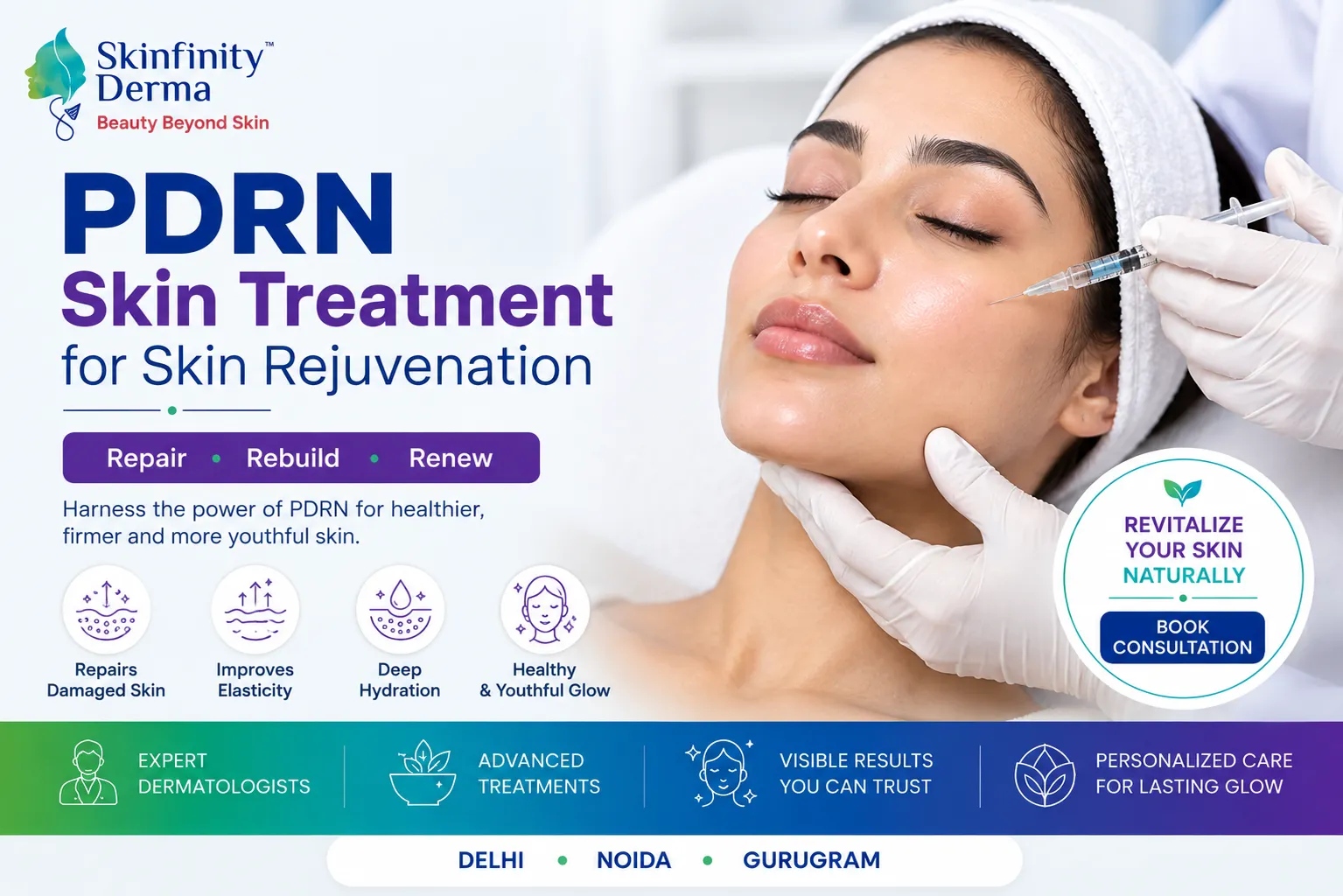
PDRN skin treatment has emerged as a regenerative approach for improving overall skin quality. It does not simply fill lines or temporarily tighten the skin. The treatment is designed to support the skin’s natural repair processes and create gradual improvement.
PDRN therapy in Delhi NCR is increasingly used for facial rejuvenation, post-procedure recovery and selected scars. However, results depend on the product, delivery method and condition being treated. A dermatologist must evaluate the skin before recommending a suitable protocol.
What Is PDRN Treatment?
PDRN stands for polydeoxyribonucleotide. It consists of purified DNA fragments that are commonly obtained from salmon or trout sources. Medical-grade products undergo purification and processing before being used for therapeutic or aesthetic purposes.
PDRN was initially studied for its role in tissue repair and wound healing. Its regenerative properties later attracted interest in dermatology and aesthetic medicine. Research suggests that PDRN may support fibroblast activity, collagen production, blood-vessel formation and tissue recovery.
PDRN treatment is often described as a skin booster or regenerative therapy. Depending on the concern, a dermatologist may deliver it through:
-
Multiple superficial injections
-
Microneedling-assisted application
-
Mesotherapy techniques
-
Combination protocols after laser treatment
-
Other medically supervised delivery methods
PDRN should not be confused with a conventional dermal filler. Fillers mainly add volume or reshape specific facial areas. PDRN focuses on improving the skin environment and supporting repair.
PDRN is also different from ordinary topical skincare. Injectable or procedure-assisted delivery places the product closer to the target skin layers. Topical products may not provide the same effect because penetration depends on the formulation and condition of the skin barrier.
Benefits of PDRN Treatment
The benefits of PDRN treatment develop gradually because the therapy supports biological repair rather than creating instant structural volume.
1. Supports Skin Rejuvenation
PDRN can help cells function and regenerate tissue. This can help make tired or damaged skin look healthier in the long run.
This treatment is sometimes recommended when patients would like to improve their appearance without making any major changes to their facial appearance.
2. Improves Skin Hydration
Dry and dehydrated skin may appear rough, dull or with prominent lines. PDRN skin treatment can be part of a moisture retention and skin quality enhancement protocol.
Some also include other moisturizing agents, such as hyaluronic acid. The overall result is then determined by the entire product and not by PDRN itself.
3. Supports Collagen Production
Fibroblasts are cells that make collagen and maintain the extracellular structure of the skin. The treatment with PDRN and related polynucleotides is being studied for its ability to stimulate fibroblasts and enhance skin quality.
Over time, increased collagen activity can help to soften lines and promote elasticity. But PDRN is not as effective as surgery or deep energy-based treatments.
4. Improves Skin Texture
If the skin is rough, prematurely aged or has mild irregularities, patients might see smoother skin following a planned course of treatment.
The improvement in texture is slow. Combination treatment is typically needed for deep scars or severe textural damage.
5. Supports Skin Recovery
PDRN has been noted for its ability to promote wound healing and tissue repair. Can be used following certain dermatological treatments to aid healing.
One study revealed that PDRN helped wounds heal faster following fractional laser therapy. The study, however, was not about the healing of skin after laser treatment, but rather about the effectiveness of PDRN in treating all skin concerns.
6. Helps Improve Dull-Looking Skin
The face can look tired due to poor hydration, environmental stress and slow skin renewal. PDRN treatment can aid in recovery and hydration, potentially enhancing the skin’s appearance.
The improvement should be natural. Patients should steer clear of clinics that guarantee instant fairness or everlasting brightness.
7. May Improve Fine Lines
PDRN can help to tone down fine lines associated with dry skin and poorer skin quality that are noticeable early in life. It is typically applied around the eyes, cheeks, forehead and neck.
Other treatments may be required for deep folds and expression lines. A dermatologist can find out which is more suitable: PDRN, Botulinum toxin, fillers or another procedure.
How Does PDRN Skin Treatment Work?
PDRN skin treatment is believed to support tissue repair through two main pathways.
First, PDRN may activate adenosine A2A receptors. This pathway is associated with reduced inflammation, improved tissue repair and new blood-vessel formation.
Second, DNA fragments can contribute to the salvage pathway. The body may reuse nucleotide components during cellular repair instead of producing every component from the beginning.
These actions may create a more supportive environment for:
-
Fibroblast activity
-
Collagen production
-
Tissue repair
-
Improved circulation
-
Skin-barrier recovery
-
Reduced inflammatory stress
PDRN does not force the skin to change immediately. The treatment supports processes that take place over several weeks. This is why results usually appear progressively.
The delivery technique also matters. Superficial injections distribute small amounts across the treatment area. Microneedling creates controlled channels and may be combined with an appropriate sterile formulation.
Not every PDRN cosmetic product is suitable for injection or microneedling. Products must only be used according to their intended route. Applying an unapproved topical product through broken skin can increase irritation or infection risks.
What Skin Concerns Can PDRN Treatment Help With?
PDRN treatment may be considered for several concerns related to skin quality and recovery.
-
Fine Lines and Early Ageing
Reduced hydration and collagen can make fine lines more visible. PDRN may help improve overall skin quality and soften early lines gradually.
It cannot remove every wrinkle. Deep expression lines or significant skin laxity may require another procedure.
-
Dull or Tired-Looking Skin
PDRN therapy may support hydration and regeneration. This can give dehydrated or stressed skin a fresher appearance.
Sleep, sun exposure, smoking and skincare habits can influence the final result.
-
Uneven Skin Texture
PDRN may help improve mild roughness and irregular texture. It can also be combined with other treatments when deeper remodelling is required.
-
Dehydrated Skin
Some PDRN skin boosters are designed to improve hydration and skin comfort. They may be suitable for skin that appears dry despite regular moisturiser use.
Persistent dryness should still be evaluated because eczema, barrier damage and other conditions may need medical care.
-
Reduced Elasticity
Collagen support may improve the appearance of mildly lax or crepey skin. However, PDRN cannot provide the same correction as surgical lifting.
-
Under-Eye Skin Quality
PDRN is sometimes used around the under-eye area to improve fine lines, dryness and thin-looking skin. This sensitive region requires precise placement by a trained medical professional.
PDRN may not correct eye bags caused by fat protrusion. It also may not fully improve dark circles caused by deep hollows or pigmentation.
-
Post-Procedure Skin Recovery
Dermatologists may use PDRN after selected lasers or resurfacing treatments. The aim is to support healing and improve the treatment environment.
The timing and delivery method must be planned carefully. Applying unsuitable products to recently treated skin can increase complications.
-
Acne Scars
Is PDRN treatment good for acne scars? PDRN may support healing and collagen activity in selected acne-scar protocols. However, it is not usually a standalone solution for deep atrophic scars.
Rolling, boxcar and ice-pick scars have different structures. Treatments may include microneedling, fractional laser, subcision, chemical reconstruction or combinations.
Emerging research has explored PDRN within combination acne-scar protocols. However, researchers continue to call for stronger evidence and optimised treatment methods.
Active acne should be controlled before aggressive scar treatment begins. Treating scars while inflammatory breakouts continue can lead to new scarring.
PDRN Treatment Procedure
A PDRN treatment session should begin with a dermatologist-led consultation.
Step 1: Skin Assessment
The dermatologist examines skin texture, hydration, sensitivity and active concerns. Medical history, allergies and current medications should also be discussed.
The doctor may take baseline photographs for future comparison.
Step 2: Treatment Planning
The delivery method is selected according to the concern. Superficial injections may be used for general rejuvenation. Microneedling-assisted protocols may be considered for texture or selected scars.
The concentration, quantity and number of sessions must be personalised.
Step 3: Skin Preparation
The treatment area is cleansed thoroughly. A topical numbing cream may be applied before injections or microneedling.
The numbing time usually ranges from 20 to 40 minutes. This can vary according to the product and treatment area.
Step 4: PDRN Delivery
The dermatologist introduces small amounts of PDRN into or across the selected skin areas. The session may take 30 to 60 minutes depending on the technique and treatment area.
Tiny raised bumps can appear after superficial injections. These usually settle as the product disperses.
Step 5: Post-Treatment Care
The dermatologist may apply a soothing product and sunscreen. Patients are usually advised to avoid touching the area unnecessarily.
Makeup, intense workouts, swimming, steam rooms and active skincare may need to be avoided temporarily. The exact instructions depend on the delivery method.
PDRN Treatment Side Effects & Downtime
PDRN skin treatment is generally described as minimally invasive. However, it is still a medical procedure and can cause side effects.
Common temporary effects may include:
-
Redness
-
Mild swelling
-
Tenderness
-
Small injection bumps
-
Pinpoint bleeding
-
Bruising
-
Itching or sensitivity
These effects often settle within a few hours or days. Bruising may last longer in some patients.
Less common risks include infection, prolonged inflammation, allergic reaction, pigmentation changes or unsatisfactory results. Poor injection technique can increase the risk of complications.
Patients must inform the dermatologist about fish allergies because many PDRN products come from salmon or trout sources. The doctor should also know about previous injectable reactions.
Downtime depends on the method. Superficial injections may cause visible bumps for one to three days. Microneedling may create redness and sensitivity for several days.
Patients should avoid strong retinoids, exfoliating acids and scrubs until the skin settles. Broad-spectrum sunscreen is essential because recently treated skin can be more sensitive.
Who Is a Good Candidate for PDRN Treatment?
PDRN treatment may be suitable for adults experiencing:
-
Dull or tired-looking skin
-
Early fine lines
-
Mild loss of elasticity
-
Dehydrated skin
-
Rough or uneven texture
-
Thin-looking under-eye skin
-
Selected post-acne marks or scars
-
Slow recovery after certain procedures
A suitable candidate should have realistic expectations. PDRN aims to improve skin quality rather than transform facial structure.
Treatment may need to be postponed or avoided during:
-
Pregnancy or breastfeeding
-
Active acne infection
-
Cold sores or open wounds
-
Active eczema or dermatitis
-
Uncontrolled medical conditions
-
Severe fish allergy
-
Blood-clotting disorders
-
Use of certain anticoagulant medicines
-
Known allergy to any product component
A dermatologist should make the final decision after reviewing medical history. Patients should never hide the history of any supplements or medications intake before an injectable procedure.
PDRN Treatment Cost in Delhi NCR
The cost of PDRN treatment in Delhi NCR depends on the product, treatment area and number of sessions. At SKINFINITY, the prices are:
-
Klardie PDRN for the under-eye area: ?15,000 per session, ?35,000 for three sessions or ?50,000 for five sessions
-
Klardie PDRN for the face: ?25,000 per session, ?50,000 for three sessions or ?75,000 for five sessions
-
Remedium PDRN: ?25,000 per session, ?50,000 for three sessions or ?75,000 for five sessions
-
Rejuran: ?45,000 per session or ?75,000 for two sessions
These treatments are performed by a dermatologist. The final cost may vary depending on:
-
PDRN brand and formulation
-
Product concentration
-
Quantity used
-
Treatment area
-
Delivery technique
-
Number of sessions
-
Combination procedures
Patients should not select a clinic based only on the lowest price. An unusually inexpensive treatment may involve insufficient product quantity, unsuitable formulations or unclear sourcing.
Ask the clinic which product will be used and whether consultation, numbing and follow-up care are included. A personalised quotation should be provided after consultation because the required quantity may differ for the face, neck and under-eye area.
Why Choose a Dermatologist for PDRN Treatment?
PDRN treatment involves more than applying a trending skin booster. The doctor must assess whether PDRN is suitable for the actual concern.
A dermatologist can differentiate dehydration and ageing from rosacea, eczema, active acne or another medical condition. This prevents procedures from being performed on unstable skin.
Dermatologist-led treatment also supports:
-
Correct product selection
-
Sterile injection practices
-
Appropriate treatment depth
-
Accurate facial anatomy knowledge
-
Safe combination planning
-
Side-effect management
-
Realistic treatment expectations
The doctor can also determine whether another treatment may provide better results. For example, deep acne scars may respond better to subcision or fractional resurfacing. Significant volume loss may require fillers instead of a skin booster.
Patients should ask about the product’s origin, intended use and regulatory status. They should also avoid salons or unqualified providers offering injectable PDRN.
PDRN Treatment in Delhi NCR
Patients considering PDRN treatment in Delhi NCR should begin with a detailed dermatology consultation. The goal is to match the treatment with the skin concern rather than follow a standard package.
During the consultation, the dermatologist may examine:
-
Skin thickness and hydration
-
Fine lines and elasticity
-
Active acne or inflammation
-
Type and depth of acne scars
-
Under-eye anatomy
-
Previous cosmetic treatments
-
History of allergies
-
Current skincare routine
PDRN treatment in Noida, Gurgaon and Delhi may be planned as a standalone skin-quality procedure. It may also become part of a wider rejuvenation plan involving microneedling, laser treatment or another dermatological procedure.
The treatment plan must include enough recovery time between sessions. Performing procedures too frequently can irritate the skin without improving results.
The same principles apply when searching for PDRN treatment in Noida, Gurgaon, Delhi. Patients should prioritise dermatologist supervision, authentic products and proper follow-up care.
Considering PDRN treatment for dullness, dehydration, fine lines or uneven texture? Consult the dermatologists at SKINFINITY Derma? to determine whether a PDRN-based skin booster or another personalised rejuvenation treatment suits your skin. With clinics in Noida and Gurgaon, SKINFINITY provides individualised treatment planning based on each patient’s skin concerns and goals.
Conclusion
PDRN skin treatment offers a gradual approach to improving hydration, texture, fine lines and overall skin quality. However, it is not a quick fix or a universal solution for every concern. Results depend on the skin condition, product quality and treatment method.
A dermatologist can assess whether PDRN suits the skin and create a safe treatment plan. With realistic expectations and proper aftercare, PDRN may support healthier and more refreshed-looking skin over time.
Frequently Asked Questions
How Many Sessions of PDRN Treatment Are Needed?
Many patients may need three to four initial sessions. These sessions are commonly spaced two to four weeks apart.
The exact number depends on skin quality, treatment area and concern severity. Maintenance sessions may be recommended after several months. A dermatologist should decide the schedule after examining the skin.
Does PDRN Treatment Hurt?
PDRN injections can cause mild pricking, stinging or pressure. A topical numbing cream is generally applied before treatment to reduce discomfort.
Sensitive areas such as the under-eyes may feel more uncomfortable. Pain tolerance and injection technique also affect the experience.
Is There Any Downtime After PDRN Treatment?
PDRN treatment usually involves limited downtime. Redness, swelling, tenderness or tiny injection bumps may remain for one to three days.
Bruising can last longer. Patients should avoid scheduling treatment immediately before an important event because individual recovery varies.
How Long Do PDRN Treatment Results Last?
Results may remain visible for several months. The exact duration varies with age, skin type, treatment regimen and lifestyle.
Exposure to the sun, smoking, and poor skincare can shorten lifespan. Maintenance sessions can be suggested to help further progress.
Can PDRN Be Combined With Other Skin Treatments?
PDRN can be used in conjunction with microneedling, fractional laser or other rejuvenation treatments. The purpose could be to promote healing or enhance skin condition.
Not every combination is suitable for every patient. The dermatologist should determine the correct treatment order and recovery interval.
What Is the Difference Between PDRN and PRP?
PDRN is a biological source material-derived, purified DNA fragment. PRP is made from the patient's blood and includes platelets that are concentrated with growth factors.
PDRN is provided as a manufactured product. PRP is a process that involves drawing and processing blood during the appointment.
Both may support tissue repair, but they work differently. Product quality, preparation and treatment goals affect the final choice.
Is PDRN Treatment Safe?
Typically, PDRN is very safe when applied correctly with a medical-grade product. Most of the reviews of polynucleotide treatments have stated mild and transient side effects, but more large-scale and long-term trials are needed.
Safety depends on correct patient selection, product authenticity, sterile technique and dermatologist supervision. Some patients are at special risk if they have a fish allergy, a current infection or specific medical conditions.
PDRN skin treatment may assist in gradual recovery, hydration and rejuvenation. But it must be included in a tailored skin care program.

 Call Now
 WhatsApp