
Medically Reviewed by: Dr. Neha Dhankar
MBBS, MD (Dermatology, Venereology & Leprosy) | Skinfinity Derma Clinic
Read Time: 8 Minutes
Hair is more than just a physical attribute, it is a part of you, your confidence and your self-esteem. Once you see hairs on your pillow, a little wider parting or a hairline that appears to be retreating, it can be alarming. There is one thing that you need to know, however, and that is that the sooner you catch on to hair loss, the better off you will be.
Patients walk into our doors at Skinfinity Derma each and everyday who would have liked to come in earlier. The reality is that for most people a loss of almost half their hair density occurs before they notice thinning. That is why it is important to identify the early warning signs of balding — before they get worse — to make a difference between maintaining your hair and playing catch-up.
Here, we explain each and every individual sign you should be alert of, and what is really taking place within your own scalp, and the advanced hair therapy we provide at Skinfinity Derma that can help you get your hair and your confidence back.
Understanding Hair Loss: What Is Actually Happening?
It is helpful to first look at the biology before getting on to the signs. Your scalp has around 100,000 hair follicles, and these follicles go through different stages of growth, a transition, resting and shedding. If you're losing 50 to 100 hairs per day, it's completely normal, as this is the natural hair growth cycle.
When this cycle is interrupted, hair loss becomes a problem. The most frequent one is androgenetic alopecia (AP) or male/female pattern baldness. It is stimulated mainly by a hormone called Dihydrotestosterone (DHT), which is a by-product of the hormone testosterone. As the DHT binds to genetically sensitive hair follicles, they gradually shrink, known as follicle miniaturisation. Folicles will become thinner, shorter, and weaker, and then cease growing hair altogether.
Book An Appointment
|
Did You Know? By age 35, approximately two-thirds of men will experience some degree of hair thinning. By age 50, that number rises to about 85%. Among women, 40% notice visible hair loss by age 40. Hair loss does not discriminate — and it is far more common than most people realise. |
The encouraging news is that hair follicles, once miniaturised, are not always permanently damaged. With timely intervention and the right treatment, many follicles can be reactivated. This is why identifying the early signs of balding is so critical.
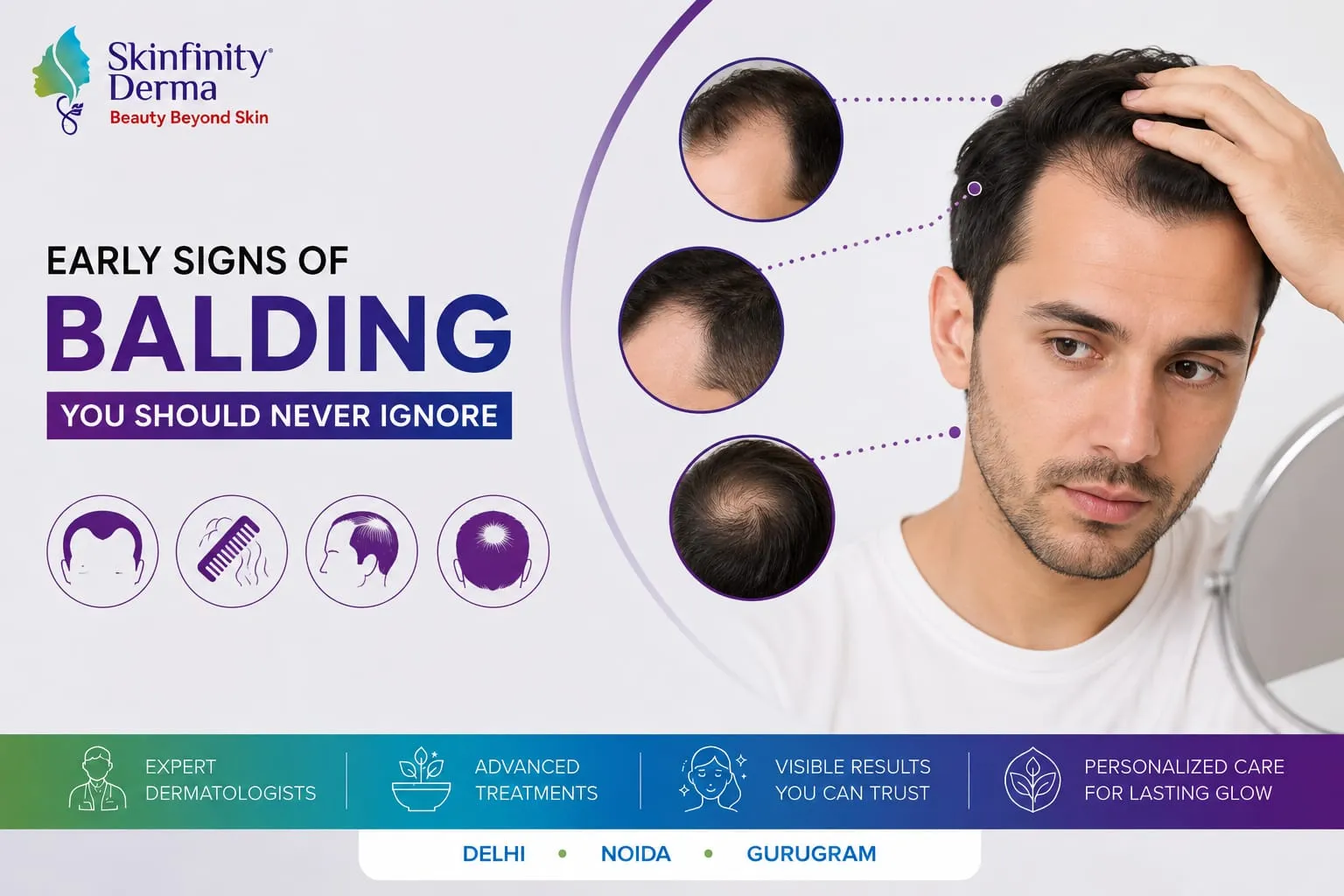
7 Early Signs of Balding You Should Never Ignore
1. Excessive Hair Shedding — More Than 100 Strands a Day
It's a fact of life to notice hair in the shower drain, in your pillowcase or when you look at your hairbrush. The difference between normal shedding and early hair loss however, lies in the amount and quality.
More than 100 hairs a day, in showers, from your brush or covering your pillow each morning is a warning sign to be taken seriously. Telogen effluvium is a temporary exacerbation of hair loss that may result from a stressful event, illness, hormonal imbalance, lack of proper nutrition and sometimes after major surgery. Shedding may be temporary, but if it continues for a few months, it needs to be examined by a professional.
|
Skinfinity Tip: Count the strands in your hairbrush after a typical wash day. If you are consistently seeing well over 100 strands, book a trichoscopy consultation. Early diagnosis separates temporary shedding from the start of pattern hair loss. |
2. A Visibly Receding Hairline
One of the most familiar symptoms of male pattern hair loss is a receding hairline, which is also a symptom that women may experience. It usually starts at the temples in men and slowly recedes to an "M" or "V" shape. This can begin as late as the late teens or early twenties.
A helpful way to check yourself, is to look at pictures of yourself from a year or two ago. A showing balding crown is a gradual process, making it simple to neglect in the mirror every day but not in comparison in the picture. If your hairline appears to be lower than in past photos and your forehead appears larger, your hairline could be receding.
A receding hairline can seem like a wider forehead or the hairline appearing higher on the face for women. In contrast to males, this is not typically an M-shape, but rather an even back vertical scallop.
3. Thinning at the Crown or Top of the Scalp
Another sign of androgenetic alopecia is thinning of the crown, which is at the top and back of the head. It is one of the most insidious, as it can only be seen with a mirror or photographs. Crown thinning is often first noticed by a friend, partner or hairstylist.
Try a test: stand in front of strong light and look at the top of your head with 2 mirrors (or take a picture from the top down). If you can see your scalp through your hair in spots where you couldn't see it before, then you may already be experiencing some follicle miniaturisation.
Crown thinning in women is more likely to manifest itself as a gradual widening of the parting line, rather than as a bald spot, on the crown of the head.
4. A Widening Part Line
This is often the first sign that women with early hair loss notice. Does the part look wider than before when you part your hair? Are there more bald spots than before? This widening is directly caused by a decrease in the density of hair per square centimetre of the scalp, thus making it noticeable.
This can happen in androgenetic alopecia as well as other hair loss conditions such as traction alopecia (due to tight hairstyles) or diffuse alopecia. One thing to note is that one of the first signs of female pattern hair loss (FPHL) is not always obvious and that the part line may take years to be identified, as they don't always present the dramatic pattern that male hair loss does.
5. Hair That Looks Finer, Shorter, or More Brittle
The miniaturisation of follicles takes time to occur. With repeated cycles of DHT, each hair will be finer and shorter. Strands of baby hair may be observed in regions where there was once full and dense hair.
This is known as miniaturisation of the hair shaft, and one of the most distinct biological indicators of pattern hair loss. At Skinfinity Derma, a dermatoscope examination can be used to identify the early stages of a thinning hair at a microscopic level — BEFORE it becomes noticeable.
When your hair feels dry, thin and weak and you haven't altered your haircare routine, it's time to take notice.
6. A Scalp That Is More Visible in Photos and Bright Light
Hair naturally acts as a cover for the scalp. When density decreases, even modestly, the scalp becomes more visible — especially in bright sunlight, under fluorescent lighting, or in high-resolution photographs. Many people notice this for the first time in a candid photo taken at a party or an outdoor event.
This visibility is not just cosmetic — it signals that hair follicle density has meaningfully decreased. The scalp's increased visibility in bright light is a diagnostic clue that experienced dermatologists and trichologists look for during consultations.
7. Sudden Appearance of Bald Patches
Whereas the gradual thinning of the hair in the crown, pattern baldness, is a different story, bald spots that appear all at once, with smooth, round edges, are an indicator of the autoimmune condition known as alopecia areata. These patches can occur overnight, and may be tingling or itchy.
While DHT and genetics are the primary culprits in pattern baldness, the cause of alopecia areata is not the same. However, the condition does need immediate medical intervention. It can develop into alopecia totalis (loss of all the hair on the scalp) or alopecia universalis (loss of all the hair on the body) if not treated. Fortunately, with proper immunological and dermatological therapy, many patients experience substantial regrowth.
When Should You See a Dermatologist?
When it comes to hair loss there will never be a wrong time to start. A professional trichoscopy and scalp analysis can determine if you are in the early stages of hair loss, as well as determine the cause of your hair loss if you experience any of the above symptoms — even one.
Early intervention isn't for the vanity of the party. It's a biology thing. Untreated miniaturised but still active hair follicles can sometimes be saved. The dormant follicles that have been stored for years are a lot harder to be revived. The opportunity is true — and it's closing slowly.
You should seek an immediate consultation if:
• You notice hair loss accompanied by scalp redness, flaking, pain, or burning
• Bald patches appear suddenly, particularly in circular patterns
• Hair loss follows a new medication, illness, or significant stressor
• Family history of early baldness is present on either side
• Hair loss is causing significant emotional distress or affecting quality of life
Why Choose Skinfinity Derma for Your Hair Loss Treatment?
At Skinfinity Derma, we believe that every strand of hair matters — and so does every patient's story. Hair loss is not simply a cosmetic concern; it affects confidence, mental health, and overall well-being. Our approach is therefore deeply personal, evidence-based, and results-driven.
Here is what sets Skinfinity Derma apart:
• Expert Dermatologists & Trichologists: Our team comprises board-certified dermatologists in Noida with specialised training in trichology — the science of the hair and scalp. We do not offer one-size-fits-all solutions; we diagnose the specific type and cause of your hair loss before recommending any treatment.
• Advanced Diagnostic Technology: We use trichoscopy and digital scalp analysis tools to assess follicle health at a microscopic level. This allows us to detect early-stage hair loss and miniaturisation that is invisible to the naked eye, enabling treatment to begin at the earliest possible stage.
• Personalised Treatment Plans: From medical-grade topical treatments to cutting-edge procedural interventions, every patient at Skinfinity Derma receives a customised treatment protocol tailored to their hair loss type, stage, lifestyle, and goals.
• Holistic Scalp Health Approach: We address root causes — hormonal imbalances, nutritional deficiencies, scalp health, stress — not just the visible symptoms. Sustainable hair health requires treating the whole person, not just the hairline.
• Comfortable, Confidential Care: We understand that discussing hair loss can feel vulnerable. At Skinfinity Derma, every consultation is conducted with sensitivity, discretion, and respect. You will leave feeling informed, supported, and empowered.
Hair Treatments We Provide at Skinfinity Derma
We offer a comprehensive range of clinically proven hair restoration and scalp health treatments. Whether you are in the earliest stages of thinning or seeking to restore significant hair density, we have an evidence-based solution for you.
Platelet-Rich Plasma (PRP) Therapy
One of the most popular of the non-surgical hair restoration treatments offered today is PRP therapy. A small amount of blood is drawn, the growth factors are concentrated, and then injected into the scalp. Hair growth hormones kick dormant hair follicles, increase blood flow and encourage natural growth of hair. Several clinical trials have shown PRP to be a successful treatment for enhancing the density of the hair and minimizing shedding — especially at the early to mid-point of androgenetic alopecia.
Mesotherapy for Hair Loss
In Mesotherapy, vitamins, minerals, amino acids and hair growth stimulants are injected directly into the mesoderm layer of the scalp in a compound mixture. It nourishes hair follicles from within, it boosts circulation, it localises the effect of DHT, and it rejuvenates the scalp environment. It's especially effective on thinning hair and stress-related hair loss.
Low-Level Laser Therapy (LLLT)
Red light therapy for hair is also called LLLT, which stands for laser light therapy, works by stimulating energy in the hair follicles. Non-invasive, painless and improves the metabolism of the follicles, increases the anagen (growth) phase and decreases scalp inflammation. LLLT is often used in combination with other treatments for enhanced results.
Medical Hair Loss Treatments (Topicals & Oral Medications)
Both the topically-prescribed and orally administered Minoxidil treatment and the prescription only Finasteride treatment (for eligible male patients) are the two FDA-approved androgenetic alopecia treatments prescribed by Skinfinity Derma's dermatologists. In addition, we prescribe spironolactone for women who experience hormonal hair loss and compounded medications when applicable. All Rx are customised to your diagnosis, blood work and medical history.
Nutritional Deficiency Correction & Scalp Health Protocols
Many of the most prevalent causes of hair loss, especially in women, remain unrecognized, such as iron deficiency, zinc deficiency, low ferritin levels, vitamin D deficiency, and thyroid disorders. Skinfinity Derma will complete full blood panels and perform targeted supplementation, dietary changes and scalp treatments to address any nutritional drivers of hair loss.
Scalp Treatments for Seborrheic Dermatitis & Inflammatory Conditions
Chronic scalp inflammation, seborrheic dermatitis, psoriasis, and fungal infections can all contribute to and accelerate hair loss. We offer medical-grade scalp treatments including prescription-strength shampoos, topical corticosteroids, antifungal therapies, and in-clinic procedures to restore a healthy scalp environment — the essential foundation for hair regrowth.
Hair Transplant Referral & Counselling
For patients with advanced hair loss who may be candidates for surgical hair restoration, Skinfinity Derma provides pre-transplant scalp optimisation protocols and referrals to trusted hair transplant specialists. We ensure you go into any surgical procedure with the healthiest possible scalp and realistic, well-informed expectations.
Frequently Asked Questions (FAQs)
Can hair loss be reversed if caught early?
Yes, early-stage hair loss can often be slowed, stopped, or even partially reversed with treatments like PRP, minoxidil, mesotherapy, and DHT blockers. The earlier you start, the better the chances of saving and reactivating hair follicles before the loss becomes permanent.
How do I know if I am experiencing normal shedding or actual balding?
Normal hair shedding is usually 50–100 hairs a day without visible thinning or hairline changes. Balding, however, follows a pattern — thinning at the temples, crown, or part line, with hair becoming finer and the scalp more visible over time. A professional trichoscopy at Skinfinity Derma can accurately tell the difference, so you’re not left guessing.
How many sessions of PRP therapy will I need, and when will I see results?
Most patients at Skinfinity Derma start with 3–4 PRP sessions spaced 4–6 weeks apart, followed by maintenance every 3–6 months. Many notice reduced hair fall within the first few sessions, while visible improvements in density and thickness usually appear within 3–6 months. PRP delivers the best results when combined with a personalised hair restoration plan guided by our dermatologists.

 Call Now
 WhatsApp