

Medically Reviewed by: Dr. Ipshita Johri
MBBS, DDV | Skinfinity Derma Clinic
Read Time: 8 Minutes
Types of Hair Treatment: Which is Best for You?
We’ve all had those mornings where we look in the mirror and wish our hair had a bit more life, more volume, or simply stayed on our heads instead of clogging the shower drain. In a world filled with pollution, high stress, and questionable diets, our hair is often the first to show the damage. But the good news is that science has evolved. Whether it's thinning patches, persistent dandruff, and/or simply dull texture, there are professional hair treatments designed to target each concern and restore hair health.
At Skinfinity Derma, we believe hair care is not about vanity– it's about confidence and overall health. Nevertheless, there are too many choices to make, and it is common to feel confused with the variety of serums and masks available, as well as with the complex clinical procedures. You may be tempted to ask yourself: which is the best treatment for hair?
This is a complete guide where we shall dissect the different types of hair treatments that are present in the market today, and this will enable you to walk through the clinical scene to pick the one that suits your specific needs.
Understanding the Need: Why Professional Hair Care Matters
Before we can delve into the various hair care treatments, it is important to know that the hair health begins from inside the follicle. Although the surface can be washed by using over-the-counter shampoos, the root cause of the hair fall or thinning is rarely taken care of. It is where the professional treatment of the hair comes in. Clinical treatments work deeper and stimulate blood flow to deliver the necessary nutrients to your scalp which leads to healthy and strong hair strands.
Common Hair Concerns We See at Skinfinity Derma:
-
Androgenetic Alopecia: Often known as male or female pattern baldness.
-
Telogen Effluvium: Sudden, excessive hair shedding often triggered by stress or illness.
-
Scalp Conditions: Include stubborn dandruff, psoriasis, or seborrheic dermatitis.
-
Structural Damage: Hair that has become brittle due to chemical processing or heat.
Exploring the Clinical Options: Types of Hair Treatments
When you visit a specialized clinic like Skinfinity Derma, the approach is medical and diagnostic. We don’t just look at your hair; we examine your scalp health, medical history, and advise necessary blood tests. Here are the best hair care treatments currently revolutionizing the industry:
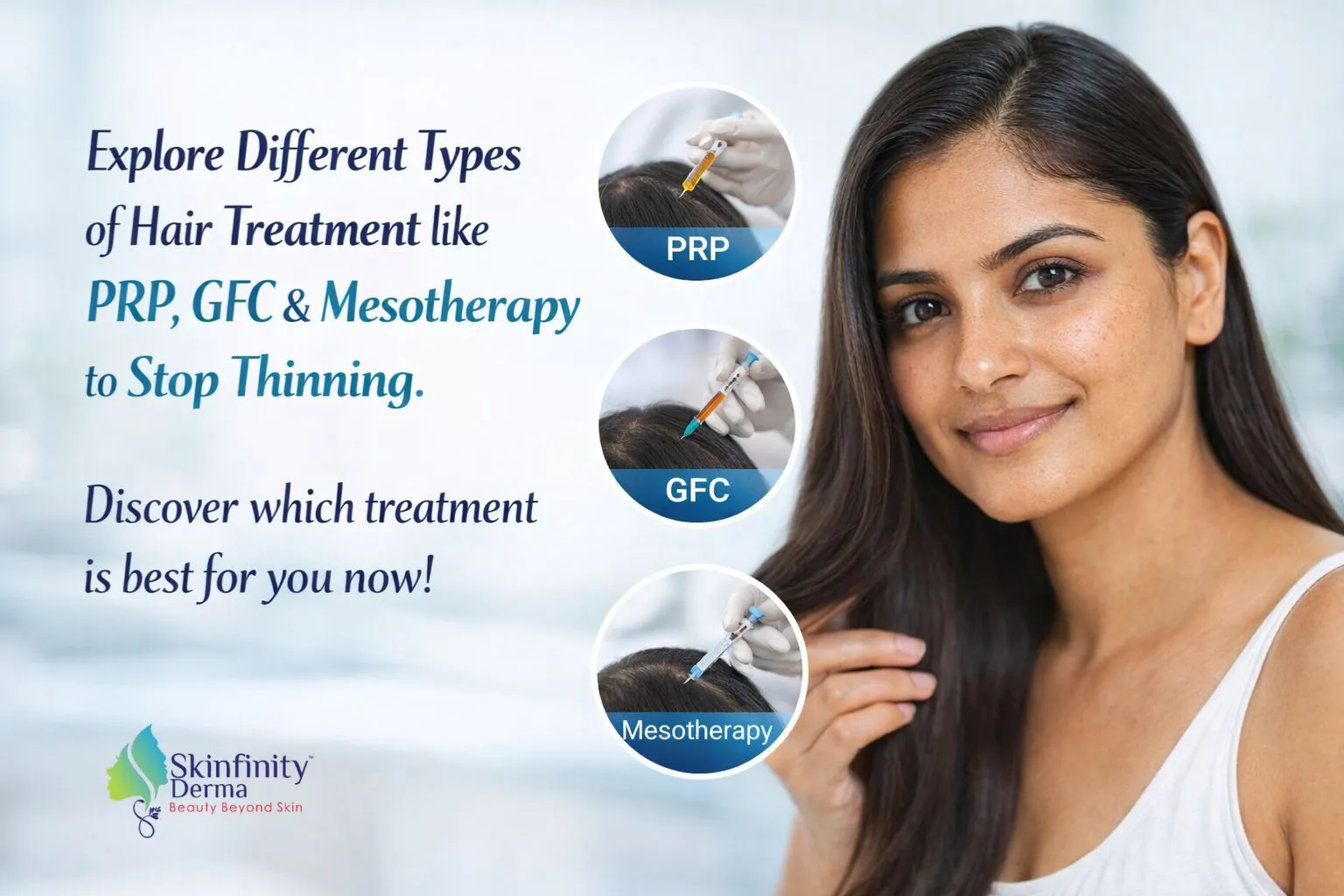
1. PRP (Platelet-Rich Plasma) Therapy
If you are looking for a natural hair treatment therapy, PRP is often the first recommendation. It involves drawing a small amount of your blood, processing it to concentrate the platelets, and then injecting this "liquid gold" back into the scalp.
-
How it works: Platelets are rich in growth factors. When injected into the scalp, they stimulate dormant hair follicles to enter the growth phase.
-
Who is it for: People experiencing hair thinning or early stages of hair loss.
-
Why is it a good hair treatment: It uses your body’s own cells, thus there is almost no risk of an allergic reaction.
2. GFC (Growth Factor Concentrate)
GFC is the advanced, more refined successor to PRP. While PRP contains various blood cells, GFC focuses purely on the growth factors extracted from the platelets.
-
The Advantage: It is more potent and usually requires fewer sessions than traditional PRP. It is highly effective for those seeking the best hair treatment for volume and density.
-
Experience: It is a relatively painless, non-surgical procedure with no downtime.
3. Mesotherapy
Mesotherapy involves the micro-injection of a "cocktail" of vitamins, minerals, and amino acids directly into the mesoderm (the middle layer of the skin) of the scalp.
-
The Goal: To boost blood circulation and provide a direct nutritional hit to the follicles.
-
Versatility: This is an excellent treatment for hair that has become dull, thin, or slow-growing due to nutritional deficiencies.
4. Low-Level Laser Therapy (LLLT)
Often referred to as "Red Light Therapy," LLLT is a non-invasive hair care treatment option. It uses medical-grade lasers to deliver light energy to the scalp.
-
The Science: The light energy increases cellular metabolism and improves blood flow to the follicles.
-
Best Used For: It is often used as a supportive therapy alongside PRP or Mesotherapy to enhance results.
5. QR678 Hair Growth Factor Therapy
QR678 is a relatively new and highly researched hair treatment therapy. It involves a proprietary blend of growth factors that are biomimetic (they mimic the natural growth factors in our scalp).
-
Why it's popular: It has shown remarkable results in clinical trials for treating alopecia and is often considered a top-tier good hair treatment for those who aren't ready for a transplant but need significant regrowth.
Which is the Best Treatment for Hair? (How to Choose)
One of the most frequent questions we hear at Skinfinity Derma is: "Which is the best treatment for hair?"
The honest answer? There is no "one size fits all." The best hair care treatments are those that are carefully chosen to address your specific concern, hair type, and scalp condition.
Scenario A: You are noticing a widening partition or thinning crown.
In such cases, a combination of GFC and QR678 is often the most effective approach. These treatments focus on reviving "tired" follicles before they completely stop producing hair.
Scenario B: You’ve had a sudden bout of hair fall after a high fever or stress.
This is likely Telogen Effluvium. Here, Mesotherapy combined with a targeted nutritional plan is usually the best hair care treatment to get your hair cycle back on track.
Scenario C: You have significant balding patches.
If the follicles have completely miniaturized or died, non-invasive hair treatments might not be enough. This is where a Hair Transplant (FUE or DHT techniques) becomes the best hair treatment for permanent restoration.
Scalp Health: The Foundation of Any Treatment
You cannot grow a beautiful garden in poor soil. Similarly, the treatment of hair is incomplete without addressing the scalp. Many people mistake scalp issues for simple dryness when it might actually be a medical condition.
At Skinfinity Derma, we integrate scalp detox and medical-grade anti-dandruff therapies into our hair care treatments. If your scalp is inflamed, itchy, or excessively oily, any treatment for hair growth will be less effective. We ensure the "soil" is healthy before we plant the seeds of growth.
The Skinfinity Derma Approach: Why Clinical over Commercial?
You might see "hair treatments" advertised at your local salon—Spa treatments, Keratin, or Smoothening. While these may improve the appearance of your hair temporarily, they are not true medical hair treatment therapies designed to address the underlying cause. In fact, many salon treatments use harsh chemicals that can lead to further hair thinning over time.
Why choose clinical treatment of hair?
-
Expert Diagnosis: We use trichoscopy (digital scalp analysis) to see what the naked eye cannot.
-
Safety: All procedures are performed by trained dermatologists in a sterile environment.
-
Long-term Results: We focus on the biology of the hair, not just the aesthetics.
-
Customization: Your treatment for hair is tailored to your hormonal profile, lifestyle, and hair type.
What to Expect During Your Hair Restoration Journey
Starting a hair treatment therapy is a commitment. Unlike a haircut, you won't see the full results in an hour.
-
The Consultation: We start with a deep dive into your history like your stress levels, sleep pattern, and diet.
-
The Treatment Phase: Most hair treatments require a series of sessions (usually 4 to 8) spaced a few weeks apart.
-
The Maintenance: Once we achieve hair growth, we provide a maintenance plan to ensure long lasting results.
Common Myths About Hair Treatments
When searching for the best hair care treatments, you will likely encounter a lot of misinformation. Let’s clear some of that up:
-
Myth 1: "Shaving your head makes hair grow back thicker."
-
Fact: Shaving has zero impact on the follicle. It only changes the tip of the hair, making it feel coarser for a moment. Only clinical treatment of hair can change thickness.
-
-
Myth 2: "Hair treatments are only for men."
-
Fact: Female pattern hair loss is fairly common. Women make up a large percentage of those seeking hair treatment therapy at Skinfinity Derma.
-
-
Myth 3: "If I start a treatment, I can never stop."
-
Fact: While some conditions like genetic thinning require long-term management, many types of hair treatments are designed to "jumpstart" your hair, after which simple lifestyle changes and topicals can maintain the hair health.
-
Life After Treatment: How to Maintain Your Results
Even the hair best treatment requires some home care. To maximize the results of your hair care treatments, we recommend:
-
A Protein-Rich Diet: Hair is made of keratin (a protein). Ensure you’re eating enough eggs, lentils, lean meats, or nuts.
-
Scalp Massage: This keeps the blood flowing to those newly stimulated follicles.
-
Gentle Handling: Avoid excessive heat and tightly tied hairstyles that cause traction.
Conclusion: Take the First Step Toward Better Hair
The first thing people see about you is your hair; and your hair is a reflection of how you see yourself. In case you have been having problems with your hair, you should not wait until it is too late.
The team of experts at Skinfinity Derma will be there to answer your questions regarding the best hair care treatments to prevent further hair loss and an intensive treatment that would restore your lost hair. We combine medical knowledge and state-of-the-art technology and provide the most effective hair treatments.
No more wondering which is the best treatment for hair and trust Skinfinity Derma.
Ready to reclaim your mane?
Visit Skinfinity Derma today to book a consultation with our expert trichologists and dermatologists. Let’s start your journey toward thicker, healthier, and more vibrant hair.
Frequently Asked Questions (FAQs)
1. Does it hurt during the treatment for the hair?
The majority of clinical therapies, such as PRP or Mesotherapy entail micro- injections. We work with very fine needles and numbing creams in order to make the process as comfortable as possible. The majority of patients describe the feeling as slight pinching.
2. How soon can I see results?
The growth of hair is slow (approximately half an inch a month). As a general rule, it takes 2-3 sessions to see a decrease in hair fall and it takes 4-6 months to see new hair growth while taking regular hair treatment therapy.
3. Are they costly treatments?
The price will be dependent on the kind of hair treatments prescribed. We consider it an investment—not an expense. Instead of spending repeatedly on endless bottles of so-called “miracle” shampoos that promise growth but rarely deliver real results, investing in a scientifically backed hair treatment often turns out to be more cost-effective in the long run.
4. Will it be possible to get a hair treatment with a sensitive scalp?
Absolutely. In fact, medical hair treatments are often exactly what a sensitive scalp needs. Professional treatments use medical-grade, hypoallergenic formulations designed to be safe and controlled. We also closely monitor how your scalp responds during and after each session.

 Call Now
 WhatsApp