
Medically Reviewed by: Dr. Dharmesh Kumar
MBBS, MD (Dermatology, Venereology, and Leprosy) | Skinfinity Derma Clinic
Read Time: 8 Minutes
Hair loss can be a slow and insidious thing. One day, you find a little more hair on your pillow. The next, your hairline starts receding. Soon enough, you are glued to your laptop, searching for a solution. If you have reached the stage where you're considering hair transplant, you're in the right place. At Skinfinity Derma, we firmly believe that an informed patient is a confident patient. So before you call up clinics for hair transplant surgery cost comparison or book your consultation, let us guide you through the hair transplant methods you have access to:
Hair transplantation is not a new thing. From its very beginning when it was painful, difficult, and looked slightly unnatural to the present where it is a precise, Minimally Invasive surgery with completely natural-looking results, this cosmetic solution has come a long way. So whether you're searching for best hair transplant in Noida or just a detailed understanding, you are in the right place.
What Exactly Is a Hair Transplant?
A hair transplant is a surgical technique wherein hair follicles are moved from a part of the body where they are thick, healthy and dense (normally the back or sides of the scalp) to bald or sparse areas of the scalp. The idea is quite simple – since the donor hair has genetic immunity from the DHT hormone (dihydrotestosterone) which causes most hair loss in men and women, the transplanted follicles will continue to grow indefinitely in the new area.
The entire success of a hair transplant hinges upon two crucial factors – the hair transplant technique and the skill of the surgeon executing it. While a different hair transplant technique will be suitable for different people depending on the degree of baldness, the flexibility of their scalp, their preferences and their budget. Let us elaborate upon the hair transplant methods.
The Main Hair Transplant Techniques
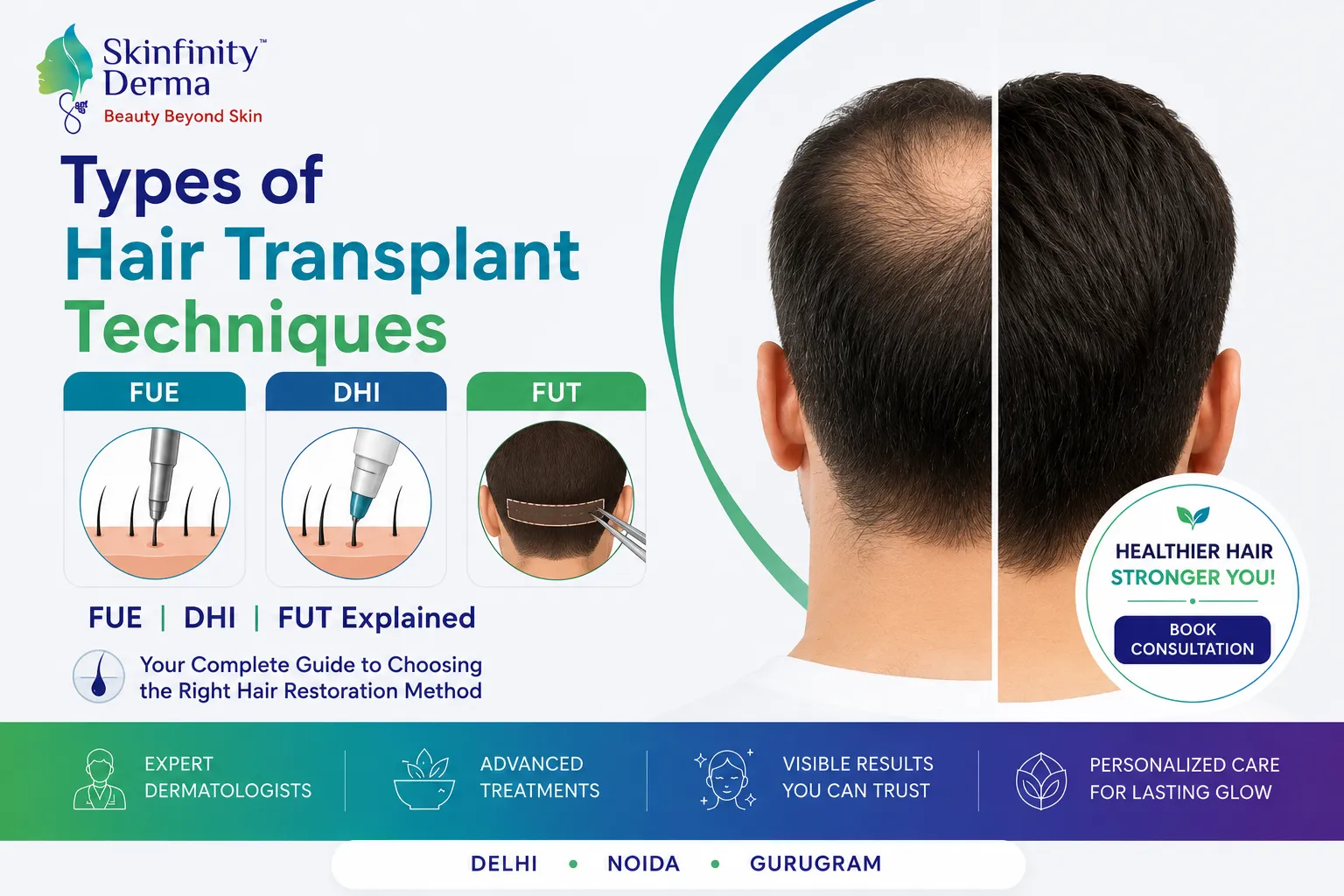
1. FUE (Follicular Unit Extraction)
This is at present the most popular hair transplant procedure performed worldwide. In this method, a tiny punch is used to extract hair follicles from the donor site one by one and then they are reimplanted into the recipient area. This method does not leave a linear scar and therefore patients can have very short hairstyles post the surgery.
How It Works:
-
The doctor carefully maps the donor and the recipient area
-
Local anaesthesia is given for the procedure
-
Micro punch tools are used for the extraction of grafts from the donor site. These are normally around 0.6-1 mm in diameter and individual follicles are removed at a time.
-
The extracted follicles are preserved in a saline solution.
-
Tiny incisions are made at the recipient site where the hair needs to be implanted.
-
The grafts are placed into the incisions at an appropriate angle to ensure a natural appearance.
Advantages of FUE:
-
Since there are no linear scars post surgery, patients have the option to keep their hair short.
-
Faster healing and recovery in comparison to earlier techniques.
-
Applicable for both men and women.
-
Can be done in multiple sittings for the recipient to get extensive coverage.
-
Completely natural results when performed by an experienced surgeon.
Limitations:
• Takes longer per session because follicles are extracted individually
• May require multiple sittings for advanced baldness
• Cost per graft tends to be higher than FUT
FUE is widely considered the gold standard technique and is the most commonly offered procedure at clinics offering best hair transplant in Noida.
2. DHI (Direct Hair Implantation)
This is the evolved version of FUE; the extraction technique used is the same but is quite different at the implantation stage. In this method, the follicles are extracted using micro punch tools similar to the FUE technique and then these are implanted using a specialised Choi Implanter Pen which inserts the hair directly into the scalp without any need for previous incisions.
How It Works:
• Hair follicles are extracted using a micro punch similar to FUE
• Each follicle is loaded individually into the Choi pen
• The pen simultaneously creates a channel and implants the graft in one motion
• No prior incisions are made in the recipient area
Advantages of DHI:
-
Since the grafts spend minimal time outside the scalp, the survival rate of grafts is higher.
-
The hair is implanted without having to shave the entire recipient area thus suitable for women or those wanting complete discretion.
-
Offers a higher degree of control over the angle, depth and direction of the transplanted hair resulting in excellent natural-looking density.
-
The recipient site is less traumatised and hence heals quicker.
-
It is ideal for hairline enhancement and fine-tuning the density of the hair in specific areas.
Limitations:
• Requires more time and expertise making it costlier
• Fewer grafts can be implanted per session compared to FUE
• The skill of the technician handling the Choi pen matters greatly
If you are looking for hairline sculpting or natural density improvement especially in early stages of hair loss DHI is often the preferred choice. This also reflects in the Hair Transplant Cost in Noida where DHI commands a premium pricing.
3. FUT (Follicular Unit Transplantation) or Strip Method
This is one of the older techniques used for hair transplants. Though older, it can be performed more quickly and efficiently for patients with very large areas of baldness needing numerous grafts, and often it is found to be the most cost-effective option per graft. In FUT, a thin strip of tissue from the scalp that contains healthy donor hair follicles is surgically removed from the donor site (normally the back of the head), the follicles are then extracted from the strip and finally reimplanted into the recipient sites.
How It Works:
-
A horizontal strip of tissue is removed from the donor site.
-
The incision at the donor site is closed using stitches, leaving a permanent linear scar.
-
The technicians manually separate the hair follicles from the strip under a microscope.
-
Tiny incisions are made in the balding area and the grafts are then placed into them.
Advantages of FUT:
-
More hair follicles can be harvested in a single sitting when compared to FUE or DHI, thus it's very efficient for large areas of baldness like NW 5 and NW 6 (large recipient areas).
-
It is most cost-effective per graft, and thus can be used by those with tight budgets.
-
The grafts produced are of high quality as they are dissected by technicians under magnification.
-
A good choice for those with extensive hair loss.
Limitations:
• Leaves a permanent linear scar at the donor site making very short hairstyles difficult
• Longer recovery time due to the sutured incision
• More discomfort post-surgery compared to FUE or DHI
• Not suitable for patients who are prone to keloid scarring
While FUT has seen a decline in popularity due to the scar issue it remains a clinically valid and often more affordable option. When comparing hair transplant surgery cost FUT generally comes in lower than FUE or DHI.
4. Robotic FUE (ARTAS and Similar Systems)
Robotic hair transplant is the latest frontier in hair restoration. Using AI-powered robotic systems like ARTAS surgeons can extract follicular units with machine-level precision. The robotic arm analyses the scalp maps out the donor area and selects the optimal follicles for extraction.
Advantages:
• Consistent precision in follicle selection and extraction
• Reduced human error during the extraction phase
• Faster extraction compared to manual FUE
• Minimal trauma to the surrounding follicles
Limitations:
• Significantly higher cost than manual FUE
• Not yet available at all clinics
• Still relies on surgeon skill for the implantation step
• May not be necessary for straightforward cases
Comparison of All Four Techniques at a Glance
Book An Appointment
|
Feature |
FUE |
DHI |
FUT |
Robotic FUE |
|
Technique |
Follicle Extraction |
Direct Implantation |
Strip Method |
AI-Guided Extraction |
|
Scarring |
Tiny dots only |
Minimal dots |
Linear scar |
Minimal dots |
|
Recovery Time |
7 to 10 days |
5 to 7 days |
2 to 3 weeks |
7 to 10 days |
|
Graft Survival |
High |
Very High |
High |
Very High |
|
Best For |
Large bald areas |
Hairline design |
Maximum grafts |
Precision cases |
|
Cost in Noida |
Moderate |
Higher |
Lower |
Highest |
|
Pain Level |
Low |
Very Low |
Moderate |
Very Low |
*All cost estimates are approximate and vary based on clinic, surgeon expertise, and the number of grafts required.
Hair Transplant Cost in Noida: What to Expect
One of the most frequently asked questions we hear is about Hair Transplant Cost in Noida. And honestly the answer depends on several variables. Here is a realistic breakdown to help you plan.
|
Technique |
Approx. Grafts |
Cost Per Graft (INR) |
Total Estimate (INR) |
|
FUT |
2000 to 4000 |
20 to 30 |
40000 to 1,20,000 |
|
FUE |
1000 to 3000 |
35 to 60 |
50000 to 1,50,000 |
|
DHI |
1000 to 2500 |
60 to 100 |
80000 to 2,00,000 |
|
Robotic FUE |
1000 to 2500 |
80 to 130 |
1,00,000 to 2,50,000 |
*These are indicative ranges. Always consult a qualified dermatologist for a personalised quote based on your hair loss grade and graft requirement.
Factors that affect the overall hair transplant surgery cost include:
• The total number of grafts needed (determined by the Norwood Scale of baldness)
• The technique chosen (DHI and Robotic being the most premium)
• The experience and reputation of the surgeon
• The geographic location and the clinic infrastructure
• Any additional treatments like PRP therapy recommended alongside
At Skinfinity Derma we make sure that every patient gets a transparent quote with no hidden charges. We believe the best hair transplant in Noida is not just about technique but also about honest communication and post-procedure care.
Which Technique Is Right for You?
This is a question that can only be truly answered after a proper scalp assessment and consultation with a trained hair restoration expert. That said here is a general guide to help you start thinking about it.
|
Technique |
Ideal Candidate |
Not Recommended If |
|
FUE |
Hair loss at any stage, active lifestyle |
Very dense donor area needed |
|
DHI |
Refined hairline, early to mid stage loss |
Budget is a concern |
|
FUT |
Extensive baldness, needs maximum grafts |
Prone to keloid scarring |
|
Robotic FUE |
Precision seekers, tech-forward patients |
Very tight budget |
Remember that the best technique for you is the one that aligns with your hair loss grade, your expectations, your lifestyle and your budget. A consultation at a reputed clinic is the first and most important step.
What Happens After the Procedure?
Aftercare is vital to the success. Regardless of the technique used, here is how the recovery will go.
-
Days 1 to 3: There will be some swelling, redness and discomfort. Your surgeon will provide you with medications.
-
Days 4 to 10: Scabs form around the transplanted follicles. Don't remove them. Allow these to slough off.
-
Weeks 2-4: Transplanted hair will fall out. This is expected and normal. It is called shock loss.
-
Month 3 to 4: New hair may start to grow. This may be sparse at first.
-
Month 6-9: Significant increase in hair density.
-
Month 12 to 18: Full results are visible. Your hair looks natural and permanent.
Carefully following your surgeon's post-procedure instructions regarding sleep positions, showering and sun exposure will play a key role in the survival and growth of your hair grafts.
Are There Any Risks Involved?
Hair transplantation is a safe procedure when carried out by trained medical professionals in a sterile environment. However, as with any surgery there are risks.
-
Donor and recipient site infections (uncommon provided aftercare is followed)
-
Folliculitis or infection of hair follicles
-
Shock loss in the non-transplanted hair (temporary)
-
Unnatural appearing hairline if poorly designed
-
Scarring particularly with the FUT technique
-
Graft loss because of mishandling and inadequate blood supply
Fortunately, under the care of an expert dermatologist or a board-certified hair restoration surgeon the risk of complications is low. That's why it's important to seek out the best hair transplant in Noida clinic with a proven record rather than the lowest price.
Why Choose Skinfinity Derma for Your Hair Transplant?
Skinfinity Derma combines technical expertise and care. Our highly skilled dermatologists in Noida and hair transplant surgeons know the pattern of hair loss, expectations and concerns before undertaking a procedure. We have expertise in FUE, DHI and newer technologies to treat different patients.
Here is what sets us apart:
-
Tailored treatment plans taking into account your scalp condition.
-
Transparency in costs with no hidden charges for hair transplant surgery costs.
-
State-of-the-art technology and sterilization.
-
Experience of surgeons who have treated hundreds of patients.
-
Superb follow-up and support.
We realise it is not a quick decision and as a result it can be emotionally and financially overwhelming and not entirely expected. We just want to make sure you feel comfortable, knowledgeable and empowered so that the process is a pleasant and memorable experience.
Final Thoughts
You don't have to deal with permanent hair loss. With the right techniques and the right surgeons, a hair transplant will no doubt be life changing in terms of your look but equally important, your confidence. Be it FUE, DHI or FUT the time is now for you to take charge.
If you live in or around Noida and have decided that now is the time, then we would be pleased to discuss the possibilities with you. At Skinfinity Derma, we not only renew hair. We restore confidence.
 Call Now
 WhatsApp