
Medically Reviewed by: Dr. Neha Dhankar
MBBS, MD (Dermatology, Venereology & Leprosy) | Skinfinity Derma Clinic
Read Time: 8 Minutes
South Korea exported a record USD 11.4 billion worth of cosmetics in 2025. This growth reflects the global popularity of Korean beauty and its focus on gentle skin care.
A Korean facial treatment follows the same approach through mild cleansing and layered hydration. Gentle exfoliation may also be included to smooth the skin and support the luminous finish linked with Korean glass skin treatments.
The exact steps may differ across clinics. Anyone seeking a Korean facial in Noida and Gurgaon should choose a dermatologist-led clinic that can adjust the treatment for sensitive or acne-prone skin.
This guide explains the procedure and benefits. It also covers aftercare and Korean facial treatment cost. Read on to learn more.
Korean Facial Treatment at a Glance
Book An Appointment
|
Treatment Detail |
Overview |
|
Treatment type |
Multi-step facial focused on hydration and surface renewal |
|
Primary goal |
Softer and smoother skin with improved radiance |
|
Common steps |
Cleansing and exfoliation followed by hydration |
|
Possible additions |
Extraction or massage based on skin suitability |
|
Treatment duration |
Usually 45 to 90 minutes |
|
Downtime |
Usually minimal after a gentle protocol |
|
Suitable concerns |
Dryness and dullness with mild surface roughness |
|
Sessions required |
Depends on skin condition and treatment goals |
|
Result duration |
Usually temporary without maintenance |
|
Medical assessment |
Recommended for acne or sensitive skin |
What Is Korean Facial Treatment?
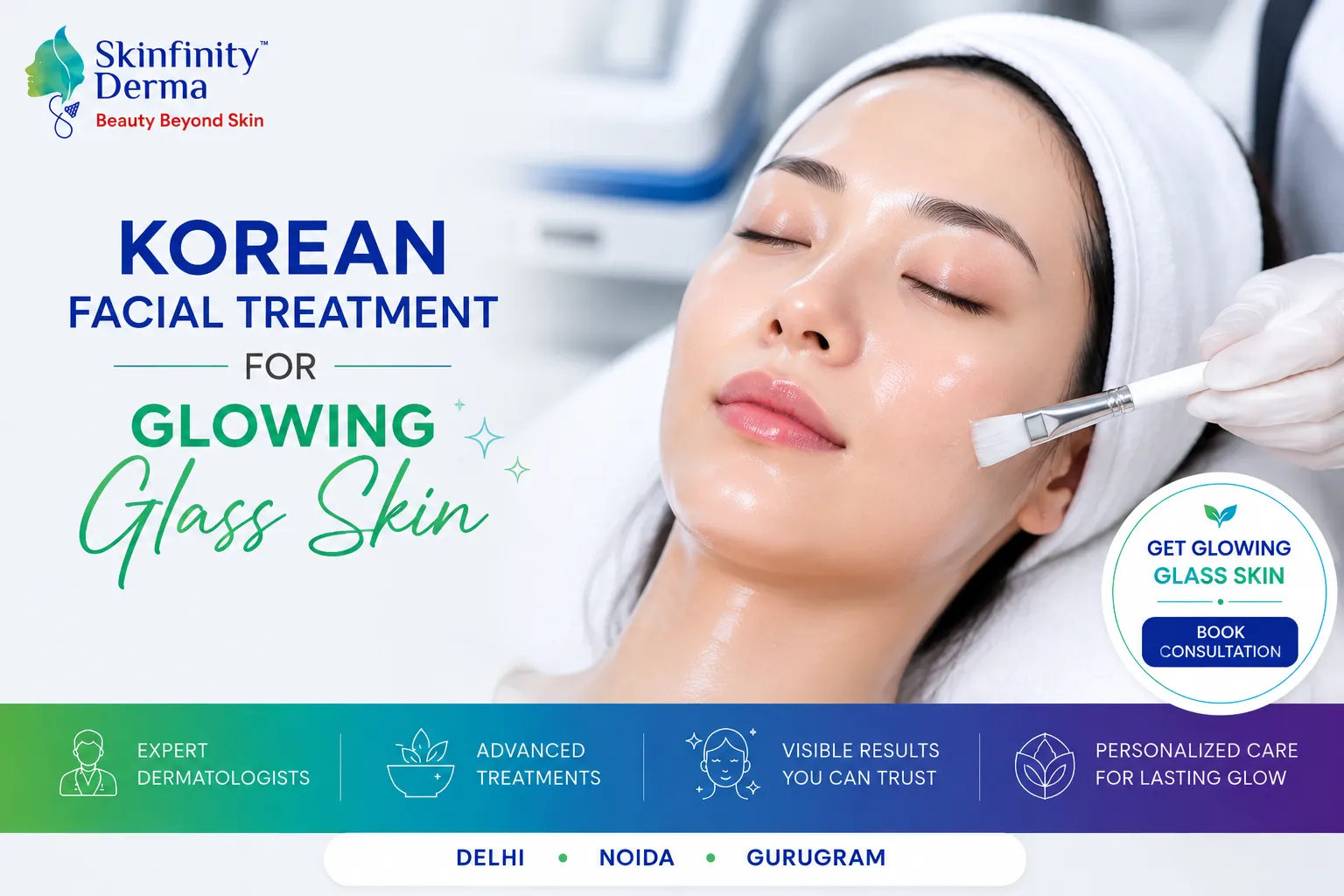
A Korean facial treatment is a multi-step skincare procedure. It is a very popular skincare regimen inspired by the Korean approach to gentle cleansing and intensive hydration. The aim is to improve skin comfort and surface smoothness while creating a naturally luminous appearance.
The treatment may begin with double cleansing so makeup and surface oil can be removed properly. Mild exfoliation may remove accumulated dead skin cells. Hydrating essences and serums are applied afterwards so the skin feels softer and more refreshed.
A sheet mask or soothing mask may form another part of the treatment. Some protocols also include gentle facial massage or LED light care. The exact steps depend on the clinic and the patient’s skin.
A Korean skincare facial should not be confused with an invasive Korean aesthetic procedure. Injectable skin boosters and microneedling require a separate medical assessment. These treatments also involve different risks and recovery needs.
What Is Korean Glass Skin?
A Korean glass skin treatment aims to create skin that looks extravagantly smooth and deeply hydrated. Glass skin is often used for skin surfaces that reflect light evenly without appearing oily. Glass skin or Korean skin originated in Korea where clear and glossy skin is widely admired.
Koreans do not necessarily inherit this appearance. The luminous and ultra-smooth look is often achieved through consistent skincare habits and intensive hydration layering. Access to professional dermatological care may also help them achieve glass-like skin.
An important point to note here is that glass skin is a beauty term rather than a medical term. Real skin is embedded with pores and minor texture. The goal thus should remain healthier-looking skin rather than an unrealistically flawless and glistening surface.
Benefits of Korean Facial Treatment
Here are the most prominent benefits of Korean facial treatment:
1. Supports Better Skin Hydration
One of the most prominent benefits of Korean facials is that it provides hydration. The treatment often includes several lightweight hydrating layers. These products may help dry skin feel softer and less tight.
Improved moisture balance can also make the complexion appear fresher as the effect usually remains temporary unless home skincare supports the result.
2. Improves Surface Smoothness
Dead skin buildup may make the complexion feel rough. Controlled exfoliation can improve the surface without using aggressive scrubs.
The skin may feel smoother after treatment. Makeup may also apply more evenly over a well-hydrated surface.
3. Supports the Skin Barrier
A gentle protocol avoids unnecessary stripping. Barrier-supporting moisturisers can also reduce dryness after exfoliation.
The right products may improve skin comfort. Irritating ingredients can still have the opposite effect so product selection remains important.
4. Offers a Customisable Treatment
The protocol can be adjusted according to skin type. Dry skin may need richer hydration while oily skin may need lightweight non-comedogenic products.
Sensitive skin can receive reduced exfoliation. Acne-prone skin may require careful avoidance of heavy oils or fragranced products.
Who Should Choose Korean Facial Treatment?
A Korean skincare facial may suit adults who experience extreme dryness or dullness. It may also help people with mild surface roughness or tired-looking skin. Suitable candidates usually are those who:
-
Want improved hydration
-
Prefer subtle skin renewal
-
Have mild surface dullness
-
Want a smoother-looking complexion
-
Have realistic expectations
-
Can follow aftercare instructions
-
Are willing to use sunscreen
-
Do not have an active skin infection
Who Should Avoid or Postpone Korean Facial Treatment?
Pregnant patients should be careful about the treatment and they must share their pregnancy status before the facial. There are some active ingredients in Korean facials that must be avoided. Patients using prescription retinoids should also inform the dermatologist as their skin may be more sensitive to exfoliation.
Some patients may need to delay the treatment until the skin settles. This includes people with:
-
Open wounds
-
Active cold sores
-
Severe inflammatory acne
-
Weeping eczema
-
Active dermatitis
-
Fresh sunburn
-
Recent aggressive peeling
-
Known allergy to treatment products
-
Recent facial surgery
-
Unexplained facial swelling
-
Skin infection in the treatment area
Step-by-Step Korean Facial Procedure
The exact procedure differs across clinics. A dermatologist-led protocol may include the following steps.
Step 1: Skin Consultation
The dermatologist reviews the skin concern and current routine. Medical history and previous treatment reactions are also discussed.
The assessment helps identify whether the facial is suitable. Active skin disease may require treatment before a cosmetic facial.
Step 2: First Cleanse
The first cleanse removes makeup and sunscreen. An oil-based or balm cleanser may be used when appropriate.
Acne-prone skin may require a non-comedogenic formulation. Heavy oils should not be used automatically.
Step 3: Second Cleanse
A water-based cleanser removes remaining residue. The product should match the skin type.
Harsh foaming cleansers can make dry skin feel tighter. Sensitive skin usually needs a fragrance-free option.
Step 4: Skin Analysis
The practitioner examines hydration and visible pores. Active breakouts and irritated areas are also checked.
The protocol may be changed at this stage. Exfoliation should be reduced when the barrier looks compromised.
Step 5: Gentle Exfoliation
A mild enzyme or chemical exfoliant may remove dead surface cells. Some protocols use gentle physical exfoliation instead.
Aggressive scrubbing should be avoided. It may worsen redness or post-inflammatory pigmentation.
Step 6: Extraction When Suitable
Blackheads may be removed through careful extraction. This step should not be performed over inflamed or painful acne.
Forceful extraction can damage the skin. It may also increase the risk of dark marks.
Step 7: Hydrating Toner or Essence
A lightweight toner prepares the skin for the next products. A hydrating essence may then support moisture retention.
The products should not contain irritating fragrance when the skin is sensitive.
Step 8: Targeted Serum
A serum is selected according to the main concern. Hydrating ingredients decrease dryness while soothing ingredients suit skin with mild sensitivity.
Brightening ingredients should be chosen carefully. Pigmentation requires a proper diagnosis rather than random product layering.
Step 9: Facial Massage
A light massage provides relaxation and improves circulation. It can also help the products spread evenly.
Massage should be avoided over painful acne or active inflammation. Excessive pressure can worsen tenderness.
Step 10: Soothing Mask
A sheet mask or gel mask may be applied to support hydration. The mask should match the skin type.
Occlusive masks may feel too heavy on acne-prone skin. Fragranced masks can also trigger irritation.
Step 11: Moisturiser
A moisturiser helps seal the hydrating layers. The texture should suit the patient’s skin.
Dry skin may need a richer formulation. Oily skin may feel more comfortable with a lightweight gel moisturiser.
Step 12: Sunscreen
A broad-spectrum sunscreen completes daytime treatment. Sunscreen remains essential after exfoliation because the skin may be more sensitive to ultraviolet exposure.
What to Expect During Korean Facial Treatment
The complete accomplishment of the Korean facial may take between 45 and 90 minutes. The exact duration depends on the steps and skin condition. The session in the initial phase feels gentle and relaxing. Patients may also experience mild tingling during exfoliation. A typical appointment may include the following things in a structured order:
-
Skin assessment
-
Double cleansing
-
Mild exfoliation
-
Optional comedones extraction
-
Layered hydration
-
Soothing mask
-
Moisturisation
-
Sunscreen application
Korean Facial Aftercare
Patients should all follow the prescribed instructions provided by the clinic. The foremost thing is to avoid makeup for at least the period recommended by the clinic. This gives skin enough time to settle after extraction or exfoliation. Daily sun protection is further important as it helps prevent pigmentation. General aftercare may include:
-
Use a mild cleanser
-
Avoid harsh scrubs
-
Delay strong exfoliating acids
-
Avoid retinoids when advised
-
Apply a gentle moisturiser
-
Use broad-spectrum sunscreen
-
Avoid unnecessary touching
-
Skip steam rooms temporarily
-
Avoid intense heat
-
Contact the clinic if irritation worsen
Korean Facial vs Regular Facial
|
Factor |
Korean Facial |
Regular Facial |
|
Main focus |
Layered hydration and gentle renewal |
Cleansing and massage with a finishing mask |
|
Cleansing |
Often uses a double-cleansing approach |
Usually includes one cleansing step |
|
Exfoliation |
Usually gentle and skin-specific |
May use scrubs or standard exfoliation |
|
Hydration |
Several lightweight layers may be used |
Often one moisturiser or mask |
|
Products |
Essences and serums may form key steps |
Creams and masks may form key steps |
|
Customisation |
Often adjusted for barrier condition |
Depends on the provider |
|
Desired finish |
Smooth and luminous glass-like appearance |
General freshness and softness |
|
Downtime |
Usually minimal after a gentle protocol |
Usually minimal |
|
Best suited for |
Dryness or dullness with mild texture |
General maintenance and relaxation |
The quality of either facial depends on the practitioner and products. The word Korean alone does not guarantee better results.
Korean Facial vs Hydrafacial
|
Factor |
Korean Facial |
Hydrafacial |
|
Treatment category |
Product-led multi-step facial |
Device-based hydradermabrasion treatment |
|
Main method |
Cleansing and layered topical hydration |
Vortex-based cleansing and extraction |
|
Exfoliation |
May use enzymes or mild acids |
Uses controlled mechanical and chemical steps |
|
Extraction |
May be manual |
Uses suction-based extraction |
|
Hydration |
Applied through serums and masks |
Serums are delivered through the device |
|
Standardisation |
Varies across clinics |
Uses a defined branded technology |
|
Needles |
No |
No |
|
Downtime |
Usually minimal |
Usually minimal |
|
Best choice |
Depends on skin type and desired experience |
Depends on congestion and hydration needs |
Hydrafacial uses patented Vortex-Fusion technology to cleanse and exfoliate the skin. The system also extracts impurities and delivers hydrating serums during one continuous procedure.
A Korean facial may rely more on manual application and layered products. The better option depends on skin sensitivity and congestion. Budget and treatment goals also influence the decision.
How Many Sessions Are Required?
|
Skin Concern |
Typical Sessions Required* |
|
Dry skin |
1 session for hydration with maintenance every 4–6 weeks |
|
Dull skin |
1–2 sessions followed by maintenance every 4–6 weeks |
|
Oily skin |
1–2 sessions with regular maintenance every 4–6 weeks |
|
Acne-prone skin |
Depends on acne severity. Facials may support skin health but active acne often requires dermatologist-led treatment. |
|
Sensitive skin |
1 gentle session initially. Future sessions depend on skin tolerance and response. |
|
Pigmentation |
A Korean facial can improve dullness but deeper pigmentation usually needs dedicated pigment treatments over multiple sessions. |
|
Mature skin |
Regular sessions every 4–6 weeks may help maintain hydration and skin radiance. |
How Long Do Korean Facial Results Last?
Results usually last several days to a few weeks. The duration depends on the skin type and products used during the facial.
Dry weather may shorten the hydrated effect. Frequent sun exposure can also reduce visible radiance.
A gentle home routine can support the result. This may include a mild cleanser and barrier-friendly moisturiser. Daily sunscreen remains essential.
Facials cannot stop normal skin-cell turnover or oil production. Maintenance may therefore be required.
Are There Any Side Effects?
Korean skin facial is a gentle treatment but it may cause mild and temporary effects. Possible side effects or reactions include:
-
Redness
-
Mild tingling
-
Temporary tightness
-
Dryness
-
Small breakouts
-
Product irritation
-
Itching
-
Mild swelling
Significant reactions are rare but they may occur after aggressive extraction or strong exfoliation. These may include:
-
Persistent redness
-
Contact dermatitis
-
Worsening acne
-
Post-inflammatory pigmentation
-
Blistering
-
Infection
-
Severe swelling
Korean Facial Treatment Cost
The Korean facial treatment cost depends on the clinic and procedure. The price also changes according to the products and devices used.
Basic salon-style Korean facials may cost less than dermatologist-led glass skin treatments. Advanced sessions may include hydrodermabrasion or specialised devices.
Estimated Korean Facial Cost in Delhi NCR
|
Treatment Type |
Estimated Cost |
|
Basic Korean glow facial |
?1,500 to ?3,500 per session |
|
Hydration-focused Korean facial |
?2,500 to ?5,000 per session |
|
Dermatologist-led Korean facial |
?4,000 to ?8,000 per session |
|
Korean glass skin treatment |
?6,000 to ?10,000 per session |
|
Advanced combination treatment |
?8,000 to ?15,000 or more |
|
Maintenance package |
Depends on the number of sessions |
The final cost of the treatment may depend on:
-
Skin condition
-
Treatment duration
-
Product quality
-
Device use
-
Doctor’s expertise
-
Extraction requirements
-
Added masks or boosters
-
Number of sessions
-
Clinic location
-
Follow-up care
How to Choose the Right Korean Facial Clinic
Patients should ask the following questions before booking:
-
Who will perform the treatment?
-
Will a dermatologist assess the skin?
-
Which products will be used?
-
Does the facial include exfoliation?
-
Will extraction be performed?
-
Are the products non-comedogenic?
-
Is the protocol suitable for sensitive skin?
-
What results are realistic?
-
How long will the results last?
-
Which side effects can occur?
-
What does the cost include?
-
Which aftercare routine is required?
Why Choose Skinfinity Derma for Korean Facial Treatment?
If you are in NCR and looking for Korean facial in Noida or Gurugram then your ultimate stop should be Skinfinity Derma Clinic. We provide dermatologist-led skin treatments for patients seeking improved hydration and radiance.
We begin every Korean facial in Noida with a detailed and personalised skin assessment. Our dermatologists in Noida examine the exact hydration level and skin texture before selecting the protocol. We take active acne and sensitivity into consideration so that an appropriate Korean glass skin treatment regime can be curated for you.
-
Dermatologist-Led Assessment
The same facial does not suit every skin type. Our dermatologists identify the main concern before recommending treatment. This helps us avoid unnecessary exfoliation on irritated skin.
-
Personalised Treatment Planning
Dry skin may need intensive hydration while acne-prone skin needs lightweight products. Sensitive skin may require a simpler protocol. We adjust the treatment rather than applying one basic routine to every patient.
-
Skin-Barrier-Focused Care
Our goal is to support skin comfort and natural radiance. Harsh scrubbing is avoided when it may damage the skin barrier.
-
Medical-Grade Hygiene
The treatment at our end follows clinic-based cleansing and hygiene protocols. Extraction is performed only when it is suitable for the skin.
-
Realistic Glass Skin Results
Real skin naturally has pores and texture. We focus on creating a smoother and healthier-looking finish instead of promising an unrealistically flawless face.
-
Clear Cost Discussion
The Korean facial treatment cost is explained after the careful and personalised assessment. Patients receive a custom estimate based on the selected protocol.
-
Structured Aftercare
Every patient receives aftercare guidance based on the treatment steps. Follow-up support is available when irritation or unexpected reactions occur. Patients searching for a dermatologist-led Korean glass skin treatment can consult our team at Skinfinity Derma Clinic.
Conclusion
A Korean facial treatment focuses on gentle renewal and layered hydration. It may improve surface smoothness and create a naturally luminous appearance. The procedure mainly comprises steps such as double cleansing and mild exfoliation. Hydrating products and barrier-supporting care form the remaining steps.
The exact protocol still varies across clinics. A Korean facial may describe a simple product-based session or a device-assisted glass skin treatment. Patients with active acne or sensitive skin need a personalised approach. Aggressive exfoliation can worsen irritation and pigmentation.
The Korean facial treatment cost depends on the clinic and treatment intensity. Product quality and device use also affect the final price. Skinfinity Derma Clinic begins every treatment with a detailed skin assessment. Our dermatologists create a personalised plan that respects the patient’s skin type and natural appearance.
Book a consultation for a dermatologist-led Korean facial in Noida. Our team can determine whether a Korean facial or another treatment will provide the most suitable result. Connect with us to learn more and receive personalised guidance toward achieving smooth and luminous glass-like skin.
FAQs
1. What Is Korean Facial Treatment?
A Korean facial treatment is a multi-step procedure that focuses on gentle cleansing and layered hydration. Mild exfoliation and soothing products may also be included to create smoother and more luminous-looking skin.
2. Is Korean Facial Good for Glowing Skin?
A Korean facial can improve temporary radiance by removing surface buildup and restoring hydration. The result varies according to the skin condition and treatment protocol.
3. How Long Do Korean Facial Results Last?
The results may remain visible for several days or a few weeks. Consistent moisturisation and daily sunscreen can help support the hydrated appearance.
4. Is Korean Facial Suitable for Sensitive Skin?
A Korean facial may suit sensitive skin after the protocol is simplified. Fragrance and strong exfoliation should be avoided when the skin barrier is reactive.
5. Can Korean Facial Reduce Pigmentation?
A facial may improve dullness around pigmented areas but it cannot reliably remove deep pigmentation. Melasma and established dark spots need dermatologist-led treatment.
6. Is There Any Downtime After Korean Facial Treatment?
A gentle facial usually causes minimal downtime. Mild redness or sensitivity may occur after exfoliation or extraction.
7. How Many Sessions Are Recommended?
Some patients notice visible freshness after one session. Monthly or dermatologist-recommended maintenance may help support more consistent results.
8. Is Korean Facial Safe for Acne-Prone Skin?
The facial may suit mild acne-prone skin when non-comedogenic products are used. Inflamed or cystic acne requires medical treatment and should not receive aggressive extraction.
9. What Is the Difference Between Korean Facial and Hydrafacial?
A Korean facial usually relies on layered skincare products and manual steps. Hydrafacial uses patented device-based technology for cleansing and extraction followed by serum delivery.
10. How Much Does Korean Facial Treatment Cost?
The cost may range from approximately ?1,500 for a basic salon facial to ?10,000 or more for a dermatologist-led glass skin treatment. Skinfinity Derma provides a personalised estimate after examining the skin.

 Call Now
 WhatsApp