

Medically Reviewed by: Dr. Ipshita Johri
MBBS, DDV | Skinfinity Derma Clinic
Read Time: 8 Minutes
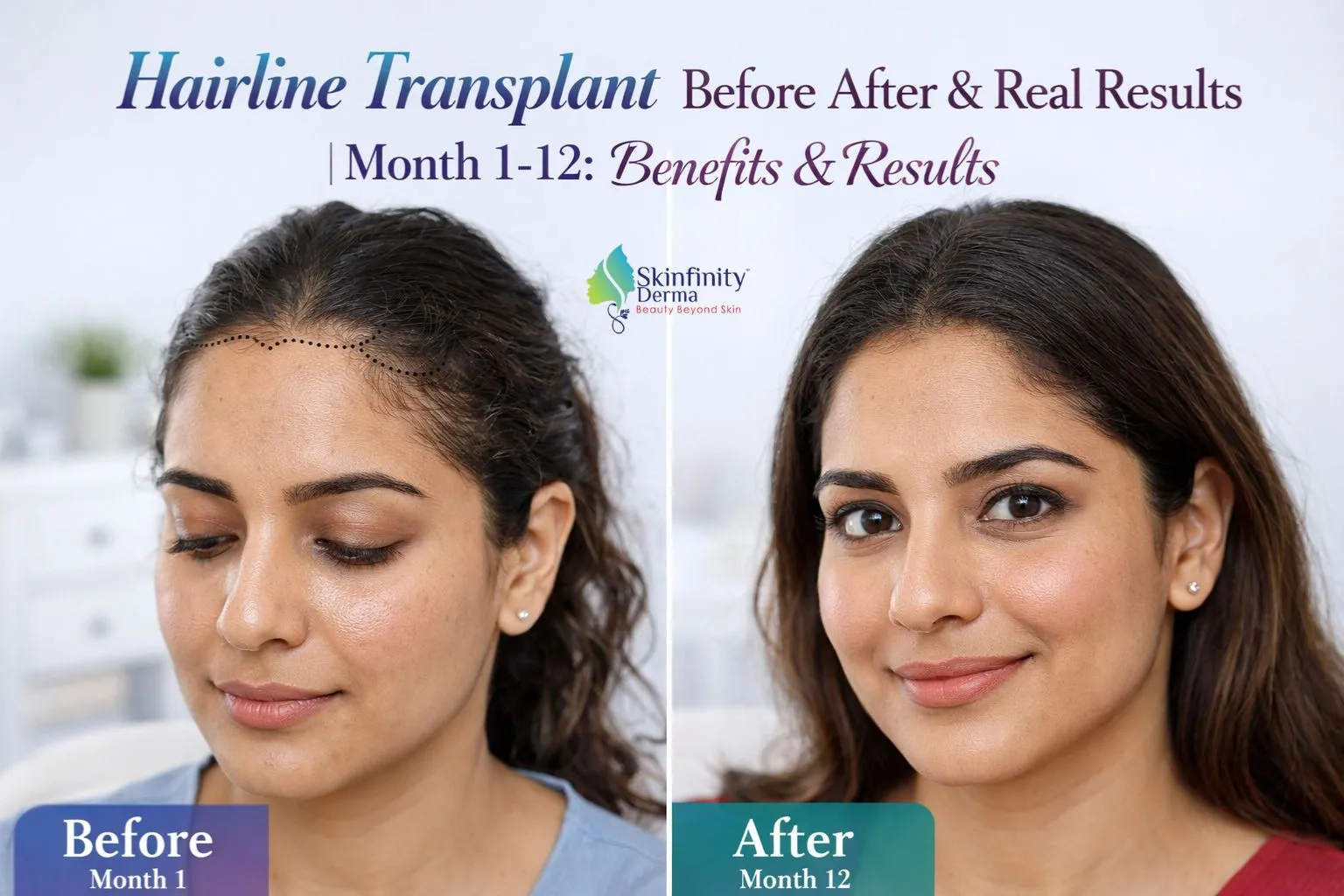
Hairline Transplant Before After: Month-by-Month Real Results
One of the most emotionally difficult cosmetic issues is hair loss on the front of the head. The receding or uneven hairline affects the way we are perceived, the way we are perceived as old or young and the amount of confidence we feel when we are in a social or workplace environment. As the medical aesthetics have improved, hairline transplantation is now a certain and long-lasting solution.
Nevertheless, this is the same question many patients ask:
What are the actual long-term results of a hairline transplant?
The changes depicted in photos on the Internet are usually dramatic, yet seldom describe the process of transformation between the “before” and “after.” The thing is that hair restoration is a biological process. You must learn to appreciate the results of a hairline transplant, which is possible only by knowing how the process of healing, shedding, and regrowth occurs each month.
This comprehensive manual covers the entire process of hairline transplant prior to and after results, why they appear natural, how many grafts are needed, how the techniques and age affect the results and how you can safeguard your investment to ensure long-term success.
The Ultimate Guide to Hairline Transplant Results: Timelines, Graft Counts, & Before/After Proof
A hairline transplant is not just a matter of introducing hair follicles in the head. It consists of artistic design and medical science. It is not only about hair growing but also about hair growing to a hairline that fits your face, your age, and your natural face hairstyle.
When patients are aware of the schedule and anticipations, they are much more contented about their result. Transplantation of hair occurs in stages, and the stages are significant to the overall appearance.
Key factors that influence visible results include:
-
The number of grafts transplanted
-
Hair thickness and texture
-
Surgeon’s expertise in hairline design
-
Healing response of the patient
-
Post-procedure care
When all these elements work together, the transformation seen in hairline transplant before after images can be life-changing.
What Makes Hairline Transplant Results Look 100% Natural?
Natural-looking results are the ultimate goal of every successful hairline transplant. The difference between an obvious transplant and an undetectable restoration lies in design precision and implantation technique.
1. Hairline Design and Facial Proportion
A natural hairline is never perfectly straight. It has slight irregularities and soft curves that mimic natural growth patterns. Surgeons design the hairline by considering:
-
Forehead height
-
Facial symmetry
-
Existing hair pattern
-
Age and future hair loss risk
A very low, aggressive hairline may look good initially but can appear unnatural as surrounding hair continues to thin over time. A conservative and age-appropriate design ensures long-term harmony.
2. Angle and Direction of Hair Growth
Each hair follicle must be implanted at the correct angle:
-
Front hairline grows at 10–15 degrees
-
Temple points grow diagonally
-
Crown area follows a swirl pattern
Incorrect angles can make hair look stiff or artificial. Correct orientation allows the transplanted hair to blend seamlessly with existing hair.
3. Graft Selection
The front hairline should contain only single-hair grafts to create a soft, feathered appearance. Behind this zone, two- and three-hair grafts are used for density.
This layered approach is essential for realistic hairline transplant results.
Month-by-Month Hairline Transplant Results: The Complete Timeline
Understanding the timeline prevents unnecessary anxiety and helps patients remain patient during the early months.
Month 1: Healing Phase
During the first few weeks:
-
Mild swelling and redness may appear
-
Small scabs form around grafts
-
Donor area begins to heal
-
No visible hair growth yet
This phase focuses on healing rather than growth.
Month 2: Shock Loss Phase
Many patients experience temporary shedding of transplanted hair. This is known as shock loss and is completely normal.
-
Hairline may look empty
-
Follicles remain alive under the skin
-
New growth will follow
This is often the most emotionally challenging stage.
Month 3: Dormant Phase
Hair follicles enter a resting stage:
-
Minimal visible change
-
Some fine baby hairs may appear
-
Growth is slow and uneven
This stage tests patience but signals that follicles are preparing for growth.
Month 4–5: Early Regrowth
At this point, the transformation becomes noticeable:
-
Thin hair strands begin to grow
-
Hairline shape becomes defined
-
Density is still low
This is when most patients start seeing clear hairline transplant before after differences.
Month 6: Visible Improvement
By the sixth month:
-
Hair becomes thicker
-
Coverage improves significantly
-
Styling becomes possible
Confidence begins to return.
Month 7–9: Maturation Phase
Hair continues to mature:
-
Texture becomes stronger
-
Density increases
-
Hair blends with natural scalp hair
Month 10–12: Final Results
This is when true hairline transplant results can be evaluated:
-
Full thickness achieved
-
Natural look established
-
Long-term stability visible
Hairline Transplant Before After: Graft Count Breakdown
Among the most frequently asked questions that patients anticipate prior to a procedure is the one of determining how many grafts they need to get the best of natural hairline transplantation.
The solution lies in two things: the degree of hairline recession and the degree of density that you want. The count of grafts is very important to how thin, natural, and long-lasting your hairline transplant will look before and after the transformation.
Hair transplantation takes advantage of your own natural follicles as opposed to wigs or cosmetic fillers. Every graft has 1 or 4 hair follicles, and their close areas are what make it look full. The correct amount of graft calculated will make sure that there is a balanced coverage without overworking the donor area.
Average Graft Requirements Based on Hairline Recession
The number of grafts required depends on the patient. Nonetheless, physicians tend to adhere to a conventional clinical spectrum in accordance with the extent of the frontal hairline that requires enhancement.
Mild Recession (800–1200 grafts)
This phase is normally accompanied by a small amount of hair loss or slight receding of the hairline at the temples. In this group of patients, the idea is to build up and hone the existing hairline and not to restore it fully.
The outcomes are not usually dramatic but effective, now with a renewed and fresh look without excessive transformation.
Moderate Recession (1500–2000 grafts)
The hairline has shifted backward at this point, and the temples are more pronounced. The restoration involves the reconstruction of the frontal hairline and putting on more density within a broader area of surface.
This is the range of grafts most frequently used in hairline transplantation and yields an obviously visible hairline transplant before-and-after outcome in 6 to 9 months.
Advanced Recession (2500–3500 grafts)
This category includes patients who are in deep recession or have an M-shaped hairline. This is aimed at restoring the whole frontal frame of the face.
It takes more grafts to achieve the asymmetry so as not to have a thin and artificial hairline.
Full Frontal Restoration (3000–4000 grafts)
The reason why this is required is when the anterior scalp of the head is considerably flattened. The process is concerned with the reconstruction of a full hairline and the addition of density to it.
These cases require professional planning to retain the health of the donor area and still achieve natural and high-density hairline transplantation.
Density Considerations for Natural Hairline Transplant Results
Graft count alone does not guarantee a natural appearance. Density — measured as grafts per square centimeter — is equally important.
A natural hairline typically requires:
-
30–35 grafts per cm?2; in the frontal hairline zone
This area must look soft and feathered. Too much density can look unnatural, while too little can appear patchy. -
40–45 grafts per cm?2; behind the hairline
The region just behind the hairline needs higher density to create the illusion of thickness and support the frontal zone visually.
This gradual increase in density from front to back mimics natural hair growth and is essential for realistic hairline transplant before after results.
FUE vs. DHI: Does the Technique Change Your Hairline Transplant Results?
Both FUE and DHI are modern and effective methods of hair transplantation.
FUE (Follicular Unit Extraction)
In FUE, grafts are extracted individually and then implanted into pre-made channels.
Advantages include:
-
Suitable for large areas
-
High graft survival
-
Cost-effective
-
Minimal scarring
DHI (Direct Hair Implantation)
DHI uses a special implanter pen to insert grafts directly without creating channels first.
Advantages include:
-
More control over angle and depth
-
Faster recovery
-
Higher precision for hairline design
Which is Better?
The technique alone does not determine success. Surgeon expertise plays a much bigger role. Both methods can produce excellent hairline transplant results when done correctly.
How Age and Hair Type Impact Your Results
Age Factor
Younger patients (20s–30s) often heal faster but may continue losing native hair. This requires conservative planning.
Older patients (35+) usually have a stable hair loss pattern, making results more predictable.
Hair Type
Hair texture and thickness significantly affect visual density:
-
Straight hair needs more grafts
-
Wavy or curly hair looks fuller
-
Thick hair shafts create better coverage
-
Thin hair may require higher density
Skin tone and hair colour contrast also play a role. Lower contrast creates the illusion of thicker hair.
5 Ways to Protect and Maximize Your Hairline Transplant Results
A transplant’s success depends not only on surgery but also on aftercare.
1. Follow Medical Instructions
Patients should avoid scratching, excessive sun exposure, and intense exercise for at least two weeks. Gentle washing is essential.
2. Use Prescribed Medications
Doctors may recommend medications like minoxidil or finasteride to support growth and prevent further hair loss.
3. Eat for Hair Health
A protein-rich diet with iron, zinc, and vitamins improves blood circulation to follicles and speeds healing.
4. Avoid Smoking and Alcohol
Both reduce oxygen supply to grafts and slow recovery.
5. PRP Therapy
PRP sessions after transplant enhance thickness and speed up growth, improving overall hairline transplant results.
Emotional and Psychological Impact of Hairline Transplant Before After
Beyond physical change, patients often experience:
-
Improved self-esteem
-
Younger appearance
-
Better professional confidence
-
Greater comfort in social settings
Many describe their transformation as not just cosmetic but emotionally empowering. Seeing real hairline transplant before after progress can feel like reclaiming a part of one’s identity.
Common Myths About Hairline Transplant Results
-
Myth: Results are instant
Truth: Full results take 9–12 months -
Myth: Transplanted hair will fall out again
Truth: Donor hair is genetically resistant -
Myth: Hairline looks fake
Truth: Modern techniques produce natural results -
Myth: One session lasts forever
Truth: Future hair loss may need maintenance treatments
Conclusion
Hairline restoration is a journey, not an overnight miracle. Real success lies in understanding biology, trusting the process, and choosing experienced professionals.
The transformation seen in hairline transplant before after images is the result of:
-
Careful planning
-
Artistic hairline design
-
Correct graft placement
-
Proper patient aftercare
When done correctly, hairline transplant results are permanent, natural, and deeply confidence-boosting. With patience and proper guidance, hair restoration can restore not only your hairline but also your self-image. This is where Skinfinity Derma comes to your rescue. Backed by a team of professionals, you can rest assured that your journey is in safe and reliable hands.
FAQS
1. What is the approximate time frame for showing the final hairline transplant?
The outcome of the final hairline transplant normally takes between 10 and 12 months to be seen. Growth begins at 34 months of age and then thickens gradually.
2. Will my hair look natural with a wet hairline or when it is swept back?
Yes. When done properly, the hairline is made with natural angles and with individual hair grafts on the front; hence, it appears natural even when wet or even when styled backwards.
3. Are the outcomes of hairline transplants permanent?
Yes. The hair which is transplanted is harvested in the donor area, which is genetically resistant to hair loss; hence, the results are perceived as permanent.
4. What is the number of grafts required to do a normal hairline transplant?
The number of grafts needed to give most types of hairline transplants ranges between 1,500 and 2,500 each, depending on the amount of recession and the desired density.
5. Why are the hairs planted out in the first weeks of the transplant?
This is called shock loss. It is a natural process of hair growing. The follicles are alive beneath the skin and after some few months, they start growing new hair.
6. Does a hair transplant decrease a natural high forehead?
Yes. The hair transplant can also be made to form a lower and more appropriate hairline, provided it is done conservatively to form a natural, age-appropriate hairline.
7. Which is the better method of restoring hairline FUE or DHI?
FUE and DHI are both effective. DHI has better angle and depth control and FUE is better in bigger areas. The skill with which the surgeon performs is much more important than the technique.
8. Do hairline transplants hurt, and what is the recovery period?
It is performed under local anaesthesia, and therefore pain is insignificant. Within 37 days, most of the patients resume normal functioning, with full recovery taking place in approximately 2 weeks.
9. Do female results of hairline transplants differ from those of males?
Yes. Female transplants are more directed to density and shape than recession, and outcomes are planned to achieve a soft, natural hairline.
10. And what is the optimal age at which to transplant a hairline?
The optimal age is normally 25 years and over since hair loss patterns can be more predictive and the results can be planned.

 Call Now
 WhatsApp