

Medically Reviewed by: Dr. Shradha Gumber
MBBS, MD - Dermatology , Venereology & Leprosy | Skinfinity Derma Clinic
Read Time: 8 Minutes
Hair fall can begin after stress or illness. It may also develop gradually because of genetics or hormonal changes. The correct treatment depends on the reason behind the shedding.
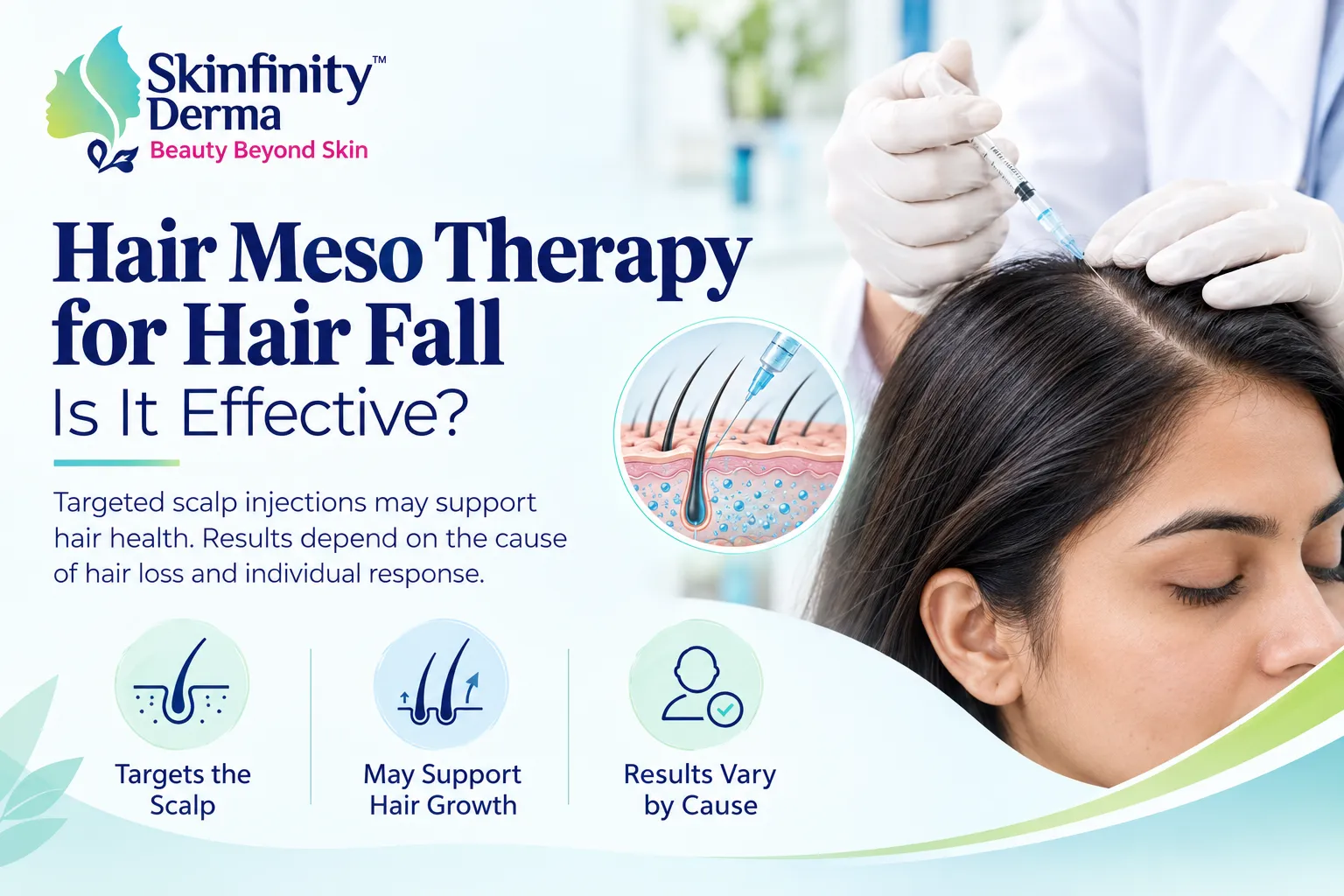
Hair mesotherapy is a minimally invasive scalp treatment that delivers selected ingredients through multiple small injections. The injected formulation may contain vitamins or amino acids. Some protocols use peptides or prescription medicines.
The purpose of hair meso treatment is to deliver selected substances close to the hair follicles. It may support scalp health and improve hair density in suitable patients. However, it cannot treat every cause of hair loss.
Research on mesotherapy for hair loss remains limited. Products and injection schedules also vary between studies. A dermatologist should therefore diagnose the condition before recommending treatment.
What Is Hair Mesotherapy?
Hair mesotherapy involves placing small quantities of selected ingredients into the scalp through superficial injections. A dermatologist performs the procedure across areas affected by thinning.
There is no single standard hair mesotherapy formula. Depending on the treatment plan, the injected solution may contain:
-
Amino acids
-
Peptides
-
Vitamins
-
Minerals
-
Hyaluronic acid
-
Antioxidants
-
Hair-supporting complexes
-
Prescription medicines in selected cases
The ingredients should be chosen according to the diagnosis. A generic injection mixture may not suit every patient.
Hair mesotherapy is not a hair transplant. It does not move follicles from one part of the scalp to another. It also cannot create new follicles where permanent scarring has destroyed them.
The procedure is generally considered an additional treatment. It may be used with medical therapy when a dermatologist believes the combination is appropriate.
How Does Hair Mesotherapy Work for Hair Fall?
Hair mesotherapy delivers selected ingredients directly into the superficial layers of the scalp. The intended effect depends on the substance being injected.
The treatment may work through the following mechanisms:
1. Targeted Delivery
The injections place the formulation close to the treatment area. This allows a dermatologist to focus on regions showing early thinning.
Targeted delivery does not automatically make every ingredient effective. The result still depends on the formulation and diagnosis.
2. Support for Follicle Activity
Certain ingredients are intended to support follicles that remain active but produce thinner strands.
The treatment cannot revive a permanently destroyed follicle. It is generally more relevant during earlier stages of non-scarring hair loss.
3. Improvement in Scalp Condition
Some formulations contain hydrating or scalp-supporting ingredients. These may improve dryness or scalp comfort.
Dandruff and scalp infections require separate treatment. Mesotherapy should not replace appropriate medical care for these conditions.
4. Controlled Injection Response
Multiple injections create a mild local response in the scalp. This may influence cellular signalling around active follicles.
However, the clinical importance of this response remains uncertain. More high-quality research is needed to understand its contribution.
What Causes Hair Fall?
Hair fall has many possible causes. Treating the scalp without identifying the trigger may delay suitable care.
Common causes include:
1. Pattern Hair Loss
Androgenetic alopecia is the type of balding that happens in men and women as they get older. In men, the hairline may recede around the temples, or around the crown. A central part will broaden in women.
This condition is influenced by genetics and hormone sensitivity. Ongoing treatment is typically needed.
2. Telogen Effluvium
Telogen effluvium leads to excessive hair loss, all over the scalp. May start following fever or surgery. It can also be caused by emotional stress.
The shedding may begin several weeks after the initial event. It is often triggered by rapid weight loss and crash dieting.
3. Nutritional Deficiencies
Diffuse shedding can be a component of low iron stores in some patients. Vitamin B12 and vitamin D deficiencies may also need to be investigated.
Supplements should be based on a confirmed need. Too much of a supplement can lead to other health issues.
4. Hormonal Conditions
Hair-growth cycle can be affected by thyroid disorders. Thinning in some women can also be caused by PCOS.
In some cases, hormonal hair loss can be treated with a broader approach. Scalp injections are not a solution to the problem.
5. Postpartum Hair Fall
The hormonal shifts that happen right after giving birth may push additional follicles into the shedding stage. This typically results in an overall thinning of hair. Recovery may occur gradually. If shedding continues to happen, it should still be assessed.
6. Alopecia Areata
Alopecia areata causes smooth patches of hair loss. It is an autoimmune condition and requires a specific medical plan.
Hair mesotherapy is not a standard replacement for established alopecia areata treatment.
7. Scalp Conditions
Severe dandruff or psoriasis may increase itching and breakage. Fungal infections can also cause hair loss.
Active scalp inflammation should be controlled before cosmetic procedures are considered.
8. Scarring Alopecia
Scarring alopecia damages follicles permanently. It may present with redness or scalp pain. Smooth shiny patches can also appear.
Early dermatologist care is essential because delayed treatment may lead to irreversible loss.
9. Hair-Care Practices
Tight hairstyles can repeatedly pull the follicles. Frequent heat styling may weaken the hair shaft.
Chemical processing can also increase breakage. Hair-shaft breakage is different from hair loss at the root.
Is Hair Mesotherapy Effective for Hair Fall?
Hair mesotherapy may help selected patients with early pattern thinning. However, the available evidence is not strong enough to consider it a universal treatment.
A systematic review found potential improvements in several hair-loss studies. It also highlighted major differences in the injected substances and treatment methods. Larger controlled trials are still required. Another clinical review concluded that mesotherapy may be useful for pattern hair loss. However, it noted that study sizes were small and direct comparisons with established treatments remained insufficient. Results can depend on:
-
The cause of hair loss
-
The stage of thinning
-
The injected formulation
-
Treatment frequency
-
Follicle activity
-
Age
-
Hormonal factors
-
Nutritional status
-
Use of other treatments
-
Consistency with follow-up care
Hair mesotherapy should not be promoted as a guaranteed cure. It may provide supportive benefits when selected carefully.
Patients with iron deficiency or thyroid disease need treatment for the underlying problem. People with advanced scarring cannot expect mesotherapy to regenerate destroyed follicles.
Benefits of Hair Mesotherapy
Potential benefits depend on the patient and formulation. They may include:
-
Targeted Scalp Treatment
The dermatologist can inject selected areas of thinning. This may be useful when changes are concentrated around the crown or central part.
-
Support for Early Thinning
Active follicles may produce finer hair during the early stages of pattern loss. Mesotherapy may support thicker-looking growth in selected patients.
-
Customised Treatment Planning
The formulation and session interval can be adjusted according to the diagnosis. Prescription ingredients should only be used under medical supervision.
-
Limited General Downtime
Most patients can return to routine activities after treatment. Mild scalp tenderness may remain temporarily.
-
Compatibility With Wider Treatment Plans
Hair mesotherapy may be used with topical treatment or nutritional correction. The combination must be planned by a dermatologist.
Adding more treatments does not always produce better results. Every part of the plan should address a clear need.
Who Can Consider Hair Mesotherapy?
Hair mesotherapy may be considered for adults with early non-scarring hair thinning. The dermatologist must first confirm that active follicles remain present.
Potential candidates may include people with:
-
Early androgenetic alopecia
-
Mild reduction in hair density
-
Diffuse thinning after a resolved trigger
-
Hair fall requiring supportive treatment
-
A widening part
-
Gradual crown thinning
-
Adequate scalp health
-
Realistic treatment expectations
Hair mesotherapy may not be suitable during:
-
Active scalp infection
-
Severe uncontrolled dandruff
-
Inflamed scalp psoriasis
-
Active eczema on the scalp
-
Open wounds
-
Unexplained patchy hair loss
-
Pregnancy or breastfeeding for certain formulations
-
Uncontrolled medical conditions
-
Known allergy to an ingredient
-
Use of medicines that increase bleeding risk
-
A history of abnormal scarring
Patients should disclose all medicines and supplements before treatment. They should also mention previous reactions to injections.
How Many Hair Mesotherapy Sessions Are Needed?
There is no universal session schedule for hair mesotherapy. The number of appointments depends on the injected product and severity of thinning.
A common initial plan may involve four to six sessions. Treatments may be spaced two to four weeks apart. Some patients may require a longer course.
Maintenance sessions may be suggested after the initial programme. Their timing depends on treatment response and the underlying condition.
This schedule should not be treated as a fixed rule. Some prescription-based protocols use different intervals.
The dermatologist should assess progress before continuing treatment. Photographs or trichoscopy can help compare changes over time.
Patients should understand the complete course before starting. One session is unlikely to produce meaningful visible density.
When Can You See Results From Hair Mesotherapy?
Hair grows slowly. Visible improvement cannot be expected immediately after hair meso treatment.
Some patients may notice reduced shedding within eight to twelve weeks. Changes in density generally require three to six months.
The timeline may be longer when the hair loss has continued for several years. Advanced follicle miniaturisation can also limit the response.
Early changes may include:
-
Less hair on the pillow
-
Reduced shedding during washing
-
Fewer strands during combing
-
Small new hairs in thinning areas
-
Gradual improvement in visible density
Short new hairs should not automatically be considered treatment success. Breakage can create a similar appearance.
Standardised photographs can help track progress. The same lighting and hair position should be used each time.
Hair Mesotherapy vs PRP for Hair Loss
Hair mesotherapy and platelet-rich plasma both involve scalp injections. However, the injected materials are different.
Book An Appointment
|
Feature |
Hair Mesotherapy |
PRP |
|
Material used |
Prepared formulation selected for the scalp |
Concentrated platelets from the patient’s blood |
|
Blood collection |
Not usually required |
Required before treatment |
|
Standardisation |
Formulations vary considerably |
Preparation methods also vary |
|
Main purpose |
Delivers selected ingredients into the scalp |
Delivers platelet-derived growth factors |
|
Common use |
Supportive care for selected thinning |
Adjunctive treatment for pattern hair loss |
|
Number of sessions |
Depends on the product and protocol |
Depends on the clinic protocol |
|
Downtime |
Usually limited |
Usually limited |
|
Research evidence |
Promising but limited |
Larger evidence base, though protocols vary |
|
Allergy risk |
Depends on the injected ingredients |
Lower material-allergy risk because it is autologous |
|
Suitability |
Depends on diagnosis and formulation |
Depends on diagnosis and blood-related factors |
PRP uses a sample of the patient’s own blood. The platelets are concentrated and injected into the scalp.
Hair mesotherapy uses a prepared solution. The ingredients can differ substantially between products and clinics.
Research on PRP has reported improvements in hair density for androgenetic alopecia. However, preparation methods are not completely standardised. Neither option is automatically better for every patient. A dermatologist should consider the hair-loss type and treatment history before recommending either procedure.
Are There Any Side Effects of Hair Mesotherapy?
Hair mesotherapy uses multiple scalp injections. Temporary discomfort and visible injection marks can occur.
Common side effects may include:
-
Pain during injection
-
Scalp tenderness
-
Redness
-
Mild swelling
-
Pinpoint bleeding
-
Bruising
-
Itching
-
Temporary headache
-
Small injection bumps
-
Short-term scalp sensitivity
These effects generally settle within several hours or days.
Less common risks include:
-
Infection
-
Folliculitis
-
Allergic reaction
-
Persistent inflammation
-
Skin discolouration
-
Scarring
-
Unexpected patchy hair loss
-
Skin thinning from unsuitable ingredients
Published reports have described rare cases of paradoxical patchy hair loss after mesotherapy. This highlights the importance of suitable formulations and dermatologist supervision. Patients should contact their doctor if they develop severe pain or increasing swelling. Pus discharge or spreading redness also requires medical review.
A clinic should use sterile needles and appropriate skin preparation. Patients should be informed about the exact product being injected.
Hair Mesotherapy Procedure
Treatment begins with a scalp assessment. The dermatologist reviews the pattern and duration of hair loss.
Medical history and current medicines are discussed. Blood tests may be recommended if diffuse shedding suggests a nutritional or hormonal cause.
The scalp is cleaned before treatment. A topical numbing product may be used when appropriate.
The dermatologist places multiple small injections across the selected area. The depth and quantity depend on the protocol.
A session may take approximately 20 to 40 minutes. The treatment time varies according to the size of the area.
Patients should follow the clinic’s aftercare advice. General guidance may include:
-
Avoid scratching the scalp
-
Do not apply unapproved products
-
Delay vigorous exercise if advised
-
Avoid swimming temporarily
-
Skip hair dye until permitted
-
Use prescribed scalp care
-
Report unusual reactions promptly
The dermatologist should provide product-specific instructions.
When Should You See a Dermatologist for Hair Fall?
Professional assessment is recommended when hair fall becomes persistent or visibly reduces density.
Consult a dermatologist when hair loss:
-
Begins suddenly
-
Continues for several months
-
Creates smooth bald patches
-
Causes a widening part
-
Affects the frontal hairline
-
Occurs with scalp pain
-
Develops with redness
-
Appears with heavy scaling
-
Begins after rapid weight loss
-
Occurs with irregular periods
-
Develops with increased facial hair
-
Starts after a new medicine
-
Continues despite regular care
-
Causes emotional distress
A dermatologist may perform a hair-pull test or examine the scalp with trichoscopy. Blood tests may be suggested when clinically appropriate.
Common investigations can include:
-
Complete blood count
-
Serum ferritin
-
Thyroid function
-
Vitamin B12
-
Vitamin D
-
Hormonal testing when indicated
Not every patient needs every test. The choice depends on the history and examination.
Treatment may include topical minoxidil or prescription medicine. Correction of a confirmed deficiency may also be required. Procedures such as PRP or hair mesotherapy can be added in selected cases.
Hair Mesotherapy at SKINFINITY Derma
At SKINFINITY Derma, we begin with a dermatologist-led hair and scalp assessment. We identify whether the concern is pattern thinning or diffuse shedding. Patchy hair loss requires a different approach.
Our dermatologists review possible triggers and current haircare practices. Blood tests may be advised when a nutritional or hormonal cause is suspected.
Hair mesotherapy is recommended only when it matches the diagnosis. We explain the formulation and expected session plan before starting treatment.
The procedure may form part of a wider hair-loss programme. Medical therapy or nutritional correction can be included when appropriate.
Our aim is to treat the cause of hair fall rather than recommend injections for every patient. Patients can visit our Noida or Gurgaon clinic for a personalised hair-loss consultation.
Conclusion
Hair mesotherapy may support selected cases of early non-scarring hair loss. However, results depend on the diagnosis and injected formulation. Research remains limited because treatment protocols vary. A dermatologist should first identify the cause of hair fall. Mesotherapy works best as part of a personalised plan rather than a guaranteed standalone solution.
Frequently Asked Questions
1. Is Hair Mesotherapy Effective for Hair Fall?
Hair mesotherapy may help selected patients with early pattern thinning. Some studies report improvements in shedding or density.
However, the evidence remains limited and treatment protocols vary. It cannot correct every hormonal or nutritional cause of hair loss.
2. How Many Sessions of Hair Mesotherapy Are Needed?
Many patients receive four to six initial sessions. The sessions may be spaced two to four weeks apart.
The exact number depends on the formulation and severity of thinning. Maintenance treatment may be suggested later.
3. How Long Does Hair Mesotherapy Take to Show Results?
Reduced shedding may become noticeable after eight to twelve weeks. Visible density changes can require three to six months.
The timeline depends on follicle health and the underlying cause.
4. Is Hair Mesotherapy Painful?
The procedure can cause mild discomfort because it involves multiple small injections.
A numbing product may be used when appropriate. Temporary tenderness can remain after the session.
5. What Is the Difference Between Hair Mesotherapy and PRP?
Hair mesotherapy injects a prepared formulation into the scalp. PRP uses concentrated platelets obtained from the patient’s blood.
Both treatments require multiple injections. PRP currently has a broader research base for pattern hair loss.
6. Who Is a Good Candidate for Hair Mesotherapy?
A suitable candidate may have early non-scarring thinning with active follicles. The scalp should be free from infection or uncontrolled inflammation.
A dermatologist must confirm the diagnosis before recommending treatment.

 Call Now
 WhatsApp