

Medically Reviewed by: Dr. Aanchal Bansal
MBBS, MD, DNB (Dermatology, Venereology, and Leprosy) | Skinfinity Derma Clinic
Read Time: 8 Minutes
Pigmentation is a stubborn skin issue that can return even after using several brightening creams. One of the most obvious reasons for its return is that the problem sometimes sits much deeper within the skin. Topical products are not always successful in reaching deeper skin layers.
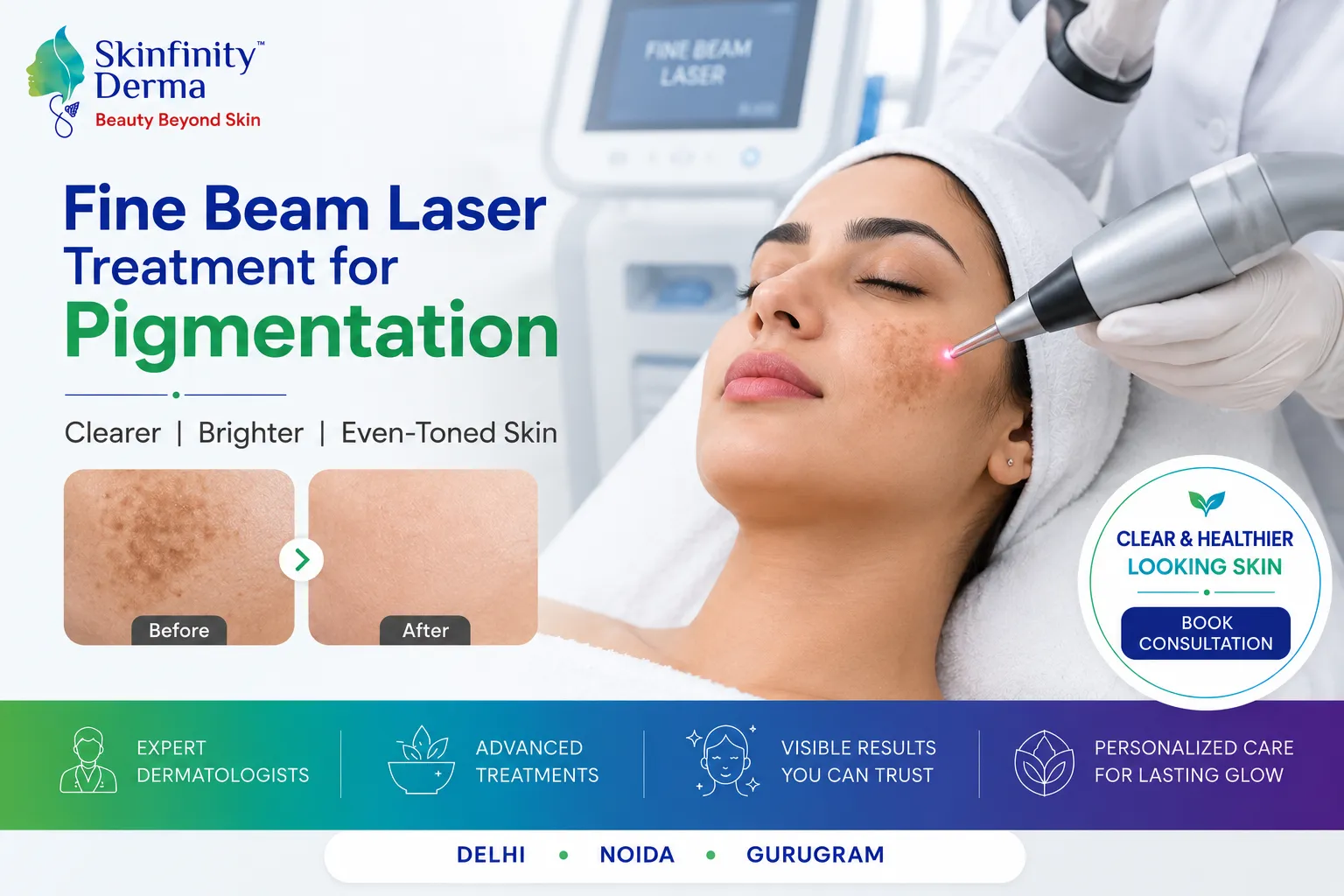
Fine Beam Laser Treatment works as a wonder treatment here. But the treatment is not suitable for every type of pigmentation. Patients considering Fine Beam Laser in Noida or Fine Beam Laser in Gurgaon should therefore choose a dermatologist-led clinic that assesses the cause and depth of pigmentation before beginning treatment.
This guide explains how a Finebeam laser works and its benefits. We will also look at the expected results and Fine Beam Laser Treatment cost. Let us explore more:
Fine Beam Laser Treatment at a Glance
Book An Appointment
|
Treatment Detail |
Overview |
|
Treatment type |
Q-switched Nd:YAG laser treatment |
|
Common wavelengths |
1064 nm and 532 nm, depending on the device and concern |
|
Primary concerns |
Pigmentation, freckles, sun spots, selected birthmarks, tattoos, and uneven tone |
|
Treatment areas |
Face and selected body areas |
|
Session duration |
Usually 15 to 45 minutes |
|
Anaesthesia |
May not be required for mild laser toning; numbing may be used for stronger treatments |
|
Downtime |
Depends on treatment intensity and concern |
|
Sessions required |
Varies according to pigment type, depth, and response |
|
Result focus |
More even-looking tone and reduced visible pigmentation |
|
Maintenance |
May be required for recurring conditions |
What Is a Fine Beam Q Switch Laser?
Finebeam is a professional Nd:YAG laser platform that is designed with ultimate precision for dermatological and aesthetic treatments. The core part of this treatment is a Q-switched laser. It releases energy in very short and high-powered pulses. Finebeam Q Plus systems commonly use wavelengths somewhere between 1064 nm and 532 nm.
Finebeam should not be confused with VBeam. VBeam is a pulsed-dye laser primarily associated with vascular concerns. These concerns primarily include visible blood vessels and redness. It further includes rosacea and selected red scars. Finebeam Q Switch Laser is an Nd:YAG platform more commonly used for pigmentation and tattoo pigment. It is also quite impactful for selected rejuvenation procedures.
How Finebeam Laser Works
Finebeam laser delivers short bursts of energy into selected pigmented areas. Melanin or tattoo ink absorbs this energy. The targeted particles break into smaller fragments which the body gradually clears through its natural processes.
Let us now look at the key steps that are fundamental parts of how the Finebeam laser works:
Step 1: Pigment Absorbs the Laser Energy
The first step includes targeting melanin or ink as they tend to absorb more laser energy than the surrounding tissue. The ultimate aim of this step is to concentrate treatment on the unwanted pigment without exposing the complete skin surface to unnecessary heat.
Step 2: Pigment Breaks Into Smaller Particles
The short pulse is released at the targeted spot and it creates a strong photoacoustic effect. The potency of the pulse makes sure that the pigment is broken into fragments.
Step 3: The Body Clears the Fragmented Pigment
Immune cells gradually remove the fragmented particles. Visible improvement therefore develops over several days or weeks rather than immediately.
Step 4: The Skin Is Reassessed
Step fourth is the most crucial one as in this step the dermatologist examines the response before adjusting the next session. Pigmentation that responds poorly may require another diagnosis or a completely distinct treatment approach.
Skin Concerns Fine Beam Laser May Address
Finebeam Q Switch Laser may be considered for selected concerns after a dermatologist’s assessment. Here are the key skin concerns that fine beam laser may address with great potency:
-
Freckles
Freckles are usually small and they appear as superficial pigmented spots linked with genetics and sun exposure. The 532 nm wavelength may be considered for selected superficial freckles. Sun protection remains important because freckles can return.
-
Post-Inflammatory Hyperpigmentation
Dark marks can remain after acne or some sort of skin irritation. These marks also appear after injury or inflammation.
Some patients may benefit from laser treatment after the active condition has settled. Incorrect settings can worsen pigmentation and this pigmentation is particularly worsened in darker skin tones.
-
Uneven Skin Tone
Low-fluence laser toning may be used within a broader plan for uneven pigmentation.
The dermatologist should first identify whether the discolouration is epidermal or dermal. They should also decide whether the cause of discolouration is vascular or inflammatory.
-
Tattoo Pigment
Q-switched lasers are widely used for tattoo removal. The number of sessions depends on ink colour and depth. It also depends on density and age. Location and previously done treatments are other reasons that impact the number of sessions. Complete clearance cannot be guaranteed but the tattoo’s appearance can be reduced to a great extent.
-
Selected Birthmarks
Certain pigmented birthmarks may respond to Q-switched laser treatment.
A dermatologist must first confirm the diagnosis and rule out conditions that should not receive cosmetic laser treatment.
-
Skin Texture and Pores
Some Finebeam models include specialised handpieces or modes marketed for pores, scars, and texture improvement. Results depend on the device configuration and treatment settings.
Finebeam should not replace fractional resurfacing when deeper acne scars or major texture changes require a different technology.
Benefits of Fine Beam Q Switch Laser for Skin Renewal
Here are the main benefits of Fine Beam Laser Treatment:
1. Targets Unwanted Pigment Precisely
The laser focuses energy on melanin or tattoo ink within selected areas.
This targeted approach can reduce unnecessary treatment of the surrounding skin when appropriate settings are used.
2. Treats Pigment at Different Depths
The 532 nm and 1064 nm wavelengths can address different pigment depths and colours.
The dermatologist selects the wavelength after examining the type and location of discolouration.
3. Supports a More Even-Looking Complexion
Reduced pigmentation can make the overall complexion appear more balanced.
The result develops gradually as fragmented pigment clears from the treated area.
4. Can Be Personalised for Indian Skin
Fine beam laser treatment is a very reliable option for Indian skin. Laser settings can be adjusted in the treatment according to skin tone. Careful calibration in the further process remains pretty essential because Indian skin can develop post-inflammatory hyperpigmentation after aggressive treatment.
5. Offers a Non-Surgical Treatment Option
Finebeam treatment does not require surgical incisions.
Most sessions take place within a clinic and allow patients to return home afterwards.
6. Can Treat Small or Larger Areas
The procedure may be used for isolated spots or broader laser-toning areas.
Treatment intensity and downtime differ between localised lesion removal and full-face toning.
7. May Require Limited Downtime
Low-fluence laser toning may cause temporary redness with little disruption.
Stronger treatment for individual spots or tattoos may cause crusting or a longer healing period.
Why Fine Beam Laser Is Not the Same as a Brightening Facial
A facial works mainly on the skin’s surface.
It may cleanse and temporarily improve hydration. It however does not selectively fragment deeper melanin or tattoo pigment.
Finebeam Q Switch Laser delivers a specific wavelength into targeted pigmented areas. This makes it more suitable for selected concerns that do not improve adequately through surface care.
A laser is also a medical energy-based procedure.
It requires diagnosis and calibrated settings. It further requires eye protection and structured aftercare. Patients should not treat it as a routine salon facial.
Who Is an Ideal Candidate for a Fine Beam Laser?
Finebeam may suit adults with selected pigmented lesions or uneven tone. A suitable candidate generally:
-
Has a confirmed pigmentation concern
-
Has realistic expectations
-
Can follow strict sun-protection advice
-
Does not have an active skin infection
-
Understands that multiple sessions may be needed
-
Can attend follow-up appointments
-
Is willing to use prescribed skincare
-
Has no suspicious lesion in the treatment area
The laser may also suit patients seeking tattoo fading or removal after a medical assessment.
Who Should Avoid or Postpone Fine Beam Laser?
Here are people who may need to avoid or delay treatment:
-
Pregnant patients unless medically cleared
-
People with active bacterial or fungal skin infections
-
Individuals with active cold sores near the treatment area
-
Patients with open wounds or severe inflammation
-
People taking photosensitising medicines without medical clearance
-
Patients with uncontrolled medical conditions
-
Individuals with recent tanning or significant sunburn
-
People prone to poor wound healing
-
Patients with unrealistic expectations
-
Anyone with an undiagnosed or suspicious skin lesion
-
People unable to follow sun-protection instructions
-
Patients who recently underwent another irritating skin procedure
How to Prepare for Fine Beam Laser Treatment
The dermatologist will provide preparation instructions based on the concern and skin type.
General preparation may include:
-
Sharing a complete medical history
-
Listing medicines and supplements
-
Reporting previous laser reactions
-
Avoiding tanning before treatment
-
Using prescribed sunscreen consistently
-
Stopping irritating skincare only when advised
-
Reporting active acne, infections, or cold sores
-
Arriving with clean skin
-
Avoiding makeup on the treatment area
-
Planning around possible redness or crusting
Patients should never stop prescribed medicine without consulting the prescribing doctor.
Fine Beam Laser Treatment Procedure
A Finebeam session generally follows these steps:
Step 1: Dermatologist Consultation
The dermatologist examines the pigmentation and confirms its likely cause in the very first step. The assessment is quite elaborate and it may include:
-
Skin tone
-
Pigment colour
-
Pigment depth
-
Duration of the concern
-
Previous treatments
-
Sun exposure
-
Current skincare
-
Medical history
-
Tendency to scar or pigment
Clinical photographs may be taken for comparison.
Step 2: Skin Cleansing
The second step of the treatment includes elaborate cleansing of makeup residue and sunscreen. Surface impurities are removed with precision in this step. The treatment area is then cleaned using an appropriate antiseptic.
Step 3: Eye Protection
Protective eyewear is provided to the patient and treatment team. Laser procedures should never begin without suitable eye protection.
Step 4: Patch Test When Required
A dermatologist may perform a test spot before treating a larger area. This step can help assess skin response and select safer settings.
Step 5: Laser Delivery
The last step includes a laser handpiece which is directed toward the selected areas. Patients may hear a light snapping sound and feel brief warmth or pinpricks.
Step 6: Cooling and Soothing Care
A cooling method or soothing product may be applied after treatment. The dermatologist then explains aftercare and expected skin changes. The complete appointment may take around 15 to 45 minutes. Treatment time depends on the size and number of areas.
What to Expect During Treatment
Here is what patients may experience during a Finebeam laser session:
-
A detailed skin assessment
-
Cleansing of the treatment area
-
Protective eyewear
-
A patch test when needed
-
Brief snapping or tingling sensations
-
Mild warmth during laser delivery
-
Cooling or soothing care afterwards
-
Written aftercare instructions
What to Expect After Fine Beam Laser Treatment
-
Immediately After Treatment
The most apparent expectation which you can observe after the performance of the treatment is that your skin may appear mildly red or warm. Targeted brown spots may temporarily look darker or develop light crusting but this is a temporary phenomenon and it gets resolved on its own.
-
During the First Few Days
Redness and sensitivity usually begin settling. Localised pigment may darken before gradually flaking or fading.
-
During the Following Weeks
The body gradually clears fragmented pigment. Improvement may become more visible after several weeks.
-
After Multiple Sessions
Repeated treatment may create a more even-looking tone. The final outcome depends on the pigment type and depth. It also depends on other factors such as treatment response and sun protection.
Fine Beam Laser Aftercare
Patients should follow the dermatologist’s specific instructions.
General aftercare may include:
-
Avoiding unnecessary touching
-
Keeping the treated area clean
-
Applying prescribed soothing products
-
Using broad-spectrum sunscreen
-
Avoiding intense heat temporarily
-
Skipping steam rooms and saunas
-
Avoiding strong exfoliants
-
Delaying retinoids when advised
-
Avoiding picking or scratching crusts
-
Applying makeup only after approval
-
Contacting the clinic if symptoms worsen
What Are the Possible Side Effects of Laser Beam Treatment?
Most of the reported side effects of laser beam treatment are temporary. They either heal completely or usually settle quickly when the treatment settings suit the patient’s skin type and concerns.
Common Temporary Effects
Patients may experience:
-
Redness
-
Warmth
-
Mild swelling
-
Tenderness
-
Temporary itching
-
Darkening of treated spots
-
Light crusting
-
Dryness
-
Mild sensitivity
Less Common Risks
Possible complications include:
-
Post-inflammatory hyperpigmentation
-
Hypopigmentation
-
Blistering
-
Burns
-
Infection
-
Persistent redness
-
Scarring
-
Uneven skin tone
-
Melasma aggravation
-
Herpes reactivation
Urgent medical review is important in cases of severe pain and blistering. It is also integral to get other issues, such as pus and spreading redness, checked. Fever or unusual skin discolouration can also appear in rare cases after the treatment but the probability of such severe symptoms is low.
Fine Beam Laser Treatment Cost
The full and final Fine Beam Laser Treatment cost depends on the concern and treatment area. It equally depends on the session intensity and the number of appointments required. Pricing is not standardised across clinics.
Estimated Fine Beam Laser Cost in Delhi NCR
|
Cost Component |
Estimated Price |
|
Initial dermatologist consultation |
rs500 to rs1,500 |
|
Small pigmentation area |
rs2,500 to rs6,000 per session |
|
Full-face laser toning |
rs4,000 to rs10,000 per session |
|
Larger pigmentation area |
rs6,000 to rs15,000 per session |
|
Tattoo treatment |
Depends on size, colour, and complexity |
|
Multi-session package |
Depends on the prescribed course |
|
Maintenance session |
Based on reassessment |
The final cost may depend on:
-
Pigmentation type
-
Treatment area
-
Pigment depth
-
Laser mode
-
Number of sessions
-
Doctor’s experience
-
Clinic location
-
Device quality
-
Combination treatments
-
Follow-up care
Patients should ask whether the quotation includes:
-
Dermatologist assessment
-
Patch testing
-
Complete laser session
-
Numbing when required
-
Post-treatment products
-
Follow-up review
-
Applicable taxes
How Many Fine Beam Laser Sessions Are Required?
The number of sessions differs for every concern.
A single superficial spot may improve after one or two treatments. Broader pigmentation, melasma, or tattoo removal may require several sessions.
The dermatologist may recommend:
-
One to three sessions for selected superficial spots
-
Several sessions for full-face laser toning
-
Multiple sessions for tattoo fading or removal
-
Maintenance treatment for recurring pigmentation
These are general patterns rather than guarantees.
Treatment intervals allow the skin to recover and pigment fragments to clear. The exact gap depends on the intensity and indication.
When Will Fine Beam Laser Results Become Visible?
Some localised spots may darken immediately before fading.
Visible improvement may begin after six to eight weeks as the skin heals and fragmented pigment clears.
Broader laser-toning results usually develop gradually across several sessions.
Melasma and post-inflammatory pigmentation may respond less predictably. These conditions often require daily sunscreen, prescribed skincare, and maintenance.
How Long Will Fine Beam Laser Results Last?
The duration depends on the condition being treated. Successfully cleared sun spots or tattoo pigment may remain reduced for a long period. However, new sun exposure can create fresh pigmentation.
Melasma may recur because hormonal and ultraviolet triggers remain active. Longer-lasting results usually require:
-
Daily broad-spectrum sunscreen
-
Reduced direct sun exposure
-
Dermatologist-prescribed skincare
-
Treatment of active acne or inflammation
-
Avoidance of skin irritation
-
Maintenance sessions when advised
Laser treatment does not permanently stop melanin production.
Fine Beam Laser vs Pico Laser
|
Factor |
Fine Beam Q Switch Laser |
Pico Laser |
|
Pulse duration |
Nanosecond range |
Picosecond range |
|
Primary action |
Photoacoustic pigment fragmentation |
Faster photoacoustic pigment fragmentation |
|
Common uses |
Pigmentation, laser toning, tattoos |
Pigmentation, tattoos, selected texture concerns |
|
Sessions |
Depends on pigment and response |
Depends on pigment and response |
|
Cost |
Usually lower |
Often higher |
|
Best option |
Depends on diagnosis and skin type |
Depends on diagnosis and pigment depth |
Fine Beam Laser vs Chemical Peel
|
Factor |
Fine Beam Laser |
Chemical Peel |
|
Main target |
Selected pigment within the skin |
Surface and epidermal renewal |
|
Treatment method |
Laser energy |
Controlled chemical exfoliation |
|
Suitable concerns |
Selected spots, tattoos, uneven pigmentation |
Superficial pigmentation, acne, texture |
|
Downtime |
Depends on settings |
Depends on peel depth |
|
Sessions |
Often multiple |
Often multiple |
|
Selection |
Based on pigment depth and colour |
Based on skin condition and peel strength |
Some patients may benefit from a planned combination.
Procedures should not be combined too closely because excessive irritation can worsen pigmentation.
Why Choose Skinfinity Derma for Fine Beam Laser Treatment?
Skinfinity Derma provides dermatologist-led laser consultations in Noida and Gurgaon. The clinic has locations in Sector 36, Noida, and Sector 28, Gurugram.
-
Dermatologist-Led Skin Assessment
We begin by identifying the cause and depth of pigmentation.
This step helps determine whether Finebeam laser, topical treatment, a chemical peel, or another procedure is more suitable.
-
Personalised Laser Settings
Our dermatologists consider skin tone and pigment type before beginning the treatment. They also take your treatment history and sensitivity into account to help you get the maximum benefits of the treatment. The settings are adjusted rather than applying one standard protocol to every patient.
-
Treatment for Indian Skin Types
Indian skin can develop post-inflammatory pigmentation after aggressive procedures. We focus on careful selection and controlled treatment planning to reduce avoidable risks.
-
Medical-Grade Hygiene
Every laser session follows clinical cleansing and safety protocols. Protective eyewear and appropriate post-treatment care remain part of the procedure.
-
Realistic Result Planning
We explain that some concerns need several sessions. Recurring conditions such as melasma may also require maintenance and consistent sun protection.
-
Transparent Cost Discussion
The Fine Beam Laser Treatment cost is discussed after evaluating the area and expected treatment course. Patients receive a personalised estimate rather than a generic package recommendation.
-
Clinics in Noida and Gurgaon
Patients can access dermatologist-led consultations through our Noida and Gurugram locations. This makes follow-up and maintenance appointments easier to plan.
How to Choose the Right Fine Beam Laser Clinic
Patients should ask the following questions:
-
Is the treatment performed or supervised by a dermatologist?
-
Which Finebeam device model is being used?
-
What condition is the laser expected to treat?
-
Which wavelength will be selected?
-
Is a patch test required?
-
How many sessions may be needed?
-
Which results are realistic?
-
Can pigmentation worsen after treatment?
-
What does the quoted cost include?
-
Which aftercare products are required?
-
How are burns or pigmentation changes managed?
-
Would another treatment be safer?
Conclusion
Finebeam Q Switch Laser offers a focused approach to selected pigmentation and uneven skin tone. The treatment uses short pulses of Nd:YAG laser energy to fragment unwanted pigment. The body then clears these particles gradually.
Patients seeking Fine Beam Laser in Noida or Fine Beam Laser in Gurgaon should choose a dermatologist-led clinic with experience treating Indian skin. Skinfinity Derma is a reliable name offering high-quality fine beam laser treatment in the NCR region.
We assess the concern before recommending treatment. Our dermatologists personalise the settings and explain the expected sessions and cost. The exact Fine Beam Laser Treatment cost at our end depends on the treatment area and number of sessions required.
Book a consultation at Skinfinity Derma to determine whether Finebeam Q Switch Laser is suitable for your skin and receive a personalised treatment estimate. Connect with us to know more.
Frequently Asked Questions
1. How Long Will Laser Treatment Last?
The result duration depends on the treated concern. Cleared sun spots may remain reduced, but new pigmentation can develop after sun exposure. Melasma commonly requires ongoing maintenance.
2. Is Laser Treatment 100% Safe?
No medical or aesthetic procedure is completely risk-free. Finebeam laser can be performed safely in suitable patients, but redness, swelling, burns, and pigmentation changes remain possible.
3. Will I Notice a Difference After One Laser Session?
Some patients notice improvement after one session, particularly with selected superficial spots. Broader pigmentation and tattoo removal usually require multiple treatments.
4. What are the side effects of Fine Beam Laser Treatment?
The most common and prevalent side effects include temporary redness and mild to modest level of swelling of the treated region. Some may also experience dryness or slight darkening of the treated area. Rare complications of the treatment are blistering or drastic changes in skin colour but their occurrence is very, very rare.

 Call Now
 WhatsApp