

Medically Reviewed by: Dr. Shradha Gumber
MBBS, MD - Dermatology , Venereology & Leprosy | Skinfinity Derma Clinic
Read Time: 8 Minutes
Hair loss may begin with a wider parting or gradual thinning at the crown. The right treatment depends on the cause and whether the hair follicles are still active.
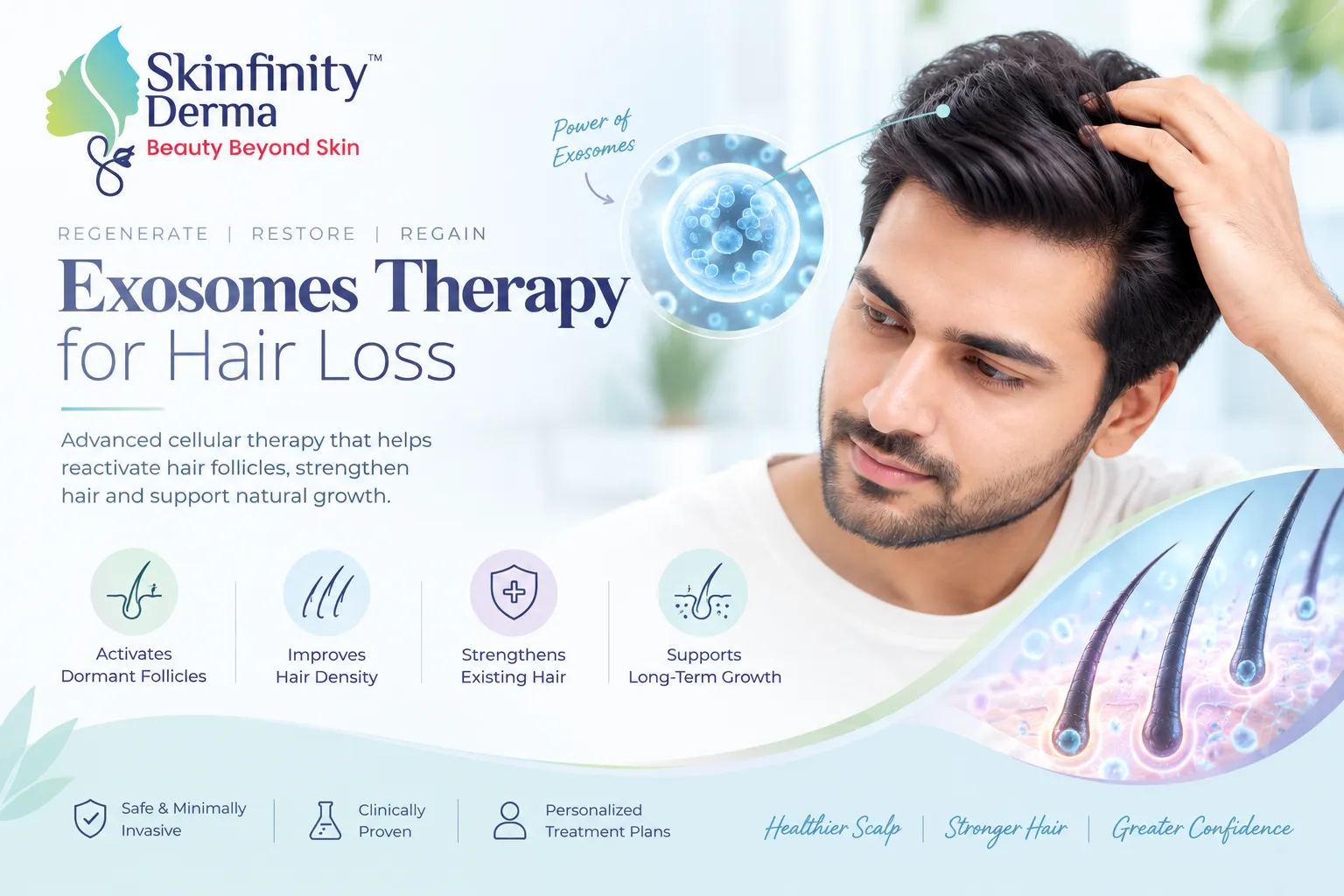
Exosomes therapy in Delhi NCR is an emerging regenerative option for selected patients with early or moderate hair thinning. Exosomes carry signalling molecules that may support follicle activity and improve hair density in some cases.
Skinfinity Derma one of the best skin clinic in Gurgaon and Noida offers exosome-based hair treatment through its Noida and Gurgaon clinics after a detailed scalp assessment.
Read the complete blog to understand how exosome therapy works and whether it may be suitable for your hair loss concern.
What Is Exosomes Therapy for Hair Loss?
Exosomes exist as small biological sacs which living units discharge. Many people believe that Exosomes function as biological messengers through the transportation of proteins and other chemical signals to neighboring structures. A process of message delivery is facilitated by exosomes because proximity allows for communication.
Targeted application of exosomes on the scalp attempts to provide signaling molecules to locations where hair roots show diminished strength. It has been observed that experts are studying how this interaction might assist hair root movement. Beneficial outcomes for the hair development environment are supported by exosomes while researchers examine the results. Using this method helps the hair roots because the molecules arrive directly.
Medical professionals claim that the exosome procedure excludes whole stem cells. Stem-cell transplantation is regarded as a different method which people should distinguish from exosomes. Performing this specific hair therapy occurs without using full cellular units.
Scientific investigations into exosomes remain sparse when people compare exosomes to conventional methods for thinning hair. Analysts believe that the 2025 review examined merely nine clinical studies with 125 patients who utilized Exosomes for hair loss. The authors found encouraging results but also highlighted the need for stronger evidence.
How Does Exosomes Hair Therapy Work?
Hair follicles move through growth and resting phases. The growth phase gradually becomes shorter while individual follicles can become smaller in conditions such as androgenetic alopecia. Exosomes are being studied because their signalling molecules may influence pathways involved in follicle activity. Research has explored their potential effects on dermal papilla cells and pathways linked with the hair-growth cycle.
Book An Appointment
|
Stage |
What Happens |
Treatment Goal |
|
Scalp assessment |
Hair density and thinning pattern are examined |
Identify whether active follicles remain |
|
Treatment planning |
The dermatologist selects the delivery method |
Match treatment with the type of hair loss |
|
Scalp preparation |
The treatment area is cleaned and prepared |
Support controlled delivery |
|
Exosome application |
The preparation is introduced into selected scalp areas |
Deliver signalling molecules near the follicles |
|
Recovery |
The scalp is allowed to settle |
Reduce unnecessary irritation |
|
Follow-up |
Hair shedding and density are reviewed |
Decide whether further sessions are appropriate |
Exosomes cannot create new follicles where follicles have been permanently destroyed. Advanced baldness may therefore require a different approach such as hair transplantation.
Benefits of Exosomes Therapy for Hair Loss
Exosome hair therapy is being studied for its potential to support weaker follicles and improve the overall environment around the scalp. The response can differ from one patient to another because the outcome depends on the cause of hair loss and the number of active follicles that remain.
-
May improve hair density: Early studies suggest that exosome therapy may increase hair density in selected patients with androgenetic alopecia. The treatment may be more useful when follicles are still active but have started producing thinner hair. This can make sparse areas look fuller over time.
-
May support thicker-looking hair: Hair thinning often happens when individual strands become finer over repeated growth cycles. Exosome-based treatment may support follicle activity and help existing strands grow with better thickness. This can improve the overall appearance of volume without adding new follicles.
-
May support the hair-growth cycle: Exosomes carry signalling molecules that may influence pathways involved in follicle activity. These signals are being studied for their role in supporting the growth phase of the hair cycle. This may help follicles remain active for longer in selected patients.
-
May help miniaturised follicles: The follicles gradually become smaller and produce finer strands in pattern hair loss. Exosome therapy may support these weakened follicles before they become permanently inactive. This is why early treatment may offer more benefit than waiting until significant baldness develops.
-
Non-surgical treatment option: Exosome therapy does not require removing hair follicles from another part of the scalp. It also does not involve surgical implantation. This makes it an option for patients who want regenerative treatment without undergoing a hair transplant.
-
Limited recovery time: Most patients can return to their usual routine soon after treatment. Mild redness or scalp tenderness may occur for a short time. The recovery period is generally much shorter than that of surgical hair restoration.
-
May support early and moderate thinning: Patients with a widening parting or reduced crown density may be suitable candidates when active follicles are still present. Exosome therapy is less likely to provide meaningful regrowth in completely bald areas where follicles have already been lost.
-
May complement other hair-loss treatments: Exosome therapy does not always need to be used alone. A dermatologist may combine it with topical or prescription treatment when the diagnosis supports a combined approach. This can help target hair loss through more than one mechanism.
-
May support scalp recovery: Exosomes are also being studied for their role in tissue repair and cellular communication. This may help create a healthier environment around the follicles which can support the overall treatment plan.
-
Can be personalised according to hair loss: The number of sessions and treatment intervals can be adjusted according to the patient’s hair-loss pattern. Follow-up assessments also allow the dermatologist to see whether density is improving before recommending further sessions.
-
May reduce dependence on immediate surgery: Some patients with early thinning may not yet need a hair transplant. Regenerative treatment can sometimes be considered first when the follicles are still active and the main goal is to preserve or strengthen existing hair.
-
Can support long-term hair management: Hair loss is often progressive which means one treatment may not be enough. Exosome therapy may form part of a longer hair-restoration plan that also includes scalp care and medical treatment when required.
The final result depends on age and genetics. The stage of hair loss also matters because treatment works best when functioning follicles are still present. Exosome therapy should therefore be viewed as a promising regenerative option rather than a guaranteed method of hair regrowth.
Who Is the Ideal Candidate for Exosome Hair Treatment?
Exosome treatment may be considered when follicles are still present but hair has started becoming thinner.
Possible candidates include people with:
-
Early androgenetic alopecia
-
Moderate pattern hair thinning
-
Reduced hair density
-
Miniaturised but active follicles
-
Progressive crown thinning
-
Female pattern hair loss
-
Hair thinning that has not responded sufficiently to basic care
A dermatologist should confirm the cause before treatment because not every form of hair loss responds to follicle-stimulation procedures.
Patients with completely smooth bald areas may have too few active follicles for meaningful stimulation. Hair transplantation or another treatment may be more appropriate in these cases.
Exosomes Therapy vs PRP for Hair Loss
PRP and exosome therapy are both used as regenerative approaches but they are not the same treatment.
|
Factor |
Exosomes Therapy |
PRP |
|
Source |
Prepared extracellular vesicles |
Patient’s own blood |
|
Blood draw |
Usually not required for the exosome product |
Required |
|
Main component |
Cell-signalling vesicles |
Concentrated platelets |
|
Evidence base |
Emerging and still limited |
More extensively studied |
|
Standardisation |
Varies between products |
Also varies between protocols |
|
Sessions |
Depends on product and treatment plan |
Usually performed as a series |
|
Regulatory status |
No FDA-approved exosome products currently |
PRP preparation uses autologous blood but protocols vary |
|
Best suited for |
Selected patients after specialist assessment |
Selected patients with pattern hair loss |
PRP has a larger clinical evidence base for androgenetic alopecia. Meta-analyses suggest that PRP can improve hair density although preparation methods remain inconsistent between studies.
Exosome therapy is newer. Early research is encouraging but current evidence is not strong enough to state that exosomes are universally better than PRP.
Exosomes Therapy vs GFC Hair Treatment
GFC or Growth Factor Concentrate uses growth factors obtained from the patient’s own platelets. Exosome therapy instead uses extracellular vesicles prepared from an external biological source.
|
Factor |
Exosomes Therapy |
GFC Hair Treatment |
|
Main material |
Extracellular vesicles |
Concentrated platelet-derived growth factors |
|
Blood collection |
Usually not required |
Required |
|
Treatment concept |
Cellular signalling support |
Delivery of concentrated growth factors |
|
Evidence |
Early clinical research |
Emerging clinical research |
|
Product variation |
Can vary considerably |
Preparation protocols can also vary |
|
Treatment choice |
Based on scalp assessment |
Based on scalp assessment |
GFC has shown promising outcomes in small studies but the evidence remains limited. One 2024 prospective report involved only five patients which shows why larger trials are still needed.
The choice between GFC and exosomes should therefore depend on the hair-loss pattern rather than which treatment sounds newer.
Step-by-Step Exosomes Hair Treatment Procedure
A typical treatment begins with diagnosis rather than immediate application.
Step 1: Hair and scalp assessment
The dermatologist examines the thinning pattern and looks for active follicles. Medical history may also be reviewed because nutritional problems or hormonal disorders can contribute to hair loss.
Step 2: Treatment planning
The dermatologist decides whether exosome therapy is suitable and whether another treatment should be used alongside it.
Step 3: Scalp preparation
The treatment area is cleaned carefully before delivery. Numbing may be used when the chosen technique is likely to cause discomfort.
Step 4: Exosome delivery
The preparation may be delivered through microneedling or another controlled technique depending on the protocol.
Step 5: Post-treatment care
Patients receive instructions about washing and scalp care. Harsh products may need to be avoided for a short period.
Step 6: Follow-up assessment
Hair shedding and density are reviewed over the following months because hair growth cannot be assessed immediately after treatment.
How Many Sessions of Exosomes Therapy Are Needed?
There is no universally accepted treatment schedule because exosome protocols have not yet been standardised.
Skinfinity Derma states that treatment plans may involve multiple sessions spaced according to the patient’s hair-loss pattern and response. Some patients may receive fewer sessions while others need a longer plan. The dermatologist should review progress before automatically continuing treatment.
When Can You Expect Results?
Hair grows slowly which means visible change takes time.
|
Treatment Period |
What May Be Observed |
|
First few weeks |
Scalp recovery and possible changes in shedding |
|
Around three months |
Early changes in density may become noticeable |
|
Three to six months |
Hair thickness may become easier to assess |
|
Later follow-up |
Overall response can be compared with baseline |
A 2025 prospective study reported improvement after exosome treatment combined with microneedling. The researchers still called for larger studies with longer follow-up before firm conclusions can be made.
Side Effects and Safety of Exosomes Therapy
Exosome therapy is often marketed as a low-downtime treatment but it is important to distinguish early clinical tolerability from established long-term safety.
Temporary effects related to scalp delivery may include:
-
Redness
-
Tenderness
-
Mild swelling
-
Temporary itching
-
Small areas of irritation
The quality and origin of the exosome preparation also matter.
The US FDA states that there are currently no FDA-approved exosome products and has warned about unapproved products marketed for medical treatment. Serious adverse events have also been reported with some unapproved regenerative products.
This does not mean that every exosome procedure causes harm. It does mean that patients should ask clearly about the product source and regulatory status before treatment.
Success Rate of Exosomes Therapy for Hair Loss
There is currently no reliable universal percentage that can be presented as the success rate of exosome therapy for hair loss.
Small clinical studies have shown improvements in hair density and patient satisfaction. A 2024 clinical study reported increased hair density after exosome injections while a 2025 systematic review found encouraging results across available studies.
The studies remain relatively small and treatment methods differ. Product sources also vary which makes a single success-rate figure misleading.
Results may depend on:
-
Type of hair loss
-
Stage of thinning
-
Number of functioning follicles
-
Treatment protocol
-
Patient age
-
Ongoing medical treatment
-
Underlying health factors
Patients should therefore evaluate improvement through clinical photographs and hair-density measurements rather than expecting a guaranteed percentage.
Exosomes Therapy Cost for Hair Loss
The Exosomes therapy cost is generally higher than PRP because specialised biological preparations are involved.
|
Exosome Hair Treatment |
Published Estimated Cost |
|
Standard single session |
?30,000 to ?45,000 |
|
Higher-count advanced session |
?50,000 to ?75,000 |
|
Three-session package |
?85,000 to ?1,40,000 |
|
Exosome with GFC combination |
?40,000 to ?55,000 |
The final exosomes therapy cost depends on the product used and the treatment area. The number of recommended sessions also affects the total expense.
Patients considering exosomes therapy in Delhi NCR should request a personalised quotation after scalp assessment because the Delhi NCR treatment page does not currently publish a fixed price.
Can Exosomes Therapy Be Combined With Other Hair Loss Treatments?
Yes. A dermatologist may combine exosome therapy with another hair-loss treatment when there is a clear reason to do so.
Combination care may include topical minoxidil for appropriate patients. Prescription treatment may also be considered when androgenetic alopecia is present.
PRP or GFC may sometimes form part of a broader regenerative plan but combining procedures does not automatically produce better results. Each additional treatment should have a clear purpose.
Exosomes are also being studied as an adjunct around hair transplantation. A 2026 review describes exosomes among emerging regenerative therapies being investigated alongside transplantation. More evidence is still required before standard protocols can be established.
Exosomes Therapy in Delhi NCR
Skinfinity Derma provides exosome-based hair treatment through its Delhi NCR location.
|
Location |
Skinfinity Derma Access |
Treatment Focus |
|
Delhi NCR |
Skinfinity Derma in Sector 36 |
Consultation with personalised exosome hair treatment planning |
|
Delhi NCR |
Skinfinity Derma in Sector 28 near Golf Course Road |
Exosomes therapy in Delhi NCR with scalp assessment and follow-up |
|
Delhi NCR |
Access through Delhi NCR clinics |
Regenerative hair-loss consultation based on individual suitability |
Patients looking for a dermatologist in Noida, Gurgaon, Delhi can begin with a scalp assessment before choosing regenerative treatment.
Why Choose Skinfinity Derma for Exosomes Hair Treatment?
Exosome therapy is not suitable for every form of hair loss. At Skinfinity Derma, we therefore begin by assessing the scalp and identifying whether functioning follicles are still present.
Here is how our clinic approaches treatment:
-
Dermatologist-led assessment: The scalp is evaluated before regenerative treatment is recommended. This helps distinguish pattern hair loss from conditions that need a different approach.
-
Personalised treatment planning: The number of sessions is selected according to the hair-loss pattern and expected response.
-
Multiple hair-restoration options: Skinfinity Derma also offers PRP and GFC treatment. Hair transplant consultation is available when regenerative procedures are unlikely to provide enough improvement.
-
Delhi NCR access: Patients can consult the clinic through its Delhi NCR clinic near Golf Course Road.
-
Follow-up evaluation: Hair response can be reviewed over several months because meaningful density changes take time.
Patients should also ask about the exact exosome product being used and its regulatory status. Claims such as “FDA approved exosomes” should be checked carefully because the FDA currently states that no exosome products have received FDA approval.
Is Exosome Therapy Effective for Hair Loss?
Exosome therapy appears promising for selected forms of hair loss but it should still be considered an emerging treatment.
Recent studies have reported improvements in hair density and thickness in people with androgenetic alopecia. A 2026 systematic review continues to describe exosome-based hair restoration as an evolving field with important translational challenges.
This means exosome therapy may be worth considering for selected patients with active follicles but it should not be promoted as guaranteed hair regrowth.
A dermatologist can determine whether exosomes or an established treatment would make more sense for the individual patient.
Conclusion
Exosome therapy is one of the newer regenerative approaches being studied for hair thinning. Early research suggests that it may support hair density when functioning follicles are still present. The evidence is encouraging but treatment protocols and products are not yet standardised.
Patients considering Exosomes therapy in Delhi NCR should first identify the cause of their hair loss. A qualified Dermatologist in Gurgaon, Delhi, Noida can assess the scalp before deciding whether exosomes or another treatment is more appropriate.
Skinfinity Derma offers personalised hair-loss assessment through its Delhi NCR clinics. Book a consultation to understand whether exosome hair therapy fits your hair-loss pattern and what results can realistically be expected.
FAQs
1. How Long Do Exosome Hair Treatment Results Last?
The duration varies because hair loss can continue due to genetics or other underlying causes. Some patients may need maintenance treatment while others may require ongoing medical therapy to protect existing hair.
2. Is Exosome Therapy Better Than PRP?
Not necessarily. PRP currently has a larger evidence base while exosome therapy remains newer and less standardised. The better option depends on the type of hair loss and the dermatologist’s assessment.
3. How Many Sessions Are Required?
There is no universal number of sessions. Some treatment protocols use one or a few sessions while others repeat treatment after several weeks. The schedule should be personalised according to response.
4. Does Exosome Therapy Regrow Hair?
Exosome therapy may improve density in selected patients with functioning follicles. It cannot reliably regenerate follicles that have been permanently lost. Current clinical studies remain small.
5. Is Exosome Treatment Painful?
Most scalp-based treatments cause mild discomfort rather than severe pain. Patients may feel pricking or temporary tenderness depending on the delivery technique.
6. What Is the Cost of Exosome Therapy for Hair Loss?
Skinfinity Derma currently lists standard exosome hair sessions in Delhi NCR at approximately ?30,000 to ?45,000 while advanced protocols may cost more. The final amount depends on the product and treatment plan.
7. Are There Any Side Effects?
Temporary redness or scalp tenderness can occur. Mild swelling or irritation is also possible. Product quality remains important because the FDA has warned about risks from unapproved exosome products.
8. Who Should Avoid Exosome Therapy?
Patients with active scalp infection should postpone treatment until the condition is controlled. People with unexplained hair loss should also receive a diagnosis first rather than starting regenerative treatment immediately.
9. Can Exosomes Be Combined With a Hair Transplant?
They are being studied as an adjunct to hair transplantation but evidence is still developing. A hair transplant surgeon or dermatologist should decide whether combination treatment is appropriate.
10. When Will I See Results After Exosome Therapy?
Visible hair changes usually require several months because follicles need time to move through the growth cycle. Clinical studies have reported improvement over follow-up periods of several months rather than immediately after treatment.
11. Is Exosome Therapy Safe for Women?
Women may be considered for exosome therapy after the cause of hair thinning is identified. Female pattern hair loss can resemble hair shedding caused by nutritional problems or hormonal conditions so diagnosis should come before treatment.

 Call Now
 WhatsApp