

Medically Reviewed by: Dr. Shradha Gumber
MBBS, MD - Dermatology , Venereology & Leprosy | Skinfinity Derma Clinic
Read Time: 8 Minutes
Your hair is one of the first things that people see about you, and it could also be one of the most misunderstood body parts. Whether it's advice from grandmothers, social media trends, or any other sources, there is hair care advice everywhere, and not all of it is right. Every day in Skinfinity Derma, we witness the effects of these myths, such as individuals suffering from unneeded hair loss and others spending money on ineffective treatments.
Time to get rid of all the fluff. Our dermatology team takes you through the top hair care myths and shows how to make science the basis of your hair care routine, not folklore.
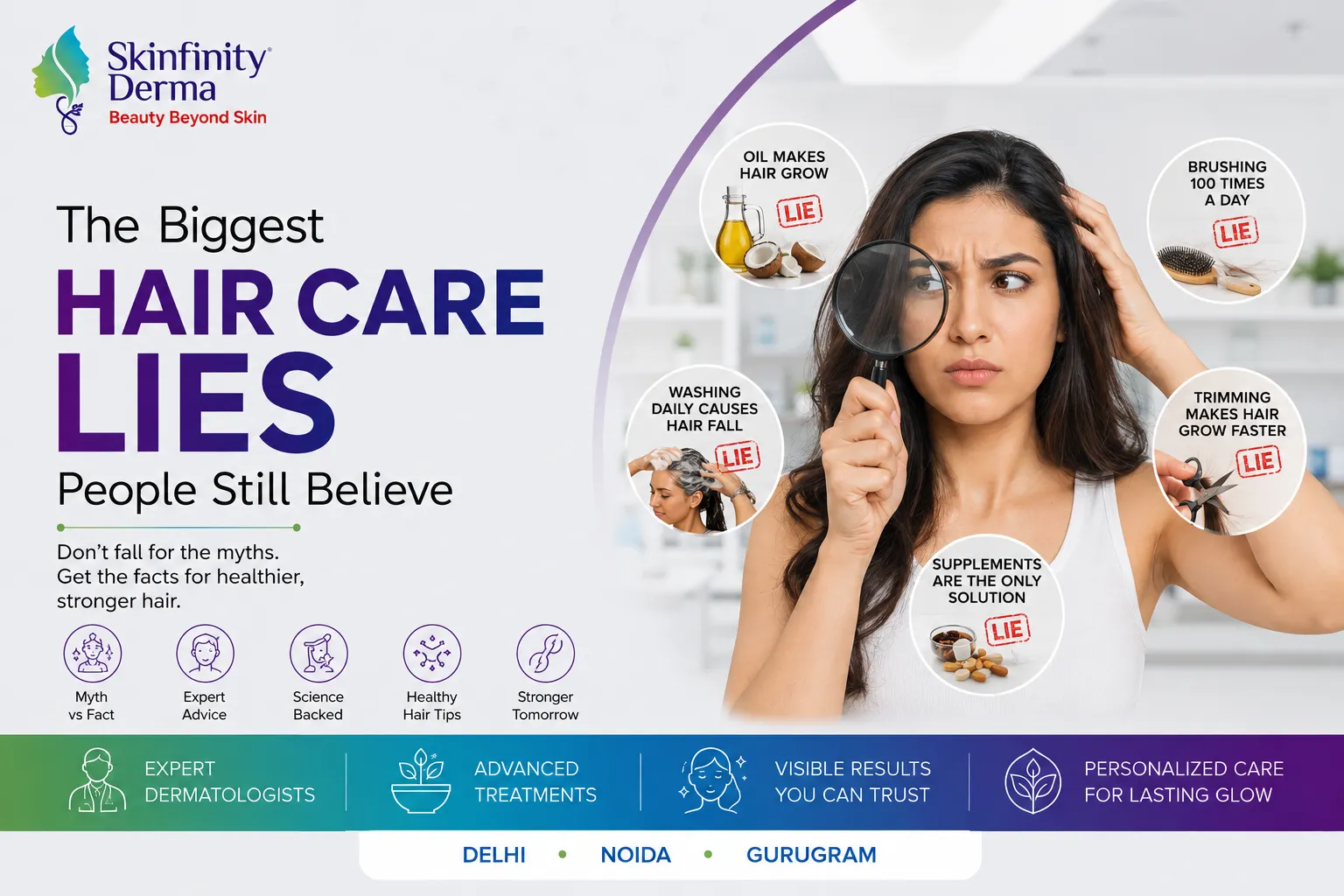
Myth 1: Cutting Your Hair Makes It Grow Faster
This is perhaps the most universally believed hair myth of all time, yet it has absolutely no biological basis. Hair grows from follicles located in your scalp, not from the tips of your strands. Trimming your ends has zero communication with your follicles.
The Truth: Hair grows an average of 1.25 cm (about half an inch) per month, or approximately 15 cm per year, regardless of how often you trim it. What regular trims actually do is remove split ends, which can cause breakage and make your hair appear shorter and thinner over time. So while trimming helps maintain the appearance of healthy, longer hair, it does not accelerate growth in the slightest.
Myth 2: You Must Brush Your Hair 100 Strokes a Day
Made famous by literary heroines and old-fashioned beauty manuals, the 100-strokes-a-day routine was once considered the pinnacle of hair care. Today, dermatologists consider it potentially damaging.
The Truth: Excessive brushing creates friction, which damages the hair's cuticle (the outer protective layer), leads to frizz, and can actually cause breakage. Brushing is most useful for detangling and distributing natural oils from your scalp to the mid-lengths. Two to three gentle passes through your hair, especially when using a wide-tooth comb on wet hair, is entirely sufficient.
Book An Appointment
|
Brushing Habit |
Effect on Hair |
Skinfinity Derma Recommendation |
|
100 strokes daily |
Cuticle damage, frizz, breakage |
Avoid — harmful and unnecessary |
|
Brushing dry tangled hair |
Snapping and split ends |
Use a detangler first |
|
Brushing wet hair vigorously |
High breakage risk |
Use wide-tooth comb gently |
|
2-3 gentle strokes daily |
Distributes oils, smooths hair |
Recommended approach |
|
Scalp massage with fingertips |
Stimulates blood flow |
Highly beneficial |
Myth 3: Oily Hair Means You Should Wash It Every Day
The instinct to wash oily hair daily seems logical, but it can actually worsen the problem. Your scalp produces sebum (natural oil) to protect and condition your hair. When you strip it away too frequently, your scalp compensates by producing even more oil.
The Truth: Over-washing disrupts the scalp's natural microbiome and moisture balance. Most people benefit from washing their hair every two to three days. Those with naturally oily scalps may wash slightly more frequently, but daily washing for most hair types leads to a cycle of overproduction that perpetuates the oiliness. Skinfinity Derma recommends speaking with a dermatologist if your oiliness is severe, as it may indicate an underlying condition such as seborrhoeic dermatitis.
Myth 4: Cold Water Rinses Make Hair Shinier
This one circulates widely on beauty blogs and has been endorsed by influencers across the globe. The theory is that cold water closes the hair cuticle and creates a mirror-like shine. While it sounds plausible, the science is more nuanced.
The Truth: Hair is not a living tissue with pores that open and close like skin. The cuticle is a rigid protein structure. Cold water may slightly compact the cuticle temporarily, which can reduce frizz marginally, but it does not create dramatic shine. Shine is primarily determined by the smoothness and integrity of your hair cuticle overall, which depends on your conditioner, heat protection habits, and the health of your hair. A good leave-in conditioner will do far more for your shine than a cold rinse.
Myth 5: Natural Oils Can "Repair" Damaged Hair
Whether it is coconut oil, argan oil, or castor oil, the idea that oils can repair damaged hair is one of the most profitable myths in the beauty industry. Countless products are marketed on this premise.
The Truth: Once the hair shaft is structurally damaged, particularly at the level of the cortex and cuticle due to chemical processing, heat styling, or mechanical damage, it cannot truly be repaired. Oils can coat the hair shaft, temporarily improving smoothness and reducing friction, and some oils (particularly coconut oil) have been shown to penetrate the shaft to reduce protein loss when used before washing. However, the only true solution for severely damaged hair is to cut it off and allow healthy hair to grow.
|
Oil Type |
Key Benefit |
Can It Repair Damage? |
Best Used As |
|
Coconut Oil |
Reduces protein loss |
No — temporary coating only |
Pre-wash treatment |
|
Argan Oil |
Adds shine, reduces frizz |
No — surface smoothing only |
Finishing serum |
|
Castor Oil |
Scalp conditioning |
No — cannot rebuild structure |
Scalp massage |
|
Jojoba Oil |
Mimics sebum, balances scalp |
No — moisture maintenance only |
Scalp treatment |
|
Rosehip Oil |
Antioxidant, scalp health |
No — nutritive support only |
Scalp nourishment |
Myth 6: You Should Switch Shampoos Regularly Because Hair Gets "Used To" Them
Many people believe that hair becomes immune to a shampoo over time, making it less effective, and that switching brands regularly is necessary to keep results fresh.
The Truth: Hair has no immune system. It cannot build resistance to a product. If a shampoo that once worked well seems less effective over time, there are two far more likely explanations. First, product build-up from conditioners, styling products, or hard water minerals may be coating the hair shaft, requiring a clarifying shampoo to remove. Second, your hair's needs may have changed due to seasonal shifts, hormonal changes, diet, or the effects of heat styling. Switching shampoos randomly, however, does not address any of these root causes.
Myth 7: Stress Cannot Actually Cause Hair Loss
In contrast to many myths that exaggerate a product's power, this is a myth that underestimates a very real and documented medical phenomenon.
The Truth: Stress absolutely can, and does, cause significant hair loss. The condition is known as telogen effluvium, a well-documented dermatological response to physical or emotional stressors. Major life events such as surgery, childbirth, extreme dieting, illness, or prolonged emotional stress can push a large number of hair follicles simultaneously into the resting (telogen) phase. The result is noticeable diffuse shedding, typically appearing two to three months after the triggering event.
At Skinfinity Derma, we routinely diagnose and manage telogen effluvium, often finding it confused with genetic hair loss. The good news is that stress-related hair loss is typically temporary and reverses once the triggering stressor resolves and nutritional support is in place.
Myth 8: Dandruff Is Caused by a Dry Scalp
This myth leads thousands of people to reach for moisturising treatments when they have dandruff, inadvertently making the condition worse.
The Truth: Most dandruff is not caused by dryness at all. The predominant cause of dandruff and seborrhoeic dermatitis is an overgrowth of a naturally occurring yeast called Malassezia on the scalp. This yeast thrives in oily conditions and triggers an inflammatory response that leads to flaking. Adding more oil or moisturiser to the scalp can actually worsen a Malassezia overgrowth. Effective treatment typically involves antifungal shampoos containing ketoconazole, zinc pyrithione, or selenium sulfide, not moisturisers.
|
Condition |
Root Cause |
Appearance of Flakes |
Correct Treatment |
|
True Dandruff (Seborrhoeic Dermatitis) |
Malassezia yeast overgrowth |
Oily, yellowish flakes |
Antifungal shampoo |
|
Dry Scalp Flaking |
Lack of moisture, cold weather |
Small, dry white flakes |
Gentle moisturising shampoo |
|
Psoriasis of the Scalp |
Autoimmune condition |
Thick, silvery-white scales |
Dermatologist-prescribed treatment |
|
Product Build-Up Flaking |
Residue accumulation |
Waxy, varied colour |
Clarifying shampoo |
Myth 9: Expensive Products Are Always Better for Your Hair
Premium pricing and luxurious packaging create a powerful psychological association between cost and quality. The hair care industry leverages this brilliantly.
The Truth: The effectiveness of a hair product is determined by its formulation, not its price point. Many affordable drugstore brands contain the same or equivalent active ingredients as their luxury counterparts. What premium products often offer is enhanced fragrance, more sophisticated packaging, and a better sensory experience, none of which affect hair health. When evaluating products, look at the ingredient list, not the price tag. Your dermatologist at Skinfinity Derma can guide you toward products formulated for your specific hair type and concerns.
Myth 10: Hair Loss Is Only a Problem for Men
Hair loss, particularly pattern hair loss, is culturally perceived as a male issue. This misconception delays diagnosis and treatment for millions of women.
The Truth: Female pattern hair loss (androgenetic alopecia) affects approximately 40% of women by the age of 50. Unlike in men where it typically manifests as a receding hairline, in women it usually presents as diffuse thinning across the crown of the scalp. Additionally, women are disproportionately affected by telogen effluvium (due to pregnancy, postpartum hormonal shifts, thyroid disorders, and iron deficiency anaemia) and alopecia areata. All of these conditions are treatable, particularly when identified early by a qualified dermatologist.
Quick Reference: Myths vs. Facts at a Glance
|
The Myth |
The Dermatological Truth |
|
Trimming makes hair grow faster |
Growth occurs at the follicle; trims only remove damaged ends |
|
100 brush strokes daily is beneficial |
Excessive brushing causes cuticle damage and breakage |
|
Oily hair requires daily washing |
Over-washing overstimulates sebum production |
|
Cold water closes cuticles and adds shine |
Hair cuticles do not open/close; shine depends on cuticle integrity |
|
Natural oils repair damaged hair |
Oils coat the shaft; true structural repair is impossible |
|
Hair gets used to shampoo over time |
Hair has no immune system; build-up is the likely culprit |
|
Stress does not cause hair loss |
Telogen effluvium is a well-documented stress response |
|
Dandruff is caused by a dry scalp |
Most dandruff is caused by Malassezia yeast overgrowth |
|
Expensive products are always better |
Formulation determines efficacy, not price |
|
Hair loss is only a male issue |
Female pattern hair loss affects up to 40% of women by age 50 |
A Word from Skinfinity Derma
Your hair and scalp are extensions of your overall health, and they deserve care informed by science rather than myth. Many of the hair concerns we treat at Skinfinity Derma, from chronic dandruff and unexplained thinning to scalp inflammation and breakage, are either caused or worsened by misinformation-driven routines.
We encourage you to approach hair care with curiosity and scepticism. When in doubt, consult a qualified dermatologist rather than a trending video. Our team at Skinfinity Derma is here to provide personalised, evidence-based guidance for your unique hair and scalp needs.
Frequently Asked Questions
FAQ 1: How often should I wash my hair? |
|
There is no single answer, as washing frequency depends on your hair type, scalp condition, and lifestyle. As a general guideline, most people benefit from washing every two to three days. Those with fine, oily hair may need to wash more frequently, while those with thick, coily, or dry hair may wash once a week or less. If you are unsure what works for your scalp type, a dermatologist at Skinfinity Derma can provide personalised recommendations. |
|
FAQ 2: Can diet affect the health of my hair? |
|
Absolutely. Nutritional deficiencies are a leading and often overlooked cause of hair loss and poor hair quality. Iron deficiency, low vitamin D, inadequate protein intake, and deficiencies in zinc, biotin, and B vitamins can all manifest as hair thinning, shedding, or dullness. A balanced, protein-rich diet supports strong, healthy hair growth from the inside out. If you suspect nutritional hair loss, Skinfinity Derma offers targeted blood panels to identify deficiencies. |
|
FAQ 3: Is hair loss always permanent? |
|
Not at all. The majority of hair loss conditions are treatable, and many are entirely reversible when addressed promptly. Telogen effluvium (stress or nutritional hair loss), alopecia areata, and hair loss caused by hormonal imbalances or medical conditions can all respond well to treatment. Even androgenetic alopecia (genetic pattern hair loss) can be significantly slowed and managed with early intervention. The key is early diagnosis by a qualified dermatologist, which is why we recommend not waiting to seek help if you notice unusual shedding. |

 Call Now
 WhatsApp