

Medically Reviewed by: Dr. Neha Dhankar
MBBS, MD (Dermatology, Venereology & Leprosy) | Skinfinity Derma Clinic
Read Time: 8 Minutes
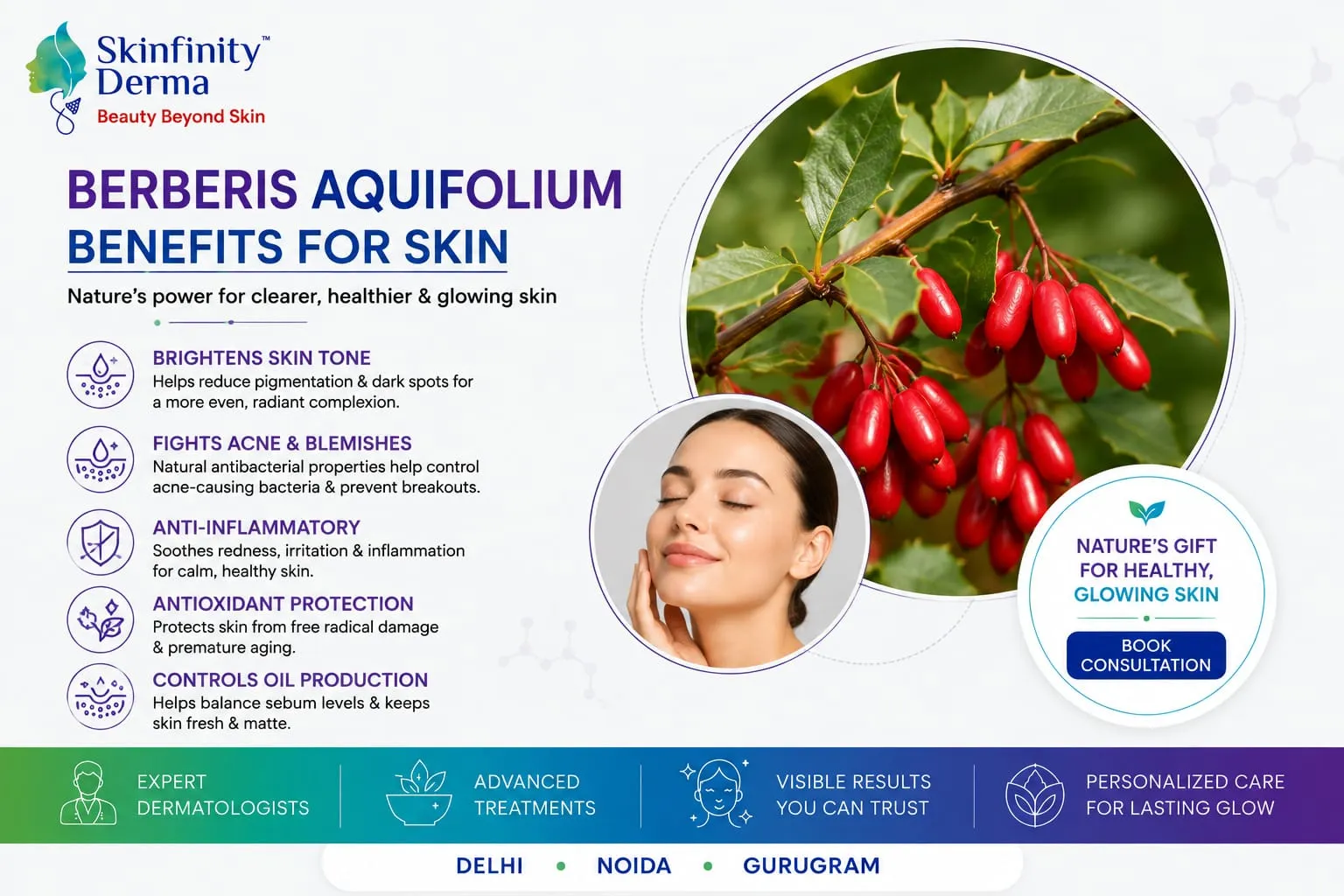
Natural skincare ingredients often become popular before their benefits are fully understood. Berberis Aquifolium is one such botanical. It comes in topical forms such as creams and gels. It is also found in herbal formulations and homeopathic products. These products are often marketed for acne and dull skin.
These formulations are not interchangeable. A topical herbal extract contains measurable plant compounds. A highly diluted homeopathic formulation may contain little detectable extract. The product concentration can therefore influence how the skin responds. The product base also plays an important role.
Berberis Aquifolium is also known as Mahonia aquifolium or Oregon grape. Most available clinical research focuses on topical preparations for psoriasis. Evidence for acne and dark spots remains limited. Reliable evidence for skin whitening is also unavailable.
People considering this herb for persistent acne should first seek medical advice. The same applies to pigmentation or inflamed skin. A Dermatologist in Noida can identify the concern before suggesting a suitable treatment.
This guide explains the potential Benefits of Berberis Aquifolium for Skin. It also covers application methods and possible side effects. Important precautions and common treatment claims are discussed as well.
Berberis Aquifolium for Skin at a Glance
Book An Appointment
|
Treatment Detail |
Overview |
|
Botanical name |
Berberis aquifolium or Mahonia aquifolium |
|
Common name |
Oregon grape |
|
Common topical forms |
Cream and gel |
|
Most studied concern |
Mild to moderate plaque psoriasis |
|
Evidence for acne |
Limited |
|
Evidence for dark spots |
Insufficient |
|
Evidence for whitening |
Insufficient |
|
Possible side effects |
Burning or redness |
|
Best approach |
Patch testing with dermatologist guidance |
What Is Berberis Aquifolium?
Berberis Aquifolium is an evergreen plant and it comes from the barberry family. The plant was earlier classified as Mahonia aquifolium but the modern botanical classification places Mahonia species within the Berberis genus. The root and bark of Berberis Aquifolium contain special and powerful plant compounds which are known as isoquinoline alkaloids. Berberine is undoubtedly one of the best-known compounds in this group. Laboratory research suggests that these compounds may have anti-inflammatory activity. Some extracts may also show antimicrobial effects and a good level of antioxidant activity has also been reported.
How Berberis Aquifolium Works on the Skin
Berberis Aquifolium may influence certain inflammatory processes within the skin. The exact effect depends on the formulation. It also depends on the concentration and the skin concern being treated.
-
It May Reduce Inflammatory Activity
Berberine and related plant compounds have shown anti-inflammatory activity in laboratory studies.
This may explain why topical Mahonia preparations have been explored for psoriasis. Some research has also examined their possible role in eczema.
These conditions have different causes. They should not be treated with the same routine without a proper diagnosis.
-
It May Affect Excessive Skin Cell Growth
Psoriasis causes the skin cells to multiply faster than usual. This rapid turnover can create thick and scaly plaques. Experimental findings suggest that Mahonia compounds may influence this process. The available clinical evidence remains limited. Results from one proprietary cream cannot be applied to every gel or ointment sold under the same botanical name.
-
It May Show Antimicrobial Activity
Laboratory studies suggest that Mahonia aquifolium extracts may act against certain microorganisms. This does not make the herb a proven acne treatment.
Acne involves blocked follicles and excess oil production. Inflammation also plays a major role. Hormonal factors may contribute in many patients. One antimicrobial property cannot address every cause of acne.
-
It May Support Selected Skin Conditions
Some clinical trials report improvement in psoriasis symptoms after using specific Mahonia preparations. These findings appear promising. They still need careful interpretation. Different studies use different concentrations. The product base may also vary. Treatment duration and application frequency can also differ.
Benefits of Berberis Aquifolium for Skin
Here are the main potential Benefits of Berberis Aquifolium for Skin.
1. May Support Mild to Moderate Psoriasis Care
Topical Mahonia aquifolium has been studied most often for plaque psoriasis. Some trials have reported improvement in scaling and redness. Other studies suggest reduced plaque thickness.
The overall evidence remains limited. One important thing to note here is that the herb should not be viewed as a guaranteed replacement for established psoriasis treatment. A dermatologist may consider it as part of a broader treatment plan but this decision also depends majorly on the severity and location of the plaques.
2. May Offer a Non-Steroidal Topical Option
Some patients look for safe and completely non-steroidal products for long-term skin concerns. A dermatologist may consider a Mahonia preparation in mild cases as it may also be used with a suitable moisturiser. Patients should not stop prescribed steroid creams without medical guidance. Sudden stoppage is prohibited as the sudden discontinuation can worsen some skin conditions.
3. May Support Selected Eczema Symptoms
Research on eczema remains mixed as it portrays both positive and not-so-satisfactory outcomes. There are some studies that state that certain Mahonia creams may reduce dryness or itching. Other trials have not shown a clear benefit over the cream base. Eczema-prone skin is highly reactive. A botanical product may trigger irritation even when it is described as natural.
4. May Provide Antioxidant Support
Laboratory studies have reported antioxidant activity in Mahonia extracts. Antioxidants are highly potent and they may help reduce oxidative stress within the skin. This finding does not confirm visible brightening or anti-ageing benefits. More human research is needed before stronger cosmetic claims can be made.
5. May Fit Into a Dermatologist-Guided Routine
A carefully selected product may complement a simple skincare routine. It may be used with a gentle cleanser. A suitable moisturiser may also support the skin barrier. A dermatologist should first confirm the skin condition. The product base must also suit the patient’s skin type.
How to Use Berberis Aquifolium for Glowing Skin
Here is a proper and full-fledged routine that will help you use Berberis Aquifolium in the most impactful way:
Step 1: Choose the Correct Product
Select a topical cream or gel intended for skin use.
Avoid applying raw plant extracts directly to the face. Concentrated tinctures can also irritate the skin.
Oral drops should not be used as facial serums unless a qualified doctor has specifically advised this use.
Step 2: Apply a Thin Layer
Use a small amount over the intended area.
Follow the instructions provided on the label. A dermatologist may suggest a different frequency based on the skin condition.
Applying more products does not create faster results. It may only increase irritation.
Step 3: Support the Skin Barrier
Use a mild cleanser during treatment because it might reduce the impact of any reaction or irritation which may occur during the treatment.
A gentle moisturiser can help reduce dryness. Avoid adding several new active ingredients at the same time.
Strong scrubs may worsen sensitivity. Retinoids and exfoliating acids may also increase irritation.
Step 4: Use Sunscreen Daily
Daily sunscreen plays an important role in managing uneven skin tone. A botanical cream cannot protect the skin from repeated UV exposure. Dark spots may become more noticeable without proper sun protection. Choose a broad-spectrum SPF 50+ sunscreen with PA+++ protection that suits your skin type.
Berberis Aquifolium Product Label Checklist
|
What to Check |
Why It Matters |
|
Botanical name |
The label should mention Berberis aquifolium or Mahonia aquifolium so the plant source remains clear |
|
Extract strength |
The concentration helps patients understand how strong the topical product may be |
|
Product type |
Herbal extracts and homeopathic preparations should not be expected to work in the same way |
|
Fragrance content |
Added fragrance may increase irritation in sensitive or eczema-prone skin |
|
Alcohol content |
Alcohol-based gels may worsen dryness or create a stinging sensation |
|
Expiry date |
An expired formulation may lose stability and should not be applied to the skin |
|
Application directions |
Clear instructions help prevent excessive use and unnecessary irritation |
|
Manufacturer details |
Transparent product information makes it easier to verify the formulation |
|
Whitening claims |
Products promising rapid or permanent whitening should be treated with caution |
Can Berberis Aquifolium Help With Acne?
Let us now explore whether Berberis Aquifolium is effective enough to treat acne or not:
-
Mild Comedonal Acne
Blackheads and whiteheads develop when pores become blocked. These concerns usually respond better to treatments that reduce follicular blockage from the root. Berberis Aquifolium may offer mild supportive care in these cases of acne because some plant compounds show anti-inflammatory activity.
-
Inflamed Acne
Papules and pustules involve highly aggravated levels of inflammation. The available evidence is still not strong enough to treat Berberis Aquifolium as a proven inflamed acne medicine. Inflamed acne may be best treated with the help of prescription creams or other medical treatment when the breakouts are frequent or painful.
-
Hormonal Acne
Recurring jawline acne may be associated with some stubborn hormonal triggers. Berberis Aquifolium may help soothe surface inflammation in some cases but it is not strong enough to correct the hormonal trigger behind repeated breakouts.
Does Berberis Aquifolium Help Dark Spots?
There is not enough or strong enough clinical evidence to confirm that Berberis Aquifolium reliably lightens dark spots. Dark marks can appear after acne and they may also develop after irritation or sun exposure.
Melasma requires a completely different treatment plan and a structured approach. Sun spots may also need another approach. Laboratory antioxidant activity does not prove a direct pigment-lightening effect in human skin.
A Dermatologist in Noida may be a savior here as they can identify the type and depth of pigmentation. The treatment plan may then include sunscreen or prescription creams. Selected patients may also benefit from chemical peels or laser treatment.
How Can I Apply Berberis Aquifolium to My Skin?
The application method depends on the product. A general and correct routine for Berberis Aquifolium may include the following steps:
-
Clean the skin gently.
-
Pat the area dry.
-
Apply a small amount.
-
Avoid the eyes and lips.
-
Do not apply it over broken skin.
-
Wash your hands after use.
-
Apply moisturiser when advised.
-
Use sunscreen during the day.
What Are the Side Effects of Berberis Aquifolium?
Natural products can still cause adverse reactions. Possible side effects include:
-
Burning
-
Itching
-
Redness
-
Dryness
-
Rash
-
Mild pain
-
Contact dermatitis
-
Worsening irritation
Signs That Berberis Aquifolium Should Be Stopped
|
Skin Response |
What It May Mean |
Recommended Action |
|
Mild temporary tingling |
The skin may be adjusting to the formulation |
Observe the area and avoid increasing the amount |
|
Persistent burning |
The product may be irritating the skin barrier |
Stop using the product and rinse the area gently |
|
Increasing redness |
Irritation or contact dermatitis may be developing |
Discontinue use and speak with a dermatologist |
|
Spreading rash |
The skin may be reacting to the extract or another ingredient |
Stop treatment and seek medical advice |
|
Facial swelling |
This may indicate an allergic reaction |
Seek urgent medical care |
|
Blistering |
The skin may have developed a severe reaction |
Do not reapply the product and arrange medical review |
|
Pus or increasing pain |
An infection may be present |
Contact a dermatologist without delay |
|
Breathing difficulty |
This may indicate a serious allergic response |
Seek emergency medical help |
Precautions While Using Berberis Aquifolium
Here are the vital precautions you must take while using Berberis Aquifolium on the skin. These steps can help reduce irritation and make it easier to identify whether the product suits your skin.
-
Perform a Patch Test
A patch test is important to help identify early irritation. You can conduct a patch test by applying a small amount to one area before broader use. Wait long enough to notice delayed reactions. Patch testing is great to understand possible irritation or reaction but it cannot solely guarantee complete safety.
-
Check the Full Ingredient List
The plant extract may not be the only source of irritation. Fragrance can trigger contact dermatitis. Preservatives may also cause a reaction. Review each and every ingredient before use.
-
Do Not Combine Several Strong Actives
Using the product with retinoids may increase dryness. Strong acids can also worsen irritation. Benzoyl peroxide may create additional sensitivity. The right and most effective strategy is to introduce one new product at a time.
-
Do Not Swallow Topical Products
A skin cream should never be taken orally. Oral berberine products have different effects. They may also interact with medicines.
-
Stop After Worsening Symptoms
Do not continue using the product through intense burning. A spreading rash may worsen with repeated application. Medical review may be required.
Who Should Avoid or Postpone Berberis Aquifolium?
The following people may need to avoid or delay use:
-
People allergic to Berberis or Mahonia
-
Patients with active contact dermatitis
-
People with open wounds
-
Patients with severe eczema flares
-
Individuals with rapidly worsening psoriasis
-
Patients with infected acne lesions
-
Pregnant patients without medical guidance
-
Breastfeeding patients without medical guidance
-
Children without specialist advice
-
People using several irritating topical medicines
-
Anyone with an undiagnosed rash
-
Patients expecting permanent skin whitening
Berberis Aquifolium Cream vs Gel vs Homeopathic Drops
|
Product Form |
Main Feature |
Important Consideration |
|
Cream |
More moisturising |
May feel heavy on acne-prone skin |
|
Gel |
Lighter texture |
Alcohol may increase irritation |
|
Ointment |
More occlusive |
May suit dry plaques |
|
Herbal extract |
Contains measurable plant compounds |
Concentration matters |
|
Homeopathic drops |
Highly diluted |
Not equal to a topical extract |
|
Oral supplement |
Creates systemic exposure |
Requires medical review |
How Long Does Berberis Aquifolium Take to Show Results?
The time required to notice a change depends on the skin concern and the exact formulation being used. Berberis Aquifolium does not work like an instant brightening product and visible improvement should not be expected within a few days.
Products used for mild plaque psoriasis are usually assessed over several weeks because scaling and redness improve gradually. Acne or dark spots may not respond in the same way since strong clinical evidence for these concerns is still unavailable.
The concentration also affects the response. A standardised herbal extract may behave differently from a highly diluted homeopathic product. The condition of the skin barrier can further influence how well the product is tolerated.
Patients should not increase the amount or frequency when results appear slow. Excessive application may lead to burning or irritation without improving the outcome.
A dermatologist should review the skin when there is no improvement after the recommended period. The diagnosis may be incorrect or the concern may need a more effective treatment.
Why Consult a Dermatologist Before Using Berberis Aquifolium?
The same visible symptom can come from different skin conditions.
A red and scaly patch may be psoriasis. It may also be eczema or a fungal infection.
A rash can also develop after contact with an irritant.
Using the wrong product may worsen the condition. It can also delay proper treatment.
A Dermatologist in Noida can:
-
Confirm the diagnosis
-
Review the formulation
-
Check allergy risk
-
Assess current medicines
-
Guide patch testing
-
Recommend proven alternatives
-
Monitor the skin response
-
Identify infection
-
Treat acne before scarring
-
Evaluate persistent pigmentation
Why Choose Skinfinity Derma for Skin Concerns?
Skinfinity Derma Clinic is a trusted clinic for dermatologist-led skin treatments. We begin every consultation with a detailed and full-fledged skin assessment by covering all the vital aspects. Our dermatologists review the visible concern and medical history. The dermatologists at our end are proficient enough to examine the patient’s current skincare routine. Patients searching for a Dermatologist in Noida can consult our team before beginning the random use of Berberis Aquifolium.
We can guide you by focusing on the following important parameters:
-
Dermatologist-led diagnosis
-
Personalised skincare planning
-
Evidence-based treatment
-
Product ingredient review
-
Patch-testing guidance
-
Acne management
-
Pigmentation treatment
-
Psoriasis assessment
-
Eczema evaluation
-
Follow-up support
Conclusion
Berberis Aquifolium has a long history of topical use. Its modern evidence is narrower than many online claims suggest. Research mainly supports a possible role for selected topical Mahonia preparations in mild plaque psoriasis. Evidence for eczema remains mixed.
Reliable evidence for acne treatment is still insufficient. The same applies to dark spot correction and skin whitening. The benefits of Berberis Aquifolium for skin depend on the diagnosis and formulation. Concentration also affects the final response. Natural does not automatically mean gentle. Burning or redness can occur. Itching and allergic reactions are also possible.
Skinfinity Derma Clinic assesses every concern before recommending herbal or medical treatment. Our dermatologists determine whether Berberis Aquifolium is suitable for the patient’s skin. Book a consultation with our Dermatologist in Noida for a personalised assessment of acne or pigmentation. We also provide expert guidance for psoriasis and eczema. Connect with us to know more.
FAQs
1. How Does Berberis Aquifolium Lighten Dark Spots?
There is not enough clinical evidence to confirm that Berberis Aquifolium directly lightens dark spots. Its anti-inflammatory properties may support inflammation-related marks in theory. Melasma and sun spots usually require diagnosis-specific treatment.
2. Is Berberis Aquifolium Safe for Sensitive Skin?
Berberis Aquifolium may irritate sensitive skin. Burning or redness can occur after application. A patch test should be performed before broader use.
3. Can I Use Berberis Aquifolium for Eczema or Psoriasis?
Topical Mahonia preparations have shown more promise for psoriasis. Evidence for eczema remains limited. A dermatologist should confirm the condition before use.
4. How Can I Apply Berberis Aquifolium to My Skin?
Clean and dry the area first. Apply a thin layer according to the product instructions. Avoid the eyes and broken skin.
5. How Is Berberis Aquifolium Gel Used for Skin?
Apply a small amount over the intended area after patch testing. The exact frequency depends on the concentration and formulation.
6. Can Berberis Aquifolium Be Used for Skin Whitening?
There is no reliable evidence that it safely whitens natural skin colour. It should not be promoted as a fairness or bleaching treatment.
7. Can Berberis Aquifolium Help With Acne?
Evidence for acne remains insufficient. It should not replace proven treatment for painful or widespread acne.
8. How Long Does Berberis Aquifolium Take to Work?
There is no standard timeline for cosmetic concerns. Psoriasis studies have evaluated specific products over several weeks.
9. Can Berberis Aquifolium Be Used Every Day?
Daily use depends on the product instructions and skin tolerance. Stop using it after persistent redness or burning.
10. Should I Consult a Dermatologist Before Using It?
A consultation is recommended for persistent acne or pigmentation. Medical guidance is also important for eczema and psoriasis.

 Call Now
 WhatsApp